Sunday, July 17, 2005

Pineapple Place

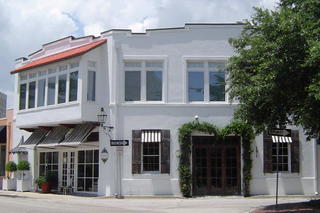
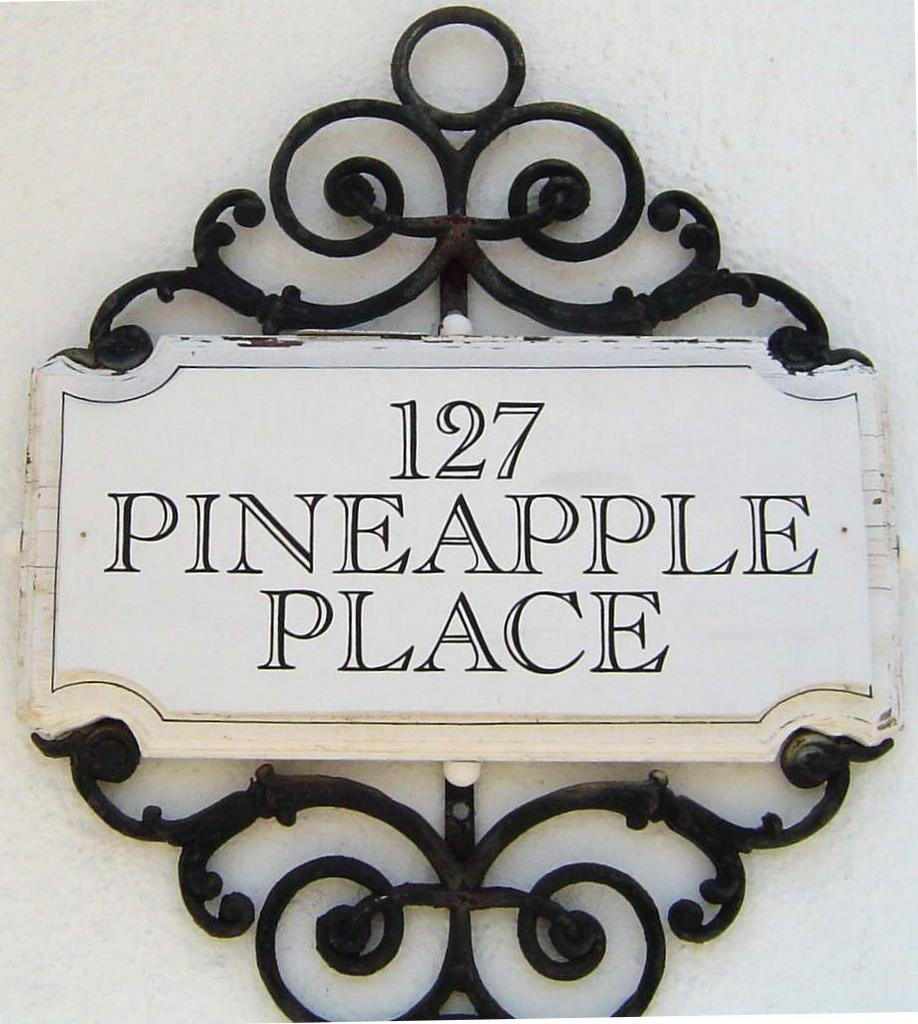
More than 10 years ago, Kevin Perry bought this historic building at 127 Pineapple and made it into a wonderful little antique and interior decorating shop. It is another of the unique, small shopping experiences that give downtown Sarasota its "sense of place."

It seems that Mr Perry’s wonderful shop is in the middle of the acquisition site being touted as Pineapple Square. Also Mr. Perry is adamant that he will not sell to the Pineapple Square developers. He loves his shop, has put much effort into the business over the years and has kept the historical building true to its roots and maintained it well.

Apparently the Pineapple Square developers have put significant pressure on him to sell, indicating they would build around and over him. Yet he resists.

This building was built in 1925 and is listed as a historical resource on the Florida Master Site File. Originally it was a plumbing shop, then in 1934 it became the home of the Sarasota Tribune. It is described as being Mediterranean revival style and it retains the integrity of design, both important criteria for historical resources.

But mostly it is a wonderful shop that should remain part of Sarasota’s sense of place. Is the greater good served by stepping aside while an upscale shopping center removes all traces of our past? We believe it is better to push back and say the greater good is best served by allowing the unique Sarasota places to continue their long established and productive existence.


Shrouded Future?


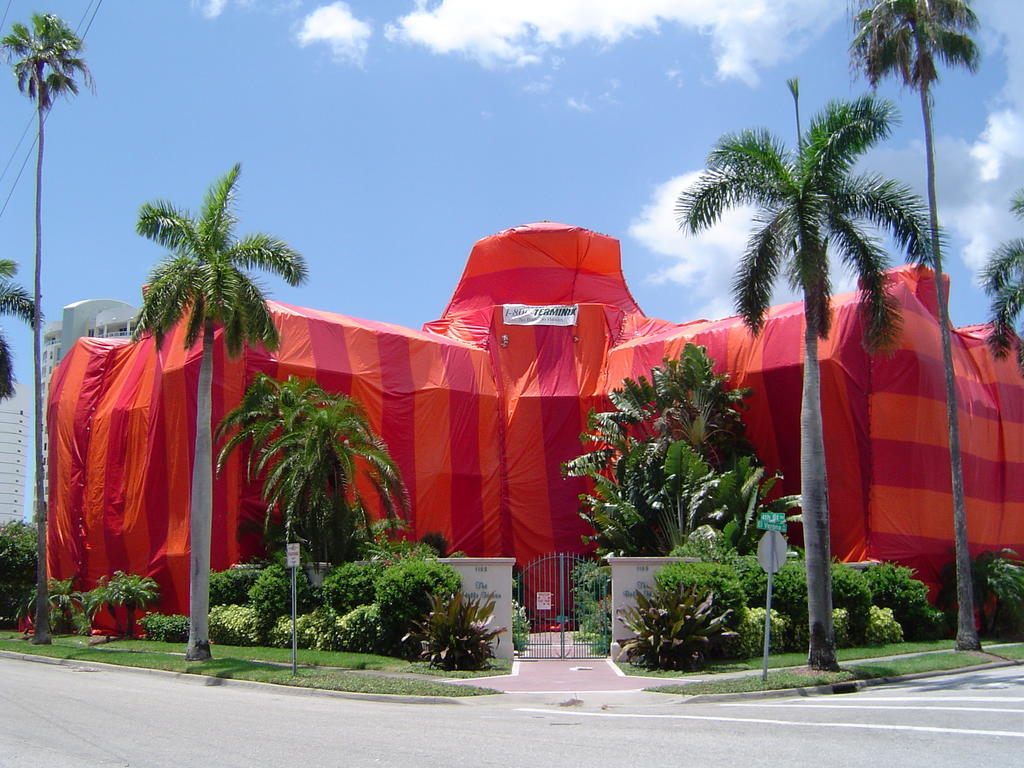
Noticed this yesterday. The Belle Haven Apts is under wraps!

I immediately thought this must be some sort of sign. Is the future of the Belle Haven Apts being considered today, is something happening that needs to be hidden from the public, what is going on here?

This obviously needed to be researched immediately - and we are known for our persistent and thorough research. So, with a calm, cool and collected determination, I drove up to the building, got out of the car with my digital camera in hand and started my research. Not one to jump to conclusions, I began with a close inspection and quickly uncovered the truth.

It seems that all the recent attention concerning the future of this historical gem has bugged the owners. In order to clear any doubt, it was obviousley necessary to take drastic action. It's current ruby-like appearence is not to be considered as a reference to it's precious place in our historical landscape, nor does the shroud like wrap indicate a dead body (at least not yet).

No, the truth is 1-800 Terminix. We trust this action will keep the Belle Haven Apts healthy for many years to come so that future Sarasota visitors may appreciate it as much as we do. Sometimes you need to look at the fine print to uncover the truth.


Saturday, July 16, 2005

Revisiting Model Behavior

From a recent posting at Sarasota Voices:

Subject: Re: COS: "giving away four stories of public space"

I would like to respond because I was the one that was quoted out of context by Bob Ardren in the Pelican Press. Ardren sat in a CRA Advisory Board meeting where we were discussing the role of one of the members in regard to design review. Because this is a financial and investment based board, as outlined in their resolution, I was discussing the difficulties in requiring those types of graphics at what is a very preliminary design review stage. We have always required detailed plans and drawings for projects but requiring models and engineered plans before DRC review is not without problems.

I agree with Save Our Sarasota regarding models but I believe it should be at the time of formal plan review and in fact I was the first person to request and receive this during the original 5 Points review in 1999. I felt I needed to correct this because I do not think it is right to sit in a public meeting,pick a sentence out that someone says, and use it in a different context, in what is an editorial passing itself off as news.

Karin Murphy [City of Sarasota Planning Dept.]

Save Our Sarasota would like to commend Karin for setting the record straight. We also appreciate the fact that we are thinking along the same lines with regard to models. With the major changes taking place in our downtown it is very difficult, if not impossible to visualize what is proposed until after the fact (construction is significantly underway).

Models can help visualize the proposed changes. We would like to see two types of models:
  • The first type would show the proposed new building embedded within the adjacent buildings. This would allow showing some architectural detail.
  • The second type would show how the proposed structure fits into the the entire downtown - that area covered by the downtown code. This would be a large model and each new proposal would show how it would contributes to the downtown area.
Only with models, can we easily grasp the size and context of the proposal. Models would cut through the "pretty picture" renderings that are so often the only thing we see. We also agree that models should be available at the plan review stage.

Friday, July 15, 2005

Bob's Main Street Beat

Bob Adren's column "Main Street Beat" in the Pelican Press is one of the more entertaining and informative columns on the local scene. There is always an interesting tidbit or two..

This week for instance we learned that:

....Isaac brothers .... last week demonstrated a savvy sense of public relations – especially with their new neighbors, the downtown merchants. They set up the Main Street Merchants Association with an office of its own at 1512 Main. It’s a building the brothers already own. Hmmmm.... Anybody else thinking about Little Red Riding Hood?

Caren Lobo (Sarasota News and Books) e-mailed city officials last week, asking why the two newly empty lots on the east side of U.S. 41 on either side of Fruitville Road couldn’t be used for downtown parking. Not exactly prime time but close to some downtown activity. Will this cut down on drivers circling around trying to find a space on Main or is a circle inevitable?

Thursday, July 14, 2005

Parking Diligence

From today’s Sarasota Herald Tribune editorial:

...the [CRA] board's decision to spring for the $4.4 million property was rushed and possibly rash. Such a large expenditure of taxpayer funds deserved more careful analysis and public discussion. Instead, it was approved in a hastily called meeting (which wasn't broadcast on television), at which the city commissioners, who serve as the CRA board, failed to ask enough questions.

But when $4.4 million of taxpayers' money is at stake, government has an obligation to show expenditure is absolutely necessary, that it meets the community's goals, and that due diligence has been done. City officials haven't yet fulfilled those obligations. They should -- long before they sign the check.

We have been asking questions about this decision also. And we think it is obvious that the commissioners stumbled on this one. Any time an offer is made with the stipulation that you have to "act now or lose this great opportunity", extra care must be taken to evaluate need and price. Too many people get snookered in these kind of offers.

Across from the street from the Orange Dolphin site is the Michael Saunders property - which ironically the city did not purchase a couple years ago when it was available from GTE. When the city declined, Saunders snapped it up. The city parking study identifies the Saunders site as a place in the Burns Court area where public parking could be targeted. Is this now off the table as a parking site?

Is this much parking needed in the Burns Court vicinity now? Are we sure there are no other options to consider? Are we sure of the future needs? If the commissioners know the answers to these questions, they have not communicated them to the taxpayers.

What do others think about this? A couple recent letters to the editor give a clue.

We think due diligence has been lacking and needs to be applied.

Wednesday, July 13, 2005

Orange Dolphin Still in Murky Waters

The Pelican Press has an article giving a little more information about the city deal to purchase the 1530 Dolphin property. Bob Ardren says "For better or for worse, Sarasota City Manager Mike McNees threw a big pitch to city commissioners Monday – asking them to offer a truly speculative price for a downtown parcel for parking.....McNees told the commission the owner was in town last weekend and told him she wanted $4.4 million and had other bidders in line if the city doesn’t offer that price.....We’re in competition with three or four pretty deep-pocketed developers," [McNees said] "Not next week, not next month, we buy it today or never."

According to public records, Eva Maria Bartenschlager (Habermanstrasse 8, Gruenwald, Germany) purchased the 1530 Dolphin site from Serbin 12/2003 for $1,700,000. Fair market value (property assessor) is $1,140,100. It is currently zoned CCBD and is will become Downtown Edge under the new Downtown Code.

The property is 21,263 square feet (0.488 acre) and the building is 10,874 square feet.

It is listed as belonging to Bartenschlager Holdings LLLP, 1510 W Hyde Park Street, a corporation created 11/21/2003. Partner is listed as Bartenschlager Management Company, 200 S Orange.

Bartenschlager Management Company was formed 11/20/2003 and officer/directors are:
Gerald Brix, Brixaugustin 320 Park Avenue 31st, New York, NY
John E. Wagner, II, 200 S Orange, Sarasota

Bartenschlager also owns Aleisa Holdings, 11891 US Highway 1, N Palm Beach, FL, created 5/7/1993, with her address given as 1510 Hyde Park.

1510 Hyde Park is almost an acre (42,825 square feet), purchased 4/12/1993 for $1,680,000 and fair market value of $3,848,500, with a building of 6,704 square feet and 2 living units, zoned RSF2.

Gerald Brix appears to be part of no other Florida corporations.

E. John Wagner, II is president of The Tax Deferred Exchange Company, which is primarily managed by attorneys of Williams Parker Harrison Dietz & Getzen, located at 200 S Orange.

A couple key questions still loom. What is the value of the property and how does it fit into the city’s parking plan?

The value of property could be determined by the price that a willing buyer and a willing seller settle on. For us this translates into how does the City establish a price they are willing to pay?

A possible answer to this is a current appraisal by a qualified appraiser. Because of rapidly rising real estate values in Sarasota, at a recent CRA meeting the value of the Plaza Verde property was questioned. The city staff presented the CRA Board with a report- along with a mathematical analysis-that would establish the rationale for not revisiting the appraisal issue. This process was accepted by the CRA Board.

A fair question for the Commissioners (CRA Board) to answer is which method was used to determine the price they would be willing to pay for the 1530 Dolphin property? Or, did the Commissioners simply fold in this "high stakes poker game" and agree with the now or never scenario?

We would certainly hope that with the staff available to answer questions and do analyses, a rational process was used to determine the value (from the city perspective) for this property. We also hope the Commissioners will be forthcoming in explaining to the taxpayers the rationale they used.

If the city now has a new policy for purchasing and selling property, the taxpayers would also like to be told what this is.
Tuesday, July 12, 2005

Out of the Blue: 1530 Dolphin


As reported Tuesday, the city apparently has made a high dive into the murky waters of the local real estate market to purchase a very nice, recently renovated building at 1530 Dolphin. The city is offering $4.4M for the less than ½ acre property and intends to tear the building down in order to construct a four story parking garage.

So what do we know about this? According to news reports, two commissioners were at an out of state affordable housing conference but voted via telephone. Only Danny Bilyeu opposed the purchase, saying that a developer is paying the city just $4.1 million for two acres between Palm and Pineapple avenues for the Plaza Verdi project and asking why that parcel has not, then, been priced at $16,000,000. The other commissioners expressed misgivings, but voted for the purchase anyway.

Apparently purchasing commercial property is just like buying residential property around here. As City Manager McNees said: "This is the price of poker...if we want to get into the parking game that's what it is going to cost." We hope the affordable housing conference has sessions on affordable parking as well.

There are many questions about this deal that we will be trying to answer over the next few days.

For instance, this property is located directly across Orange Avenue from Michael Saunders’ recently announced hi-rise development. Will her development be required to meet full parking requirements and not rely on the city parking garage?

The "Orange Dolphin Galleria" mall is only 3 short blocks from a larger city-owned parking lot on State Street. This is the lot the Isaac Group wants as part of its proposed Pineapple Square development. The city has a plan to issue a RFP for the State Street lot to get 350 parking places in exchange for the property and development rights of that lot.

What of the businesses that at great expense have set up shop in the 1530 Dolphin Mall and the city’s responsibility to them? What are those business owners’ responses to this sale and their upcoming eviction?
What about the parking master plan? Was this area identified as requiring this number of parking spaces? When did the parcel come up for sale and what was the identified parking need at that time? Why was the parcel not purchased in December, 2003, when the present owner bought it for $1,700,000? What are the local connections involved in this sale? And many other questions.

Calling an "emergency meeting" to make this decision certainly raises a lot of questions. Questions about the deal itself, questions about the true city need, questions about the timing, questions about other city priorities and where this fits in the city and downtown strategy. We understand that sometimes there is need to act quickly, when the window of opportunity is open. However, didn’t this decision require careful analysis of the needs and options prior to acting? In public affairs it always is wise to have several alternatives identified so that pressure decisions can be avoided.

Decisions like the one made Monday raise many questions while at the same time lowering the confidence level in our leadership. And a lot of people are asking the question whether downtown development is a high stakes poker game in which the public does not participate, or an effective long range planning effort that takes all community needs into consideration.

Monday, July 11, 2005

Great Spaces

Planning Liveable Communities (a planning blog), has an excellent posting on July 10 titled. "Boston Places, Great and Horrid". The article starts:

It was a beautiful summer Sunday today here in New England, and Boston was swarming with both locals and tourists eager to enjoy the weather. Parks, streets and neighborhoods were packed with pedestrians - in fact, I overheard a tourist nearby comment, "Boston is a walker-friendly city." Indeed!

Yet this is what Boston’s City Hall Plaza looked like at lunchtime today [picture shows empty plaza].

We, and many others comment frequently about the design parameters required for a lively city. Density is a factor, but if we shorten ourselves on the design side, we will just get ugly density. We need to incorporate landscaping (lots of the soft variety, to hide the hardscape), a sense of enclosure while still being outside ("outdoor rooms" set apart form the large open "plaza space", tree shaded streets, smaller (intimate) spaces, human scale, unique settings where people can just hang out and watch the happenings.

We think about the "5 Points Plaza" space. What if this were designed so that several smaller spaces could be delineated (ideally with shade trees and shrubs), yet could operate as an open space when an event was scheduled (Reading Festival, Art Show). People living in the downtown condos could have an easily accessible, lively outdoor space. Residents and visitors alike would be drawn to such a lively place. Street vendors might find enough customers to offer a hot or cold drink or something to eat. This could be a very special gathering space.

Over on Lemon, the wide open plaza space north of Mattison’s is always bare. Looks like the Boston photo from above - concrete, open, bare. When there is an event (Friday After 5, Farmer’s Market, etc) lots of people mill around. But the lack of shade, places to sit and an "enclosed space", keep it empty most of the time. This could also be a very lively place given a few amenities.

South on Lemon, at the intersection of Lemon and Pineapple intersection is a small "plaza" with a fountain and some nice benches. I have never seen anyone sitting in this place. Obviously it needs something else to act as a gathering space. For starters, some nice shade trees might tempt a few people to spend some time there.

Planning Liveable Communities has other insight:

A liveable neighborhood has more than a place to live and a place to work. It’s got another place - a third place, as CoolTown Studios explains, noting Ray Oldenburg's book on the topic – an appealing community gathering place, not for official events, but to hang out. That’s what Cheers was; that’s what the Central Perk coffee shop and the diner were in Seinfeld.

We could use a few "third places" in downtown Sarasota as well as in other parts of our town.

Sunday, July 10, 2005

Hurricane Monitoring

For an up close commentary of the Pensacola hurricane encounter, take a look at the series of postings on the Pensacola Beach Blog. They are now without power but their commentary will resume when they are able. We all hope that their community comes out of this event with the determination to rebuild and keep going.

A Sarasota Housing Bright Spot

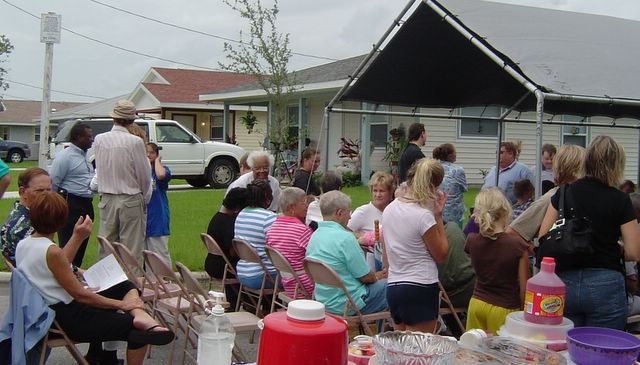
On Sunday, over 100 people gathered to dedicate eight new Habitat for Humanity homes in Sarasota. These houses are the latest in an on-going plan to build more than 60 homes at the Jordan’s Crossing site near Tuttle and 12th St.

Habitat for Humanity’s home ownership program is one of the few bright spots in Sarasota’s high priced real estate market. Here at Jordan’s Crossing, low income families can realize the dream of home ownership. Volunteers bring dollars and labor to help purchase materials and help construct very nice homes. The new homeowners also work on the construction of their home and pay for remaining costs. This is a program that works here in Sarasota as well as around the country and the world.

Local dignitaries attending the ceremony included Congresswoman Katherine Harris, County Commissioner Paul Mercier, City Commissioner Danny Bilyeu and Sarasota HUD Director Bill Russell. Habitat’s Sarasota leaders included Ron Feller, President and John Schaub, Development Director. Many volunteers attended and saw their hard work and support efforts pay off in the happy faces of the new home owners.

We wish continued success to Habitat for Humanity in Sarasota. Their efforts and successes help build our community. Because of their efforts we now have eight new home owners that likely would have always been priced out of our housing market.

Habitat for Humanity dedication ceremony. July 10, 2005, Sarasota.

Thursday, July 07, 2005

Stalking in Sarasota

For those of you that read only the local SHT, check this story about Sarasota. I doubt you will find it elsewhere. Nicely done Logan!

Wednesday, July 06, 2005

Back to Our Roots

Save Our Sarasota formed out of a desire to save the wonderful trees we have downtown. A new code and the dramatic development that is underway have put extreme pressure on these, our existing trees.

A couple weeks ago, a consultant, who has been researching Sarasota County tree canopy changes over the past several decades, gave a "tailored" presentation to the City Commissioners. He concentrated mostly on changes to the city’s canopy during the time frame studied.

Raymond Kurz of PBS&J presented research results that indicated that in the City of Sarasota:
  • From '75 to '86 we lost 33% of our tree canopy
  • From '86 to '93 we gained 4% of canopy
  • From '93 to '02 we lost 4% of canopy

Mr Kurz indicated it was possible that the canopy had "stabilized' in the last decade.

The primary forces causing the loss of canopy in the county are increasing agriculture and increasing development.

East of I-75, canopy cover has been reduced from about 80% to 60% over the time frame studied. Also it appeared that this canopy had stabilized.

West of I-75, the canopy coverage dropped from 60% to 35%.

In the City, during the time frame of '93 to '02, it appears that we are seeing growth of existing trees at a 4-6% annual rate. The existing canopy coverage is 17-18% and he would suggest 40% as an achievable target. The increase in growth has been primarily along streets.

Compared to Tampa, Sarasota has a low canopy coverage. We are also below the American Forest guidelines for cities.

Using the American Forest Model for economic benefit of tree canopy, it was suggested that we have an annual benefit of $7.7M (primarily energy benefits). If stormwater runoff benefits are included this increases to $19M per year.

It was pointed that tree canopy is particularly efficient in attenuating the first 1" of rainfall. Rainfall events larger than 1" will still require added mitigation.

It was also suggested that the City establish tree canopy goals and include these in the Comprehensive Plan.

Save Our Sarasota would strongly encourage the City to adopt tree canopy goals and include these in our Comprehensive Plan. We need to find the resources to increase our tree canopy. The return on this investment will be significant.

Tuesday, July 05, 2005

Sampling the Local Flavor

Here’s an original idea. "Sarasota Originals," the group of restaurants listed below, are all local suncoast establishments. They have banded together to promote the fact that they are unique and local. While this is part of a marketing campaign (trying to compete against the chain restaurants) it carries a larger message - these and other local businesses make up the unique fabric of Sarasota (and nearby communities).

During the summer doldrums, these businesses struggle as many of their clientele head north for a cool time. Why not help our local businesses by patronizing them and supporting their unique place in our community. Many of these restaurants have summer specials as an added bonus. Get to know them, they live here and are likely to be neighbors and friends.

This list, of course is not exhaustive. There are many neighborhood establishments as well as local businesses that are not part of this marketing venture. But by seeking out our local flavor, we will help insure they remain for a long time into the future. Help keep Sarasota's unique, local flavor.

15 South
Bayou Bleu
Beach House
Bijou Café
Blasé Café
Broken Egg
Café Baci
Café L'Europe

Café on the Bay
Caragiulo's
China Palace Express
Colony Restaurants
Crow's Nest

Euphemia Haye
Galileo Ristorante

Gitane

Harry's Continental
Hillview Grill

Jonathan's/Smokin' Martini
Latitude 23.5 Coffee and Tea
Lobster
Lynches Pub & Grub
Madfish
Manhattan Bar & Grill
Marie's Italian Kitchen

MarVista
Mattison's City Grille
Mattison's Siesta Grille
Mattison's Steak House
Maureen's Palm Grille

Mediterraneo

Michael's On East
Pattigeorge
Roessler's
Sandbar

Selva Grill
Siesta Key Oyster Bar
Silver Cricket
Sun House Restaurant &

Monday, July 04, 2005

Community Dialogue

In Sunday’s lead editorial in the Sarasota Herald Tribune, the editors say:
Every American city and county needs good government in order to establish and maintain a pleasant quality of life for the vast majority of its people. But government cannot create communities or good citizens. It is up to individuals, and the associations they form, to fashion a sense of community and promote causes that benefit the greater good. In strong cities and counties, governments, communities and citizens take additional steps -- forming partnerships, engaging in dialogue, leading when necessary and following when beneficial.

We couldn’t agree more fully. Thoughtful, well researched dialogue concerning civic well being is the key to a quality lifestyle for all. Sarasota is fortunate to have many excellent institutions that are willing and able to positively contribute to our community.

One of these, SCOPE, has engaged the community in discussions on a number of issues we face. SCOPE's methodology starts with researching the issue, then looks for best practices and tries to find ways to apply this knowledge to our community. SCOPE has been very successful in these endeavors and is a model well worth following.

Save Our Sarasota tries to follow this model. We engage in public discourse, we formulate a position on a topic that we believe Sarasotans have a high degree of concern about, and we try to find better ways to move forward. Along the way, we point out "mistakes" we believe have been made. We do this in an attempt to show the effect of changes that have been allowed with apparently little discussion or community involvement.

As we move into our second year of existence, we would hope that our discussions with civic leaders have been fruitful. We believe Save Our Sarasota has been the spark for some change that is positive. We will continue to fashion a sense of community and promote causes that benefit the greater good.

Sunday, July 03, 2005

Save Our Sarasota Has A Birthday

Dear Friends,

This month, Save Our Sarasota is celebrating its First Birthday!

From the very beginning, when concerned citizens filled the Selby Library meeting room to capacity, you told us our primary focus should be saving trees and opposing runaway growth downtown. We are working to meet those challenges. And as issues have arisen a common purpose has become clear---we are protecting public space that is being gifted for development.

The survival of trees on public sidewalks, the massive downtown arcades and three stories of habitable space to be built in the public air rights above the sidewalks, proposed privatization of Five Points Park, the idea of a Conference Center on public bayfront property, the possible vacation of State Street for a regional shopping mall, the taking away of newly planted green space on Lemon Avenue, the intrusion of the porte cochere at 100 Central into the very roadway…and more…ALL are issues of publicly owned space.

If you are interested in any of these issues, please write or call to let us know you want to help. We need more working members, and some of the simplest tasks are important to our success. Planning programs, making phone calls, copying reports, ordering and picking up documents from City Hall….are all valuable help we could use. Knowing your preferences on programs is very important to us. We plan another public meeting this July. Please call Carol Reynolds at 362-9779 to volunteer.

Lastly, we are very proud of our new Save Our Sarasota blog. SRQ Magazine recently cited it as one of the best local blogs. It is an intelligent and lively take on current issues and a daily "must read" for a lot of us. Be sure to look at not only the most current posting, but previous articles and pictures, all cached on the site. It can be accessed at Saveoursarasota.blogspot.com.

We thank you for caring about the future of our wonderful city. We all regret what has been lost, but there is much to save. We all look forward to an even more active "Year Two" for Save Our Sarasota.

Sincerely,
Janice Green
Chair
Save Our Sarasota

Saturday, July 02, 2005

Eyes on the Garage, Back to the Street

"Eyes on the street", is a phrase coined by the legendary urban sociologist, Jane Jacobs, in her landmark book: Death and Life of Great American Cities. This phrase is fundamental when planners think about public safety. It is the fundamental concept for CPTED (Crime Prevention Through Environmental Design).

Jane Jacobs words: "There must be eyes on the street, eyes belonging to those we might call the natural proprietors of the street. The buildings on a street equipped to handle strangers and to insure the safety of both residents and strangers, must be oriented to the street. They cannot turn their backs or blank sides on it and leave it blind. The sidewalk must have users on it fairly continuously, both to add to the number of effective eyes on the street and to induce a sufficient number of people in buildings along the street to watch the sidewalks."

Where do you suppose the designers of Whole Foods in downtown Sarasota came up with the idea that having blank walls (adorned by some artistically placed paint) on three sides of their building makes for good urban design? No windows, just walls. How did our Planning staff decide to agree with this? How did our CRA Advisory Board and Commissioners decide to give an incentive in terms of TIF dollars for this "walkable, street friendly" addition to downtown? Did they once again succumb to the developer’s pretty pictures that have no relationship to reality?

Maybe I am too cynical. I guess having the front entrance on an alley with a parking garage entrance across the alley makes up for poor design. This certainly put eyes on the parking garage. Maybe this is part of the new smart growth movement or our smart code? It certainly "smarts" when I think about this design.

I guess I need to keep searching urban design best practices for this principle: "eyes on the garage, back to the street". I just haven’t come across it yet.

Friday, July 01, 2005

Leadership and Vision - Here's an Excellent View

Neil Pierce is a nationally syndicated columnist who writes about various issues. A recent column focuses on a major issue facing Sarasota - housing and our sense of place. An excerpt from Pierce’s column written while attending the Urban Land Institute's World Cities Forum in London last week:

"I can't think of one U.S. national politician who mentions cities or urban environment in any meaningful way," noted Urban Land Institute President Richard Rosan. "Not one of them is out there talking seriously about critical issues of transportation and housing, metropolitanwide planning, viability of communities — all ways that national government, even without dictating quite the way London does, could at least encourage a more secure and livable urban future."

Like the amazing run-up of housing costs that started around such U.S. hot spots as San Francisco and Boston and is now spreading nationwide, the London metro region escalation means fantastic wealth gain for some, but housing unaffordability for millions more.

Deputy Prime Minister John Prescott vows not to repeat the errors; he talks instead of "sustainable" communities that don't just incorporate good environmental standards but assure a sense of place, low crime, transportation choices, citizen participation, economic development and "life chances for all." Such places, he argues, "create superb buildings and open spaces — where people want to be together and feel real pride in their own community."

Prescott's premier test of a sustainable community: housing opportunities and a welcome mat for people of many income groups. He sees deep divisions of income and class as the scourge of our time, to be attacked aggressively with public power and the public purse.

It's a stunning vision, extraordinarily tough to execute, even by a determined national government. The tragedy is that we Americans aren't even dreaming it."

Quite the vision indeed. You’d think maybe our leaders would think in these terms instead of the more narrow "local entity" role they only consider. You’d also think that maybe our state and national representatives would get a clue about what the real domestic issues are, instead of listening only to the big time lobbyists about issues that will make them more money. You might even think our local leaders would be pushing for these solutions for these very issues: transportation, housing, viable communities - all connected on a regional basis.

Unless we have a vision that includes all of us, we will stay stuck in the quagmire. Many Floridians and even Sarasotans see themselves primarily as keepers of the tourism economy and profiteers in the land business. We need to see ourselves as a community of people from many backgrounds and economic levels that contribute to the community in a wide variety of ways. We can not afford to include only the wealthiest. We need to find a place for all the community contributors. We will all be richer because of it.

Where is our leadership? What does their vision include? Is it a vision for all of us or can only select groups buy into it?

Thursday, June 30, 2005

Keeping Time with William Murtagh

A couple months ago, we posted (March 11) information about the Sarasota Alliance for Historical Preservation meeting that featured a talk by Dr. William Murtagh. Dr. Murtagh is the founder of the National Registrar of Historic Places. He has been known as the "Keeper of the National Registry."

In an interview with him, printed Tuesday in the SHT, he discussed his life long love affair with historical places. He has developed a keen awareness of the relationship of older structures and their ability to speak to future generations about their own time and place. This connection to the past is vital if we are to build upon the best that has come before us.

Murtagh is quoted as saying "I’m appalled at what little attention Sarasota has paid to the concept of preservation. There’s not been much of a sense of community identity and maybe it’s because of the snowbirds; I don’t know. It may also be the problem that they’re older people, and the older people only look upon where they came from as historic." He added "Also, most (real estate developers) are really in the business of making money. I have never seen this to the excess it is in Florida, where people are turning properties on a spade."

Sarasota has organizations that try very hard to preserve the best of our past. We are fortunate to have several organizations that have many dedicated members striving to do just that. However, the pressure of real estate development profits is extremely strong here. Without a commitment of dollars by local governments to save historical places they succumb to the development pressure.

We are getting better at this, but the process needs more help. Opportunities are all around us for involvement - currently a group is working very hard to find a permanent place for the Crocker Church and the Luke-Bidwell House, both important structures with stories to tell about the early days of Sarasota.
See if you can find a way to help. We need to up the ante for preservation.

WalMart’s Coming to Town - Newtown That Is

A recent "neighborhood workshop" gave WalMart representatives the opportunity to explain to the Newtown community what might be in the cards. WalMart is considering a Super Center at the NE corner of 301 and MLK Way.

An article in the SHT described the confab in these terms: "Wal-Mart hasn't presented a formal offer to the city. Thursday night's meeting at Booker High School was part of the company's research process, to ensure any store built is a reflection of the community."

Attorney Brenda Patten, the local WalMart development rep, painted a pretty picture of what WalMart could be. "What would you like to see Wal-Mart do for this community?" she said. Wal-Mart would "kick start" the Newtown revitalization process, working to "draw people into your community," Patten said. "They'll come with their dollars."

Every suggestion was answered with something like "that can be done" or "we’ll look into that", although no commitments were made.

This group of interested residents had done their homework and much skepticism was expressed. Job training, jobs for Newtown residents, health care benefits, child care, traffic and many other issues were brought up. The issue of using the 18 acre brown-field site and its clean up cost was also discussed.

In the end it seemed that while most could see some benefit (after all the picture was pretty), the sense was that it would take a lot of community involvement to get real benefit for the Newtown community. There are potential pluses and there are definite minuses in the WalMart equation. To tip the balance to favor the community will require much effort, involvement and creativity. The community made a good start by showing up in force and asking tough questions.

Commissioner Fredd Atkins closed the meeting with an animated summation: "this is the beginning of a process "... he referred to as "a negotiation with a gorilla." " This struggle is going to require all of us to get ropes around it, so it works for us."

Amen, Fredd!