Two weeks ago we published a condensed version of the Planning Board's evaluation of the proposed density bonus plan. Here we publish the long version. It is well worth the few minutes it will take to read this as it provides great insight into this proposal.
Save Our Sarasota remains convinced that the implications of this proposal are not understood by the citizens and that unintended consequences are likely to accompany this. Issues of traffic, parking, infrastructure, etc. have not been addressed.
The following was provided by Kate Lowman as an accompanying part of the condensed version. While it may not be exactly word for word, it is very complete and has not been edited.
Shannon Snyder (Planning Board Chair)
CLOSE THE PUBLIC HEARING.
WE'LL HAVE THE CITY COME BACK DOWN.
Shawn Fulker (Planning Board Member)
(This first question refers to Doug James ‘(Planning Staff) earlier statement that overall density in the downtown area would not increase, but that instead density would be unevenly distributed across the downtown area.)
I DON'T WANT TO BE ACCUSED OF GETTING INTO THE MINUTIA, BUT WITH REGARD TO THE CONCEPT OF LIMITING A PARTICULAR AREA TO AN AVERAGE...IF HALF THE UNITS APPLY FOR A BONUS AND GET IT, ...DOES THAT MEAN THE OTHER HALF IS JUST EMPTY LAND? ...
Doug James (Planning Staff)
THE DENSITY AND THE MIX OF USES IN THE COMPREHENSIVE PLAN IS SPECIFICALLY NOTED AS NOT BEING SITE SPECIFIC. SO WHAT WE'RE SAYING IS THAT ... THE 9,003 UNITS WOULD BE CALCULATED OVER THE ENTIRE ACREAGE AND NOT ON A SPECIFIC SITE. SO IF YOU AS A DEVELOPER WANTED TO DEVELOP ALL NONRESIDENTIAL ON A 10-ACRE SITE OR ALL RESIDENTIAL, YOU COULD DO THAT AS LONG AS THE OVERALL MIX THROUGHOUT THE ENTIRE CLASS WAS NOT VIOLATED.
Shawn Fulker
WHAT THAT MEANS THEN, IS AT A CERTAIN POINT IN TIME, IF ENOUGH PEOPLE APPLY FOR BONUSES, A PERSON HAS A EMPTY LOT, (HE) WILL NOT BE ABLE TO BUILD ON THAT. ...
Doug James
THE MONITORING PROGRAM ... IS NOT ONLY TO ASSURE US THAT WE DON'T GO OVER THE MAXIMUM BUT IT'S ALSO TO ALERT US WHEN WE'RE REACHING A PERCENTAGE OF THAT MAXIMUM AND WE MIGHT WANT TO REVISIT THE COMPREHENSIVE PLAN AND PERHAPS LOWER IT ,OR INCREASE IT ,OR DO AWAY WITH IT IN TOTALITY. ... IT'S NOT THE INTENT OF THE COMPREHENSIVE PLAN TO BE WRITTEN IN GRANITE AND NEVER BE CHANGED. ...
Michael Shelton (Planning Board Member)
... THE DETAILS THAT WE WERE TOLD NOT TO WORRY ABOUT, AM I CORRECT IN ASSUMING THAT WE'RE NOT PASSING JUDGMENT, SO TO SPEAK, ON THESE DETAILS? WE'RE TALKING ABOUT A PLAN AMENDMENT AND THAT'S IT?
Michael Connolly (Planning Board Lawyer)
WE'RE TALKING ABOUT A PLAN AMENDMENT THAT DOES A NUMBER OF THINGS. ... DO YOU NEED TO WORRY ABOUT THE DETAILS OF IT TODAY? NO. ... HOWEVER, YOU DO NEED TO BE COMFORTABLE WITH THE OVERALL SCOPE OF THE PROGRAM, AND IF YOU THINK THAT THE RUDDER IS GOING IN THE WRONG DIRECTION, NOW IS THE TIME TO MAKE THAT DECISION BECAUSE YOU ARE IN THAT LEGISLATIVE FUNCTION.
Michael Shelton
BASICALLY WHAT WE'RE BEING TOLD IS “TRUST US. AND WE'LL FIGURE OUT THE DETAILS LATER.” AM I KIND OF CORRECT IN THAT?
Michael Connolly
YES. BUT THERE ARE SOME OF THE DETAILS THAT ARE SPECIFIC. FOR EXAMPLE, I THINK ONE OF THE ACTION STRATEGIES WOULD BE A NEW DEFINITION FOR WHAT IS ATTAINABLE HOUSING. THAT'S A SPECIFIC THAT YOU DO NEED TO FOCUS ON TODAY. ANOTHER ... IS THE PARTICULAR AREAS THAT THERE WOULD BE A CHANGE IN THE LAND USE CLASSIFICATION.
Michael Shelton (to ERA consultant)(This question refers to the initial ERA report last August which recommended that the City of Sarasota develop a comprehensive affordable housing plan, of which this density program might, or might not ,be one element.)
... SEEMS LIKE I READ IN AUGUST THAT YOU RECOMMENDED AGAINST DOING THIS. AND NOW WHEN ASKED ... WHAT YOUR RECOMMENDATION IS NOW, IT IS, “YES, WE RECOMMEND YOU DO DO THIS.” WHEN I ASK WHY, “WELL, I WAS TOLD TO SAY THAT.” NOW, AM I INCORRECT SOMEWHERE IN THIS?ERA
Consultant (hired by the City of Sarasota)
THANKS FOR PUTTING ME ON THE SPOT THERE. BELIEVE ME, WE HAVE TALKED ABOUT THIS AT THE FIRM. WE ALSO TALKED ABOUT THIS WITH CITY STAFF. ... THE INSTRUCTION CAME BACK FROM THE COMMISSION AND FROM THE CITY MANAGER, THE DESIRE IS TO CREATE AFFORDABLE HOUSING IN THIS AREA . ... TO START THAT PROCESS, ...THIS IS A FINE WAY TO BEGIN DOING IT. ... THERE WAS OBVIOUSLY A DESIRE ON THE PART OF THE COMMISSION AND CITY STAFF TO START IN THIS LOCATION. SO I'M NOT TRYING TO DODGE THE QUESTION. OUR ASSESSMENT ORIGINALLY WAS THIS IS PERHAPS NOT THE PLACE TO DO IT; HOWEVER, WE HAVE WORKED THROUGH THE, I THINK, SUFFICIENT DETAILS TO PUT YOU IN A POSITION TO ALLOW THIS PROCESS TO START.
Michael Shelton
...YOU ARE MAKING SPECIFIC RECOMMENDATIONS HERE. TELL ME WHERE ELSE THESE SPECIFIC RECOMMENDATIONS ARE BEING APPLIED.
ERA Consultant
I THINK THAT IS A FUNCTION OF THE SPECIFICS OF THE LOCALE.
...Michael Shelton
THERE ISN'T ANOTHER PLACE THAT DOES IT JUST LIKE THIS?
ERA Consultant
NO.
...Michael Shelton
WHAT TYPE OF INTERACTION DID YOU HAVE WITH THE ... COUNTY'S HOUSING TRUST AND WHAT TYPE OF INPUT DO THEY HAVE? AND HOW DO YOU SEE ALL THIS WORKING AS A REGIONAL SOLUTION TO THE PROBLEMS?
ERA Consultant
WE ACTUALLY MET WITH THE COUNTY REPRESENTATIVE ... ALONG WITH CITY STAFF ... AND ALSO CONVERSED WITH THEM SEVERAL TIMES DURING THE PROCESS. THERE IS A DESIRE, I THINK RIGHTLY SO, TO HAVE PARITY BETWEEN THE PROGRAMS. THE DIFFICULTY IS THE DENSITIES ARE COMPLETELY DIFFERENT. ... THEY ARE PRIMARILY TARGETED AT SINGLE-FAMILY AND ... LOWER DENSITY MULTIFAMILY UNITS, WHEREAS WE'RE TALKING ABOUT HIGH DENSITY MULTIFAMILY UNITS, PARTICULARLY CONDOMINIUMS, GIVEN THE CURRENT MARKET CONDITIONS.
Michael Shelton
...DID I HEAR YOU CORRECTLY WHEN YOU SAID ... THAT BASICALLY IT'S NOT ECONOMICALLY FEASIBLE TO DEVELOP CONDOS NOW?
ERA Consultant
IF YOU WERE A DEVELOPER ENTERING THE MARKET COLD, TODAY, ... YOU WOULD NOT RATIONALLY CHOOSE TO ENTER THIS MARKET UNDER CURRENT CONDITIONS. NOW, IF YOU HAD A DEVELOPMENT PARTNER WHO IN SOME WAY WAS ALREADY VESTED, IT'S DIFFERENT.
Michael Shelton
...IT SEEMS TO ME LIKE A MAJOR COMPONENT OF THIS IS TO ENCOURAGE THE BUILDING OF NEW UNITS, ... AND I'M NOT SURE THAT THAT'S SOMETHING THAT WE OUGHT TO BE DOING. ONLY 10% OF THE UNITS WILL MEET A SPECIFIC NEED. 90% OF THE UNITS ARE GOING TO MAKE A PROFIT FOR THE DEVELOPER. IF IT'S NOT ECONOMICALLY FEASIBLE TO DO IT TO BEGIN WITH, WHY DO WE WANT TO CREATE A SYSTEM SO THAT THE DEVELOPERS CAN MAKE MONEY AND WE END UP WITH A VERY SMALL NUMBER OF UNITS THAT SATISFY NEEDS?
ERA Consultant
...WHILE AT THE END OF THE DAY THE DEVELOPERS ARE BUILDING MORE UNITS AND THEY ARE CERTAINLY MAKING HIGHER PROFIT MARGIN ON THOSE UNITS, AND THEIR TOTAL PROFIT WILL BE HIGHER, THAT IS BEING USED TO PAY FOR THE AFFORDABLE UNITS. SO YOU'RE, IN ESSENCE, RECAPTURING THAT MONEY. ...YOU'RE GETTING AFFORDABLE UNITS THAT YOU WOULDN'T HAVE GOTTEN OTHERWISE.
Michael Shelton
WELL, OKAY. HOW DID YOU COME UP WITH THE 10% NUMBER?
ERA Consultant
WE RAN THE NUMBERS TO SEE WHERE APPROXIMATELY PERHAPS THE POTENTIAL EXISTED FOR THE DEVELOPMENT OF THOSE ATTAINABLE UNITS AND THE BALANCING ENTICEMENT OF ADDITIONAL DENSITY.
Michael Shelton
SO IT TAKES 130 UNITS AT MARKET PRICE TO OFFSET THE REDUCTION IN PRICE FOR THE 20 UNITS THAT WE'LL GET? AND WHAT WAS THE AVERAGE SALES PRICE THAT YOU HAD FOR 130 UNITS?
ERA Consultant
IT DEPENDED UPON THE LOCATION WE WERE IN. I THINK IN THE DOWNTOWN EDGE AND I THINK IN THE CORE WE WERE AT 600,000 A UNIT. AND WE USED AN AVERAGE UNIT SIZE. ...1250 SQUARE FEET. ...
Michael Shelton
SO IF, FOR EXAMPLE, IN ITS INFINITE WISDOM, THE COMMISSION ULTIMATELY DECIDES IT WANTS 20% INSTEAD OF 10%, THEN IT WOULD BE YOUR CONCLUSION THAT (THIS) WOULD UNDERMINE THE ENTIRE PROGRAM...?
ERA Consultant
WELL, AGAIN, IT'S A VOLUNTARY PROGRAM.
Michael Shelton ...
WAS THERE ANY ANALYSIS OF THE HOUSING STOCK WITHIN THE CITY?
ERA Consultant
OTHER THAN THE EXISTENCE OF THE UNITS, NO, OF WHAT'S THERE AT THE MOMENT AS TOTAL COUNT.
Michael Shelton
AND NOBODY HAS DONE AN OVERALL, THOROUGH AND COMPREHENSIVE ANALYSIS AS TO WHAT OTHER OPTIONS WE MIGHT HAVE TO DO THIS, WHAT OTHER ASSETS WE MIGHT HAVE WITHIN THE CITY?
...ERA Consultant
(AS) PART OF THE STUDY BACK IN AUGUST, WE RECOMMENDED A COMPREHENSIVE HOUSING STRATEGY ... BE DEVELOPED FOR THE CITY.
...Michael Shelton ...
WAS THAT DONE?
ERA Consultant
WE DIDN'T DO IT. WE WEREN'T TASKED WITH THAT.
Michael Shelton
BUT DO YOU HAVE ANY KNOWLEDGE ABOUT THAT RECOMMENDATION?
ERA Consultant
I DON'T.
Michael Shelton
WAS ONE EVER DONE?
ERA Consultant
NOT TO MY KNOWLEDGE.
Michael Shelton
WAS IT EVER DISCUSSED?
ERA Consultant
I DON'T KNOW THAT EITHER.
Michael Shelton
WHAT ABOUT RENTAL UNITS? ... WAS THERE ANY ANALYSIS OF OUR RENTAL SUPPLY OR RENTAL NEEDS? I'M HAVING A REAL TOUGH TIME ENVISIONING A FIVE-YEAR POLICEMAN WITH WIFE AND TWO KIDS MOVING INTO A BAYFRONT CONDO AND THINKING THAT WOULD BE ADEQUATE HOUSING FOR THEM. IT'S JUST NOT WORKING FOR ME. ... GRANTED, NOTHING WILL BE A SINGLE SOLUTION. BUT I JUST DON'T KNOW THAT WE ARE FULLY EXAMINING ALL THE OPTIONS AND LOOKING AT THE FULL GLOBAL PICTURE. ... I CAME FROM MARYLAND AND I KNOW YOU KNOW THAT VERY WELL. WOULD YOU AGREE THAT THEY HAVE PROBABLY A FIRST-CLASS HOUSING OPPORTUNITIES COMMISSION? THEY KNOW WHAT THEY ARE DOING?
ERA Consultant
THEY HAVE A LARGE STAFF. WE CONSULTED WITH THEM IN THE COURSE OF THIS PROJECT.
Michael Shelton
I CAN'T BELIEVE THAT THEY AGREED WITH MUCH OF ANYTHING IN HERE. I WOULD BE ABSOLUTELY SHOCKED AND APPALLED IF THEY AGREED WITH MUCH OF ANYTHING IN THIS REPORT. THAT'S NOT BEING CRITICAL OF YOUR REPORT, THIS ISN'T THE WAY THEY DO IT THERE, IS IT?
ERA Consultant
WELL, THEY ARE ONE OF THE EARLIEST PROGRAMS IN THE UNITED STATES.
...Michael Shelton
WOULD YOU SAY IT'S BEEN A RATHER -- VERY, VERY SUCCESSFUL?
ERA Consultant
THE POSTER CHILD, IF I MAY SAY, OF THE AFFORDABLE HOUSING WORLD.
Michael Shelton
AND I WOULD BE HARD PRESSED TO FIND MUCH OF ANYTHING IN THIS THAT CORRESPONDS TO THE WAY THEY DO IT THERE. I'M A FIRM BELIEVER IN NOT REINVENTING THE WHEEL. ... TRYING TO FORCE FAMILIES INTO HIGH-RISE CONDOS THAT HAVE DOORMEN AND ... EXPENSIVE AMENITIES AND NOT HAVE A REAL SOLUTION AS TO HOW TO PAY FOR THE CONDO FEES, I JUST DON'T SEE IT WORKING. ... I'M A BIG, BIG PROPONENT OF INCLUSIONARY ZONING. ... I DON'T THINK THIS IS WELL THOUGHT OUT.
...Jennifer Wilson (Planning Board Member)
WHEN MR. VENGROFF WAS DOWN HERE, (HE SAID) HE WANTS TO DO 1600 UNITS.
...ERA Consultant
WELL, WE MET WITH HIM AS A PART OF THE PROCESS.
...Jennifer Wilson
I LIVE IN PARK EAST. ... WHY WOULDN'T YOU GIVE HIM THE DENSITY HE NEEDS?
ERA Consultant
I CAN'T ANSWER THAT QUESTION. I DON'T KNOW.
Jennifer Wilson
HERE IS A GUY THAT WANTS TO DO A PROJECT THAT IS SOMETHING THAT'S WORTHWHILE. DOESN'T WANT ANY CITY MONEY. AND THEN WE PUT ANOTHER HAND BEHIND HIS BACK.
...Doug James
WHETHER WE LIKE IT OR NOT, WE DO HAVE A PROCESS. PART OF IT IS MANDATED BY THE STATE. ... THE FIRST STEP IN THE PROCESS IS ... ALLOWING WHATEVER PARCEL HE OWNS TO BE RECLASSIFIED TO THE DOWNTOWN URBAN MIXED-USE CLASS. THE BEST YOU CAN GET OUT OF THAT AS WE SIT HERE IS 50 DWELLING UNITS AN ACRE.
...Jennifer Wilson
LET'S GO OVER TO AREA FIVE. THANK GOD THE PLANNING GOD HAS PULLED OUT MY STREET, BECAUSE IT'S THE ONLY PART OF PARK EAST THAT'S SINGLE-FAMILY WHERE YOU HAVE 12 HOMES, YOU HAVE 11 THAT ARE OWNER OCCUPIED. WHEN YOU GO OVER TO THE OTHER SIDE OF LIME ... AND WE REZONE THAT, WHAT HAVE WE NOW DONE TO THE ONLY DECENT PART OF PARK EAST IF WE PUT HIGH-RISES ALONG LIME AVENUE? DO YOU SEE WHAT WE'RE THINKING HERE?
Doug James
ALL WE HAVE BROUGHT BEFORE YOU THIS EVENING IS A LAND USE CLASS IN TERM OF A MAP CHANGE.
...Jennifer Wilson
BUT WE, THE PEOPLE, HAVE COLD FEET. ... THAT'S WHY WE HAD THIS CROWD OUT HERE TONIGHT. THEY ARE AFRAID OF WHAT MIGHT HAPPEN IF THEY LOOK AWAY. THEY ARE AFRAID OF WHAT MIGHT HAPPEN IF THEY QUIT BEING FOREVER VIGILANT. AS THE NEIGHBORHOOD DEPARTMENT TELLS PEOPLE, IT'S OUR RESPONSIBILITY TO PROTECT OUR NEIGHBORHOODS. ... I JUST DON'T KNOW WHY WE GO ALL THE WAY AROUND IT. WE ASK FOR INPUT--WE DON'T TAKE THE SUGGESTIONS THAT ARE GIVEN, AND THEN WE HAVE A SPACESHIP LAND IN THE MIDDLE OF PARK EAST WITHOUT ANY NEIGHBORS KNOWING WHAT WAS HAPPENING TO THEM. IT'S JUST NOT FAIR. THAT'S ALL I GOT.
Shannon Snyder:
CLOSE THE PUBLIC HEARING. IS THERE A MOTION? RECOMMEND --
[INAUDIBLE].(Motion by Robert Lindsay, seconded by Jennifer Wilson, to reject the comp plan amendments.)
Shannon Snyder:
MOTION HAS BEEN MOVED AND SECONDED.
Robert Lindsay (Planning Board Member)
...WE ... GET ONE ATTAINABLE UNIT FOR EVERY 10 EXPENSIVE ONES WE BUILD. THE PEOPLE THAT COME TO TOWN AND (CAN) AFFORD A 2 MILLION-DOLLAR CONDO ARE TYPICALLY GOING TO NEED PROBABLY A REVERSE RATIO, MORE LIKE TEN SUPPORT PEOPLE FOR EVERY ONE OF THEM. SO WE'RE NOT MAKING A SIGNIFICANT DENT IN THE PROBLEM IF WE BUILD A HUNDRED OF THESE -- A HUNDRED EXPENSIVE UNITS THAT ARE GOING TO REQUIRE A THOUSAND PEOPLE IN THE GENERAL POPULATION TO SUPPORT THEM. PLUMBERS, ELECTRICIANS, LAWYERS, LAW CLERKS, ALL THESE OTHER PEOPLE. SO IT'S NOT REALLY DOING A WHOLE LOT. THE OTHER THING IS THAT ... WE'RE GOING TO HAVE A PROFESSIONAL DIRECTOR OF THIS PROGRAM. THAT PERSON IS GOING TO HAVE A SECRETARY, FLOOR SPACE, PROBABLY A CITY CAR. ... MORE COSTS LATER FOR ARCHIVING ALL THIS STUFF, ON AND ON. ... SO I THINK YOU CAN EASILY SEE ...THE COST OF THE PROGRAM WINDING UP ...IN THE CITY'S BUDGET, IF YOU TAKE IN ALL THE FACTORS OF FLOOR SPACE AND EVERYTHING ELSE, SOMETHING OVER A MILLION BUCKS A YEAR. WELL, AT A MILLION BUCKS A YEAR, THE LOW END OF OUR PROJECTED GAIN HERE IS 230 AFFORDABLE UNITS. WE CAN JUST ABOUT MEET THAT BY HAVING THE CITY WRITE A CHECK TO SARASOTA MEMORIAL HOSPITAL FOR $50,000 GRANTS TO DESERVING NURSES FOR THEIR HOUSING. SO, IT MAKES NO SENSE TO GO THROUGH THIS HUGE EFFORT HERE. WE CAN JUST SOLVE IT WITH SOME CASH AND NOT HAVE TO SIT HERE THROUGH ALL OF THIS. ...THE SOLUTION HERE IS VERY SIMPLE, REALLY. ... THE WHOLE CITY WAS BASED ON A DENSITY AND LOT SIZE BASE FORM OF REGULATION A WHILE AGO. WE CHANGED TO A FORM-BASED REGULATION WHEN WE WENT WITH DUANY'S PLAN WHERE WE REGULATE THE PHYSICAL CONFIGURATION OF THE OUTSIDE OF THE BUILDING. I DON'T THINK WE SHOULD REALLY CARE WHETHER THE DEVELOPER BUILDS 800-SQUARE-FOOT UNITS OR 8,000-SQUARE-FOOT UNITS. RIGHT NOW, THEY HAVE NO INCENTIVE TO BUILD SMALLER. ... IF YOU ELIMINATE THE REFERENCES TO DENSITY, THEN A DEVELOPER, ... HAS THE OPTION TO BUILD THE SIZE OR MIX OF SIZES THAT HE THINKS WILL SELL AND BE THE MOST PROFITABLE. AND MAYBE WE'LL GET SOME 800-FOOT STUDIO APARTMENTS FOR THE SINGLE ...YOUNG PROFESSIONAL. AND SOME 1200-FOOT APARTMENTS FOR A RETIRED COUPLE.... ... THE SIMPLE THING (IS) WE GO IN THERE AND ELIMINATE REFERENCES TO DENSITY IN THE DOWNTOWN CORE AND DOWNTOWN BAYFRONT. AND THAT PRETTY WELL WILL PROBABLY CURE THE PROBLEM AT LEAST IN THE DOWNTOWN AREA WITHIN THE NEXT FEW YEARS WITHOUT THE CITY SPENDING A LOT OF MONEY AND PUTTING ALL THE NEIGHBORHOODS AND EVERYBODY ELSE THROUGH ALL THIS PAIN.
... Jennifer Wilson
I THINK MR. LINDSAY SAYS IT, WE'RE JUST NOT GETTING ENOUGH BANG FOR THE BUCK HERE.
... Shawn Fulker
...THE THING IS, THEY ARE TRYING TO PUT THE AFFORDABLE STUFF IN THE MIDDLE OF THE MOST EXPENSIVE LAND. ... THAT'S WHY THE NUMBERS AREN'T WORKING OUT, BECAUSE THE DIRT IS SO EXPENSIVE, DOESN'T MATTER HOW MANY UNITS YOU GIVE THEM, IT'S ALMOST NOT -- IT ALMOST NEVER WOULD BE WORTH DOING. ... THE MODEL, I THINK, NEEDS TO BE REEXAMINED. I HATE SAYING THAT BECAUSE I REALLY THINK WE NEED SOME DENSITY INCREASES. ... SO WE'RE GOING TO SEE WHAT'S GOING TO HAPPEN TWO, THREE YEARS DOWN THE ROAD, IF THERE REALLY IS A SERIOUS PROBLEM. ... FOR YEARS, YOU HEAR ABOUT PEOPLE DRIVING FROM NORTH PORT AND ... ST. PETE ...TO COME HERE, AND EVEN DEPARTMENT HEADS OF THE CITY, OR AT LEAST ONE, DRIVES THAT FAR BECAUSE THEY CAN'T AFFORD TO LIVE IN THE CITY, SUPPOSEDLY. BUT YET THERE ARE ALL THESE HOUSES FOR SALE. I WISH THERE WAS AN INVENTORY DONE, FRANKLY, AND OUTSIDE OF (INCLUDING?) THE COUNTY. WE'RE BEARING THE BURDEN OF TRYING TO FIGURE OUT HOW TO FIT ALL THIS AFFORDABLE HOUSING IN A CITY THAT'S FIVE MILES BY SEVEN MILES OR SOMETHING LIKE THAT. MOST OF THAT IS BEACH FRONT OR WATERFRONT, REALLY NOT EVEN IN PLAY. I DON'T SEE HOW YOU CAN DO THIS WITHOUT LOOKING INTO THE COUNTY. ... I DON'T THINK WE'LL MIND DRIVING A FEW MILES DOWN FRUITVILLE. IT SEEMS TO ME TO BE THE PERFECT SPOT. ... AS MUCH AS I WOULD LOVE TO BE ABLE TO SAY, HEY, LET'S APPROVE THIS THING AND JUST SEE IF IT WORKS, I DON'T KNOW IF I CAN. I HAVEN'T HEARD ANYTHING THAT REALLY CONVINCED ME OF THAT.
Michael Shelton
AS MUCH AS I HATE TO SAY IT, I CAN'T SUPPORT THIS. AND I'VE TRIED AND TRIED TO THINK OF A REASON WHY I CAN DO THIS AND HOW I CAN MAKE IT WORK, BUT I CAN'T. AND TO BE HONEST..., THE TWO PEOPLE THAT I THOUGHT ... MIGHT SUPPORT THIS, THEY DON'T EVEN SUPPORT IT, WHICH MAKES ME EVEN MORE NERVOUS. ... I DON'T THINK THAT IT REALLY GOES NEARLY FAR ENOUGH TO SOLVE ...WHAT WE'RE TRYING TO ACCOMPLISH HERE. I'M REALLY, REALLY NERVOUS ABOUT KNOWING WHAT THE REAL END PRODUCT IS GOING TO LOOK LIKE. IF I WERE TO SUPPORT THIS, (I’VE) GOT A REAL FEAR THAT WHAT I'LL END UP WITH IS THIS ABILITY TO HAVE A MUCH, MUCH HIGHER LEVEL OF DENSITY WITH A PROGRAM THAT I'M COMPLETELY OPPOSED TO. ...I CAN GO DOWN THE LIST HERE AND CHECK OFF THE THINGS THAT I DON'T LIKE ABOUT THE PROPOSAL. I DON'T THINK IT GOES NEARLY FAR ENOUGH. I'M ALSO BEING TOLD THAT IT'S JUST NOT ECONOMICALLY FEASIBLE TO RAISE THE PERCENTAGE OF AFFORDABLE HOUSING UNITS THAT CAN COME OUT OF THE PROGRAM, AND 10% IS NOT ENOUGH OF A RETURN ON THE INVESTMENT THAT WE'RE BEING ASKED TO MAKE. JENNIFER SAID THERE WASN'T ENOUGH BANG FOR THE BUCK, AND (THAT) PROBABLY REDUCES IT TO THE BOTTOM LINE FOR ME. ... THIS IS A REGIONAL PROBLEM. ... IT'S NOT OUR PROBLEM ALONE, SO I DON'T KNOW WHY WE NEED TO THINK THAT WE'RE GOING TO SOLVE IT WITHIN OUR BOUNDARIES BY OURSELVES. THIS ... NEEDS TO BE TAKEN ON BY THE COUNTY, THE CITIES. ... WE ALL HAVE TO GET TOGETHER AND LOOK AT IT AS A REGIONAL ISSUE, AND I DON'T SEE ANY EVIDENCE OF THAT BEING DONE. IN FACT, THERE WAS A RECOMMENDATION THAT THAT BE DONE. AND FOR SOME REASON, IT WASN'T DONE. I REAFFIRM MY SUPPORT FOR THIS CONCEPT. I JUST DON'T SEE THIS PLAN AS BEING THE ONE THAT DOES IT, AND I CAN'T SUPPORT IT.
Shawn Fulker
MAY I ADD ONE QUICK PIECE? I WAS LOOKING DOWN AT MY NOTE, ONE DANGEROUS THING HERE, TOO, IF YOU APPROVE THIS DENSITY THING -- AND I CAN SPEAK TO THIS FIRST HAND -- THE PROPERTY VALUES ARE GOING TO GO UP BECAUSE YOU CAN BUILD MORE UNITS. THEN WHEN THE PERSON GOES IN TO DEVELOP IT, THEY SPEND MORE MONEY ON THE LAND AND THEN IT MAKES THE PROJECT NOT FEASIBLE TO BUILD THEM AT A CHEAPER PRICE. YOU HAVE TO BE REAL CAREFUL ON HOW YOU DO THIS DENSITY THING.
Shannon Snyder
I'M GOING TO SUPPORT THE MOTION FOR DENIAL. THIS IS A TROJAN HORSE. JOHN SUSCE WAS RIGHT WHEN HE CALLED IT THAT. THE ATTAINABLE HOUSING ISSUE IS SEPARATE FROM THIS PLAN RIGHT HERE. IF THIS IS APPROVED, WHAT THIS WILL DO IN FIVE YEARS IS WHAT THE LEVEES DID IN FIVE HOURS TO NEW ORLEANS. NO IFs, ANDs AND BUTS. IT WILL BASICALLY TELL ANYBODY THAT IS MAKING LESS THAN $100,000 A YEAR -- THE CLOCK IS TICKING ON YOU AND YOU BETTER GO DOWN TO U-HAUL AND GET SOME BOXES. ... TRYING TO PUT ATTAINABLE HOUSING IN DOWNTOWN IS LIKE TALKING ABOUT PUTTING ATTAINABLE HOUSING OUT ON ST. ARMANDS. IT'S JUST NOT GOING TO HAPPEN. I MEAN, ARE THERE OPPORTUNITIES ONCE IN A WHILE? SURE. I'M SURE MR. VENGROFF HAS A GOOD SHOT AT DOING SOMETHING WITH HIS PROPERTY. BUT THAT IS A DEDICATED INDIVIDUAL DEDICATED TO A PROJECT. HE'S A SPECIAL INDIVIDUAL. THIS WHOLE PROCESS -- AND -- I MEAN, COULD I RIP THE REPORT APART, BUT I REALLY CAN'T FAULT THE CONSULTANT. (HE) TOLD (THEM) BACK IN OCTOBER IT'S NOT GOING TO WORK. ... AS FAR AS FAST TRACKING, I'M CHAIRMAN OF THE BOARD, I HEARD ABOUT IT AFTER OUR EAR PROCESS. THIS IS THE FIRST TIME I HEARD ABOUT IT. YEAH, IT'S BEING FAST TRACKED. I DON'T CARE WHAT SPIN ANYBODY IS TRYING TO PUT ON, IT'S BEING FAST TRACKED. IT'S NOT RIGHT TO DO TO THESE NEIGHBORHOODS. BASICALLY, ...ANYTHING WITHIN A TWO-MILE RADIUS OF DOWNTOWN WOULD BE OVERRUN WITH SPECULATORS OVERNIGHT IF THIS IS APPROVED AND BASICALLY -- I MEAN, WE ALREADY HAVE AN ECONOMIC REALITY IN THIS COMMUNITY THAT ALL OF US AGREE ON, THAT IT IS BECOMING MORE EXPENSIVE. I CAN'T BE A PARTY TO SHOVING MY NEIGHBORS OUT OF TOWN. YOU KNOW, THERE ARE PEOPLE I GREW UP WITH. I LIVE IN THE NEIGHBORHOOD I GREW UP IN. I ACTUALLY LIVE ON THE STREET I GREW UP ON. I PHYSICALLY AND EMOTIONALLY CANNOT SHOVE MY NEIGHBORS AND MY FRIENDS OUT OF HERE JUST BECAUSE WE'RE GOING TO MAKE A COUPLE OF DOLLARS. ... THEN I'LL TALK ABOUT THE ATTAINABLE HOUSING. TWO PIECES OF PROPERTY IF ANYBODY WANTS TO LOOK AT THEM, TUTTLE AVENUE AND MYRTLE, NORTH SIDE AND SOUTH SIDE, THERE'S PLENTY OF PROPERTY. LITTLE EXTRA DENSITY, YOU'RE TALKING OVER A THOUSAND UNITS. GO TO THE END OF 17th STREET, HANG A LEFT, NORTH ON HONORE AVENUE, NORTH ON METRO PARK, COUNTY OWNS MORE THAN A MILE OF LAKEFRONT PROPERTY YOU COULD PUT 2,000 UNITS OF ATTAINABLE HOUSING RIGHT THERE. THIS COULD BE OCCUPIED IN TWO YEARS IF THERE WAS A POLITICAL WILL TO DO IT. THERE'S SEWER, WATER, ELECTRIC TO ALL THE PROPERTY, LARGE ENOUGH TO SUPPORT ALL OF IT. THIS IS A REGIONAL PROBLEM. THIS IS NOT GOING TO BE SOLVED INSIDE THE CITY, AND WE NEED TO STEP BACK AND SAY, LISTEN, ANYTHING WITHIN A NINE MILE RADIUS OF FIVE POINTS WE NEED TO BE LOOKING AT FOR ATTAINABLE AND AFFORDABLE HOUSING FOR OUR EMPLOYEES AND THE REST OF THE COMMUNITY. AND I JUST -- I THINK -- ILL-PLACED AND A COLOSSAL WASTE OF MONEY THIS WHOLE THING.
CALL THE VOTE. (a yes vote is to support the motion for denial, rejecting the density bonus program.)
Shawn Fulker: YES.
Michael Shelton: YES.
Robert Lindsay: YES.
Jennifer Wilson: YES.
Shannon Snyder: YES.
Friday, April 14, 2006


Density Bonus Proposal
This communication was received from Kate Lowman - Laurel Park resident.
Greetings all,
As you know, the City is considering giving developers a double or quadruple density bonus in exchange for 10% affordable housing units in the downtown area. This would not apply inside Laurel Park, but would affect most of the areas around us.
Many aspects of the plan are still vague, but the comprehensive plan change that would allow this density increase is moving ahead.
The Planning Board voted against it 5-0, along with many comments about what a bad program it would be. The Laurel Park Neighborhood Association Board also voted against the proposal, as has the coalition of city neighborhoods (CCNA).
Our concern is that the plan is incomplete and unclear, does not appear to clearly address affordable housing concerns, and could have major negative impacts on downtown neighborhoods, including our own. We support the pursuit of affordable housing, but do not see that this program, as currently defined, is a reasonable way to achieve it.
Proponents of this plan are pushing very hard for its approval and are promoting a heavy turnout at the City Commission meeting this coming Monday (where the final Commission vote will take place). I would encourage you to attend, as I expect it to be a fascinating evening which could greatly affect the density of the downtown areas around us.
Sincerely, Kate Lowman
Save Our Sarasota agrees with Kate's comments on this proposal. We believe the proposal has been pushed forward too fast and is clearly not understood by most of the community. The proposal was introduced on Feb 14 at at a workshop attended by a dozen or so neighborhood residents and more than 75 developer and development related business interests.
Other than the initial workshop, city commissioners and staff have made no effort to clarify what the implications of this proposal are. As Kate indicated, the Planning Board, after studying the proposal and hearing testimony, voted unanimously to reject the plan.
Wednesday, April 12, 2006
SAVE RIVERVIEW HIGH SCHOOL

Riverview High School is an important part of Sarasota’s built history and a significant part of the Architectural Legacy of America. It is significant as it is the first public building in Florida by the undisputed leading architect of the Sarasota School of Architecture, Paul Rudolph. It was built in 1958.
However the Sarasota School Board plans to tear down this structure as part of the plan to redesign and rebuild the Riverview Campus.
A consultant's report from September of 2004 describes an approach that could work for the proposed replacement. The consultant, Stuart Barger, indicates the School Board should "Plan on replacing all existing buildings on campus over time, with the exception of the original Rudolph buildings, which should be rehabilitated."
Recently a group of Sarasota architects and preservationists met to see what could be done to save the Rudolph buildings at Riverview - at least save the main building.
A recent SHT article about the proposed Riverview School plan quoted Timothy Rohan, assistant professor at the University of Massachusetts in Amherst, who wrote his doctoral dissertation on Rudolph during his Ph.D. work at Harvard University:
In 1995, the county's historic resources department
contracted with a preservation expert to conduct a Sarasota school of architecture survey, and about 300 buildings were identified. Of those included in the survey, 13 were identified as by Rudolph.Since that survey, two of Rudolph's houses have been torn
down."I think that what's happening now, they're really going to regret 20 years down the line," said Rohan. "Everybody really regretted the demolition of Penn Station, and 20 years from now you're really going to regret all of this because you're not leaving any kind of built legacy."
The loss of Sarasota's important built history is significant and we must find ways to preserve those important buildings that still exist.
SURE Public Action Meeting - Affordable Housing
 PUBLIC ACTION
April 20, 2006
6:30 p.m. Arrival & Registration
7:00 Public Action Starts
St. Martha Catholic Church
200 N. Orange Avenue, Sarasota
Affordable Housing: Next Steps
Sarasota continues to experience shortages of affordable or workforce housing—it does not matter whatever name is used—there is a shortage of housing for rental or purchase.
We understand that providing increased housing for low– to moderate-income persons living in Sarasota County is a complex problem, and that some gains are being made. Despite these gains, we believe immediate steps need to be taken to insure a successful affordable housing program.
At the Public Action, we will offer recommendations to the City, County, and the newly hired director of the land trust to fund Sarasota housing needs using Tax Increment Financing (TIF) money and to insure financial strength and longevity of the Trust.
Come and hear the issues and recommendations that we will make to your elected officials and decision-makers. Let us all continue to work to insure that justice and equity prevails for EVERYONE in Sarasota.
[SURE is a faith based organization composed of more than 20 churches. Current issues of importance to this group are affordable housing and early education. At this "rally" SURE will present their suggestions for increasing the supply of affordable housing in Sarasota. This is open to the public.]
Tuesday, April 11, 2006
News From the Web
Another approach to preserving character and uniqueness:
NANTUCKET, Mass. - Nantucket joined several other historic tourist towns across the country in approving a measure that would ban chain stores from the island's downtown, a move endorsed by more than 480 residents at a town meeting.
The rule would bar any new chains with more than 14 outlets that have standardized menus, trademarks, uniforms or other homogeneous decor from opening downtown. The ban would not affect gas stations, grocery stores, banks and other service providers.
"I'm extremely gratified," said independent book seller Wendy Hudson, who proposed the ban. "I guess it feels validating ... people saw the balance and need to protect our character rather than this amendment just being another new regulation."
The measure passed by a unanimous voice vote Tuesday night, but still needs to be approved by the state Attorney General's office.
Other historic tourist towns have passed similar measures, including Bristol, R.I.; Ogunquit, Maine; and Carmel-by-the-Sea, Calif. The driving motive for the bans is to preserve a quaint, small town atmosphere.
Last year, clothier Ralph Lauren paid $6.5 million for a building on Nantucket's Main Street and hung his trademark polo sign outside an upscale boutique. The proposed ban would not affect that store.
Other chains have tried the Nantucket market and closed after a few years, including Crabtree & Evelyn and Talbots. The offseason — when the island's population shrinks to 10,000 from 50,000 in August — is hard for many businesses.
[From YAHOO! News, 4/6/06]
The Sarasota City Manager's Blog currently has a discussion concerning this issue, he asks:
Can local independents generate the foot traffic critical to retailers? Would national retailers take a chance on a center anchored by unknown (to them) independents? Don't we want those nationals that are so popular other places - aren't they popular for a reason? What do you think?
Maybe the question is whether have we gone so far with development that we can no longer be unique? Have we crossed over to the chain side? Why have we given our tax dollars and public property to support the chain restaurants at the expense of our local, unique restaurants?
Monday, April 10, 2006
More From the Affordable Housing Discussion
Some comments from the recent gathering of CCNA, DTP, SOS, Landlord/Tenant Coalition and YPG:
Haven’t we got this backwards? We are proposing a solution and we have not yet defined basic parameters and basic needs. While we all know affordable housing is the major concern for our community but our needs still need clarification. For example:
Haven’t we got this backwards? We are proposing a solution and we have not yet defined basic parameters and basic needs. While we all know affordable housing is the major concern for our community but our needs still need clarification. For example:
- What is our current affordable housing stock? How many units exist and where are they?
- How much do we need (City and County)? Do we know how much affordable housing we need, such as rental units as well as ownership units?
- Where should it be located? Where in the city makes the most sense? Should affordable units be clustered? How far from downtown is OK? How close to public transportation should we target?
- When we have defined these we will be in a much better position to determine solutions.
The YPG is interested in getting affordable housing built in the downtown area a soon as possible. They see the current proposal as a way to achieve that objective.
The DTP indicated that they still liked their previous proposal (A-ROD) better but decided that the ERA proposal had a better chance of passing, thus they support the current proposal
Alta Vista recently had a traffic survey on Wood St - in a 2 day time period, 10,000 cars traveled Wood St. Is this the area to put 200 units per acre (the 9 acre site on the east side of Payne Park)?
The Community Housing Trust is ready to build 42 single family homes on Wood St ranging from low $100's to $175,000. This is happening now, an excellent example of what we can do.
Park East indicates that the area near Fruitville and Lime is good for increased density - the Vengroff area. Why not push on this to see if a reasonable project can happen there?
Five years ago, residents participated in the downtown master plan process. Part of this was the urban transect plan. Another part was the Burns Court area being Downtown Edge. What happened? Downtown Core has suddenly spread everywhere. We have lost faith in our commissioners and their ability to make an agreed upon plan happen. We are now talking about more areas of Downtown Core abutting single family residential where it is not wanted.
What are the environmental implications of this proposal? What are the traffic implications?
The neighborhoods along the North Trail have indicated many times during the recent "Innovation41 Process" (a.k.a. University District) that affordable housing and transportation needs to be part of this (the Innovation 41 plan) plan. So far this has been ignored - where is the trust.
"Density is an essential part of affordable housing" vs "Increased density has not yielded any affordable housing in Sarasota so far" vs "developers always want increased density, it makes the land more valuable".
Alta Vista was never part of the Downtown Master Plan discussions. Now they are facing amendments that will result in their neighborhood abutting the most intensive segment of downtown - Downtown Core. When and where does downtown stop? How much further east will it march?
CCNA has been discussing a town hall meeting for residents to have input into possible solutions for the affordable housing issue.
The lack of affordable rental options was also discussed. Potential solutions include preserving current rentals through the use of creative ways to reduce the rising taxes and insurence rates that landlords face. Create "bonuses" for landlords that keep affordable rentals.
Sunday, April 09, 2006
Common Ground - Affordable Housing
Representatives of five major Sarasota organizations with interests in downtown, neighborhoods, and affordable housing met Saturday to discuss and seek common ground on the controversial comprehensive plan amendment the City Commission will be considering at its April 17th hearing.
That amendment would enable developers in Sarasota’s downtown core and bayfront and in certain downtown edge neighborhoods to build projects at four times allowable density if ten percent of the units are affordable to buyers with annual incomes of $55,000-$67,000. In downtown and bayfront areas, this amendment would increase density from 50 to 200 units per acre.
The group included executives and board members of the CCNA (Coalition of City Neighborhood Associations), the Downtown Partnership, the Chamber’s Young Professionals Group, SOS (Save Our Sarasota), and the Tenant-Landlord Coalition.
Among concerns discussed were the speed with which such a far-reaching amendment has been crafted and processed, the small total number of affordable units that consultants projected would be generated, the impact on infrastructure, and the lack of an overall city affordable housing policy addressing all tiers of need for affordable and work force housing rather than just higher end affordable housing needs and the general lack of agreement concerning this proposal.
After a spirited discussion, a compromise solution was offered for consideration by CCNA and SOS representatives---that the downtown, bayfront and Alta Vista be excluded from the amendment but that portions of the Park East, Rosemary, and Central Cocoanut districts where neighborhoods have asked for increased density for affordable housing be used as pilot projects to test the 4x density solution. Each participating organization will have its board of directors consider this proposed compromise with the hope of appearing at the commission hearing with a unified position on the amendment.
Representatives were in agreement that affordable housing is a most crucial city need and problem and that their discussion had been very productive and a constructive first step toward an inclusive public consideration of city-wide affordable housing initiatives.
All of the representatives indicated they would be opposed to any "in lieu of" payment by developers, indicating that the intent of the proposal is to get affordable housing units built.
This was a unique gathering of these stakeholders in an attempt at coming together to bring a constructive solution, as a first step, to this issue.
 Representatives included Susan Chapman, Andrew Foley, Dick Clapp, Linda Holland, Kelly Kirshner, Janice Green, Jude Levy, Joe Moraca, Carol Reynolds, Dick Sheldon, Gretchen Serrie, Tony Souza, John Susce and Stan Zimmerman.
Saturday, April 08, 2006
Attainable Housing and the Comprehensive Plan
The city commissioners decided in December to fast track an amendment to the city comprehensive plan. The amendment would give a density bonus to developers that would allow quadruple density in a broad swath of "downtown" if the developers would agree to build 10% of the units so they could sell in the "attainable" price range.
Save Our Sarasota has agreed with CCNA that the timing of this fast track proposal is much to fast to allow understanding of the implications. Implications for traffic, implications for infrastructure, implications for actual attainable housing developed in a reasonable time frame.
One part of this proposal indicates that the attainable housing actually has to be built - by the developer getting the bonus and in the project he is developing. The developer and real estate agent community have been pushing for an "in lieu of" option instead of actually building the units. They indicate it would be too difficult to sell the luxury units if the buyers knew that attainable units were in the same building. Apparently they would rather give the city cash and have the city go through the process of finding suitable land at a suitable price and negotiate construction of the attainable units. They would get to walk away by only paying a fee.
This approach would delay further any attainable housing that might come from this proposal. The idea of fast tracking was to get attainable housing. If we allow developers to get the valuable density increase and then side step actually supplying attainable housing, what has been gained.
Save Our Sarasota would like to see the current proposal discussed, understood and accepted by the community before it is put into our comprehensive plan. It is evident that the community does not understand the implications let alone support the plan at the current time.
We strongly urge the commissioners to pull this proposal from the current comp plan amendment plan cycle.
Ultimate Parking
 From the book The City Assembled, by Spiro Kostof.
The caption for this photo reads:
Houston, TX, has come to represent the automobile-oriented city in its purest form. With a vast growth in area and a steady increase in automobile community to ever-higher office buildings (95% of Houstonians depend on cars for all their transportation), up to 70% of the central business district is taken up by roadways and parking. The lots also form a holding pattern for properties awaiting development.
A scary view of a fast growth urban area.
Thursday, April 06, 2006
Going Organic
 Worden Farms of Punta Gorda is a regular at the Saturday Farmers Market. They are a certified organic, family farm.
Their produce attracts many shoppers for good reason - it is excellent, fresh, priced fairly, locally produced and available.
Organic foods have been in the news recently - articles about the increasing demand for organic foods putting pressure on the sellers to find adequate supply. Even Wal-Mart is looking at organic foods.
Our downtown grocery store, Whole Foods, has also been in the news. In a recent Slate article, it was noted:
Another heading on the Whole Foods banner says "Help the Small Farmer." "Buying organic," it states, "supports the small, family farmers that make up a large percentage of organic food producers."
This is semantic sleight of hand. As one small family farmer in Connecticut told me recently, "Almost all the organic food in this country comes out of California. And five or six big California farms dominate the whole industry." There's a widespread misperception in this country—one that organic growers, no matter how giant, happily encourage—that "organic" means "small family farmer."
That hasn't been the case for years, certainly not since 1990, when the Department of Agriculture drew up its official guidelines for organic food. Whole Foods knows this well, and so the line about the "small family farmers that make up a large percentage of organic food producers" is sneaky. There are a lot of small, family-run organic farmers, but their share of the organic crop in this country, and of the produce sold at Whole Foods, is minuscule.

A recent Consumer Reports (Feb 2006) article about organic foods describes the "dirty dozen" of fruits and vegetables - those that consistently carry much higher levels of pesticide residue compared to others, even after being washed. The FDA says you should always buy these fruits and vegetables as organic because their conventionally grown counterparts "tend to be laden with pesticides."
The "dirty dozen" includes: apples, bell peppers, celery, cherries, imported grapes, nectarines, peaches, pears, potatoes, red raspberries, spinach and strawberries.
On the other hand, unless price is no object, the following rarely have pesticide residuals when grown conventionally: asparagus, avocados, bananas, brocolli, cauliflower, sweet corn, kiwi, onions, papaya, pineapples and sweet peas.
A few other items are listed on both lists. Check the article if interested.
In the meantime, support the farmers at the Downtown Sarasota Farmers Market!
Wednesday, April 05, 2006

Architectural Critique
The following is a portion of Joan Altabe's recent column concerning the proposed Condo at US 41 and Gulfstream. The entire column can be found at this link.
Sarasota Condo Tower Design Not 'Classical'
Joan Altabe - Bradenton Herald
Streetscene
It's time to call a spade a shovel.
The Grande Sarasotan, an 18-story condominium tower planned as the Ritz-Carlton's new neighbor at U.S. 41 and Gulfstream Avenue, is being heralded as classical architecture. And it shouldn't be. There's little "classical" about it.
Bad enough when Realtors get style wrong, but an architect? Larry Cohan of BC Architects of Coral Gables told the press that his design yields to the town's "preference for a classical building." I've looked and looked at his proposal and all I see is a wall of windows set in a rectangle laid on its long side, like a beached whale. What's classical about that?
Unless you count the teeny pastiche on the roof - a peaked structure that looks like a Tiki hut. And depending on which Web site you see the elevation on, there are either one or three of these. To give you an idea of what the diminutive structure looks like atop the big one, imagine Goliath wearing one of those little paper party hats and you get the out-of-whack picture. Classical architecture celebrates balance, not disproportion.
Her column concerning the "Memory Path" art work in Five Points Park is also well worth reading.
Tuesday, April 04, 2006
Raising Awareness - Protecting Our Waterways
 This past weekend the Hudson Bayou Neighborhood Association sponsored a neighborhood wide effort to mark all the stormwater drains that take water to Hudson Bayou or to Sarasota Bay.
Sarasota County’s NEST (Neighborhood Environmental Stewardship Team) approach helped with mapping locations of stormwater drains, provided identification signs and materials to attach the signs.

It is hoped that these signs will raise awareness that anything that goes into these drains will go directly to Hudson Bayou or Sarasota Bay. Pollutants and trash need to be kept away form these drains to protect the health of our waterways.
The pictures show Susan Chapman and the County NEST coordinator helping make area assignments; Joe Moraca getting some signs for his neighborhood;
 a Hudson Bayou neighbor fixing the sign to the storm drain, and finally the finished sign in place.
We hope other neighborhoods follow the example set by our Hudson Bayou neighbors.

Monday, April 03, 2006
Fresh Air and Light
A recent article in the Philadelphia Inquirer titled "Sunlight concerns cast shadow over condo plan" talks about shadows cast by new condo towers and the concerns raised by neighbors.
There are comments in the article that we should be considering in our town while we still have places downtown where fresh air and sunlight reach the street level:
Here in Sarasota we have been doing the opposite; we have been moving toward making it simpler and easier for the developers to propose and build any building with little opportunity for public input and comment.
There are comments in the article that we should be considering in our town while we still have places downtown where fresh air and sunlight reach the street level:
Access to sunlight and fresh air is increasingly being considered in urban planning and building design. It is not yet part of Philadelphia's zoning code, said Thomas Chapman, acting executive director of the city Planning Commission.
Some architects, however, say the wrong question is being asked.
"The question is the project itself," said William P. Becker, a Center City architect and chairman of the Design Advocacy Group, a group of architects, planners and citizens that encourages excellence in building design and construction.
"If you live in a city, sometimes your property may get cast into shadow, and I don't mean to trivialize that," Becker said. "I think what people are really reacting to is the fact of this building's absolute height... . It's a shocking change from what has been in that area."Becker said Design Advocacy Group is preparing recommended changes for the way the city evaluates and approves construction projects.
The group's vice chairman, architect Alan Greenberger, said it wants to encourage more public input on major projects rather than Philadelphia's system that gives developers an "absolute right" to build as long as they comply with zoning codes.
One reason for the anger about the Barnes Tower is that the public learned of it only when demolition notices were posted on the hotel late last month.
Because the tower proposal already meets zoning requirements, a zoning hearing was not needed.
Greenberger noted that, in Boston, any project bigger than a certain size must be reviewed by a civic design commission.
Even though the commission cannot veto a project, Greenberger said, "there is a thorough public review of all the project's merits and demerits... . It's a very interesting system that lets the public get involved."
Here in Sarasota we have been doing the opposite; we have been moving toward making it simpler and easier for the developers to propose and build any building with little opportunity for public input and comment.
Sunday, April 02, 2006
Palm Ave Parking Lot
On Monday, Apr 3, the City Commission/CRA will discuss what to do with the Palm Ave lot. Consideration will be given to an RFP that will include 400 new parking spaces.
Save Our Sarasota has indicated in the past, and we continue to advocate, that some level of affordable housing should be included in this project.
While the land may be considered expensive, recent history has shown that the commissioners have been more than willing to bend over backwards to accomplish an objective - consider the recent gift of the $11,000,000 parking lot on State St to get 30+ retail shops.
Since affordable/attainable housing continues to be high on the city's "must do" list of objectives, what would keep us from using a significant portion of the Palm Ave. site to help achieve affordable housing goals?
Concerning parking, we question whether 400 parking places is the best number for this spot. We realize that that the city parking consultant indicated that the net result of the Pineapple Square project will be to increase the demand for parking by a little more than 100 spaces - even after all the 1000+ new parking spaces are functional, the reason being that the added retail activity and work force will create the need for 1100+ parking spaces. Given that we have created a shortfall, we obviously need more spaces.
The real question is where should these spaces be located. We believe that smaller lots, located at more places spread around downtown is a better solution. This would allow more people to park closer to their intended destination as well as spread traffic over more streets. Having 500+ public parking spaces at Pineapple Square and another 400 at Palm Ave., just 2-3 blocks away is a very high concentration in this part of downtown. This is especially true when considering the public parking at Whole Foods. This will draw even more cars to this small section of downtown creating more car/pedestrian interaction potential.
Other areas of downtown need public parking. The Burns Square area needs some level of added public parking, upper Main needs public parking at several places.
Reducing parking at Palm (maybe to 200 spaces) would also leave more room for affordable housing. Creating a lively downtown requires having people live there year round. Affordable housing, sold to people intending to live there will help achieve the goal of a lively downtown.
We hope the commissioners take these factors into consideration as they choose among the alternatives.
Friday, March 31, 2006
Planning Board Comments Concerning the Density Bonus Proposal
From Kate Lowman (President of Laurel Park Neighborhood association via e-mail :
Greetings all,
As you have no doubt read in the paper, the City of Sarasota is considering implementing a voluntary density bonus in the downtown area. Developers would be given double or quadruple density in exchange for 10% affordable housing. Many aspects of the plan are still not worked out, but the amendment to change the comprehensive plan and allow the additional density is moving forward. It will be considered by the City Commission on April 17. Additional density would not be allowed in Laurel Park, but all of our border areas would be impacted by this program. The LPNA Board has taken a position that the plan should be removed from the current comprehensive plan changes in order for a more through analysis, discussion, and some degree of consensus. We continue to study the issue.
The following material is an abridged version of the Planning Board's discussion and vote at the end of their hearing on this subject. It is long, but absolutely fascinating and informative. I encourage you to print it out so that you can read it at your convenience. The words are all their own, and the full document is available from the City of Sarasota.
All the best, Kate Lowman
Here’s what the Planning Board members think of the density bonus affordable housing plan, in their own words....
Shannon Snyder (Planning Board Chair)
Michael Shelton (Planning Board Member)
Greetings all,
As you have no doubt read in the paper, the City of Sarasota is considering implementing a voluntary density bonus in the downtown area. Developers would be given double or quadruple density in exchange for 10% affordable housing. Many aspects of the plan are still not worked out, but the amendment to change the comprehensive plan and allow the additional density is moving forward. It will be considered by the City Commission on April 17. Additional density would not be allowed in Laurel Park, but all of our border areas would be impacted by this program. The LPNA Board has taken a position that the plan should be removed from the current comprehensive plan changes in order for a more through analysis, discussion, and some degree of consensus. We continue to study the issue.
The following material is an abridged version of the Planning Board's discussion and vote at the end of their hearing on this subject. It is long, but absolutely fascinating and informative. I encourage you to print it out so that you can read it at your convenience. The words are all their own, and the full document is available from the City of Sarasota.
All the best, Kate Lowman
Here’s what the Planning Board members think of the density bonus affordable housing plan, in their own words....
Shannon Snyder (Planning Board Chair)
- THIS IS A TROJAN HORSE. JOHN SUSCE WAS RIGHT WHEN HE CALLED IT THAT.
- THE ATTAINABLE HOUSING ISSUE IS SEPARATE FROM THIS PLAN RIGHT HERE. IF THIS IS APPROVED, WHAT THIS WILL DO IN FIVE YEARS IS WHAT THE LEVEES DID IN FIVE HOURS TO NEW ORLEANS.
- YEAH, IT'S BEING FAST TRACKED.
- I DON'T CARE WHAT SPIN ANYBODY IS TRYING TO PUT ON, IT'S BEING FAST TRACKED.
- IT'S NOT RIGHT TO DO TO THESE NEIGHBORHOODS.
Michael Shelton (Planning Board Member)
- BASICALLY WHAT WE'RE BEING TOLD IS “TRUST US AND WE'LL FIGURE OUT THE DETAILS LATER.”
- I DON'T THINK THAT IT REALLY GOES NEARLY FAR ENOUGH TO SOLVE ...WHAT WE'RE TRYING TO ACCOMPLISH HERE.
- I'M REALLY, REALLY NERVOUS ABOUT KNOWING WHAT THE REAL END PRODUCT IS GOING TO LOOK LIKE.
- IF I WERE TO SUPPORT THIS, (I’VE) GOT A REAL FEAR THAT WHAT I'LL END UP WITH IS THIS ABILITY TO HAVE A MUCH, MUCH HIGHER LEVEL OF DENSITY WITH A PROGRAM THAT I'M COMPLETELY OPPOSED TO.
Jennifer Wilson (Planning Board Member)
- I THINK MR. LINDSAY SAYS IT, WE'RE JUST NOT GETTING ENOUGH BANG FOR THE BUCK HERE.
- BUT WE, THE PEOPLE, HAVE COLD FEET. ...
- THAT'S WHY WE HAD THIS CROWD OUT HERE TONIGHT. THEY ARE AFRAID OF WHAT MIGHT HAPPEN IF THEY LOOK AWAY. THEY ARE AFRAID OF WHAT MIGHT HAPPEN IF THEY QUIT BEING FOREVER VIGILANT.
- AS THE NEIGHBORHOOD DEPARTMENT TELLS PEOPLE, IT'S OUR RESPONSIBILITY TO PROTECT OUR NEIGHBORHOODS.
Shawn Fulker (Planning Board Member)
- THE THING IS, THEY ARE TRYING TO PUT THE AFFORDABLE STUFF IN THE MIDDLE OF THE MOST EXPENSIVE LAND. ...
- THAT'S WHY THE NUMBERS AREN'T WORKING OUT, BECAUSE THE DIRT IS SO EXPENSIVE, DOESN'T MATTER HOW MANY UNITS YOU GIVE THEM, IT'S ALMOST NOT -- IT ALMOST NEVER WOULD BE WORTH DOING. ...
- THE MODEL, I THINK, NEEDS TO BE REEXAMINED.
Robert Lindsay (Planning Board Member)
- WE GET ONE ATTAINABLE UNIT FOR EVERY 10 EXPENSIVE ONES WE BUILD.
- THE PEOPLE THAT COME TO TOWN AND (CAN) AFFORD A 2 MILLION-DOLLAR CONDO ARE TYPICALLY GOING TO NEED PROBABLY A REVERSE RATIO, MORE LIKE TEN SUPPORT PEOPLE FOR EVERY ONE OF THEM.
- SO WE'RE NOT MAKING A SIGNIFICANT DENT IN THE PROBLEM IF WE BUILD A HUNDRED OF THESE -- A HUNDRED EXPENSIVE UNITS THAT ARE GOING TO REQUIRE A THOUSAND PEOPLE IN THE GENERAL POPULATION TO SUPPORT THEM. PLUMBERS, ELECTRICIANS, LAWYERS, LAW CLERKS, ALL THESE OTHER PEOPLE. SO IT'S NOT REALLY DOING A WHOLE LOT.
The above quotes are taken from the Planning Board’s discussion and comments following it’s March 22 hearing.
Kate Lowman
[Kate has furnished a more complete version that I will post separately.]
The Planning Board voted 5-0 to recommend against the proposal.
Wednesday, March 29, 2006
Density Bonus
If the city of Sarasota really wants to fast-track affordable housing, it should not tie its hopes to the density-bonus proposal aired -- and unanimously panned -- by the planning board this week.
That proposal, which would incentivize work-force housing by raising density limits in and around the downtown, has clearly failed to achieve consensus among the neighborhoods it would affect. The chief reason for that failure, we believe, is that the plan would not yield anywhere near enough affordable housing to warrant the big inducements it would provide to high-end condo developers. (Depending on the area, the plan would double or quadruple the number of those dwellings allowed.)
Good Advice from the editors of the SHT.
The Coalition of City Neighborhoods board has been having e-mail discussions about this issue. What would we suggest that our city consider? Who else might be able to contribute to the discussion?
Earlier in the month CCNA and the Downtown Partnership hosted a forum to discuss the merits of the current density bonus proposal. While the DPA favors some kind of downtown density bonus and would suggest going forward with the current proposal, the neighborhood people believe there may be unintended consequences and do not want to rush forward with this proposal. Instead, take a slower path so everyone understands the proposal and its consequences.
Everyone agrees we need to do something.
The editorial continues:
Alternatives exist, and we urge the commission to fast-track their consideration. Possibilities include: expanded rent subsidies; tax relief for landlords who provide decent work-force housing; repair grants to salvage deteriorating homes; and public purchase of for-sale units, which could then go to the Community Housing Trust.
Another option is to include significant affordable housing as part of the Palm Ave parking lot RFP (along with some parking and street level retail). The YPG leaders favor this as an option. Save Our Sarasota has suggested this option in the past - along with the State St lot that was given to the Pineapple Square developers.
Further discussion has centered around Harvey Vengroff's proposal for some 1600 affordable rental units on land he owns on Fruitville near downtown. While the devil may be in the details, this option needs to be looked into. Since the Park East neighborhood (where this is located) seems to be OK with the proposal, working with Vengroff to flesh out the details and resolve issues sooner rather than later, appears to be another option.
A broad brush approach utilizing the comprehensive plan is not the way to accomplish affordable housing goals. Regardless of what conventional thinking would say, added density downtown is NOT the answer to our problems. We have had several developers utilize the added density provision of the DROD, yet they have not built one unit of housing that is affordable or attainable by the average Sarasota working resident.
Some added density in some parts of the urban area are likely options to drive housing prices down. The caution is that the city Sarasota serves a wide metropolitan area, providing housing, jobs and education. We also know that areas near Sarasota (ie., Bradenton) have similar issues with housing. Adding density will create higher infrastructure demand and if it does reduce housing prices many people will take advantage of the "deal". Are we ready for this?
Tuesday, March 28, 2006
Zoning and Planning
A recent editorial in the Washington Post concerning zoning has some interesting commentary.
Sarasota has been involved for many years in land use discussions and disagreement about zoning specifics - particularly downtown zoning. We realize that we can improve on our "quality of life" but competing interests bring strong different viewpoints - often pitting economic value against community value.
Urban design thinking and practice have greatly advanced over the past 30 years.
Unfortunately, conventional zoning, the crude but all-powerful regulatory tool shaping cities, has changed little. Given the need to transform land-use planning and development, why is it so difficult to transform conventional zoning?
Impediments to zoning reform are predominantly political, social and economic, usually having little to do with design.
Holistically amending a jurisdiction's zoning statutes and regulations requires both executive leadership and legislative action. Because strong political sentiment always arises in opposition to proposed changes in land development, most elected officials and their constituents are reluctant to contemplate and push for such changes.
Zoning is potent because once zones are mapped and categories of land use, land-use intensity and building criteria are prescribed, the future character of thephysical environment, along with its potential economic value, is substantially determined.
Sarasota has been involved for many years in land use discussions and disagreement about zoning specifics - particularly downtown zoning. We realize that we can improve on our "quality of life" but competing interests bring strong different viewpoints - often pitting economic value against community value.
Zoning creates vested land-use rights and potential wealth for property owners. In fixing boundaries, uses, densities and building form, zoning also presumably creates stability and predictability. Thus many oppose zoning changes because they see it as a threat to their neighborhood and property.We have seen the zoning disagreements as property owners look at their property rights and community activists look at the effect of changes on the community. Lawyers have argued and continue to argue for code wording and interpretations that maximize the economic value for their clients. Community activists raise issues of compatability and scale, looking for community building rather than wealth generation.
In many areas, zoning effectively excludes less affluent people from property ownership by generating land scarcity and unaffordable land costs through constraints on use.
Although many have benefitted economically from zoning, it has become increasingly ineffective as an instrument of urban design. Zoning's fundamental flaw is that it operates primarily by setting limits, spelling out what cannot be done, while remaining relatively mute as to what should be done.
Zoning laws often were written by lawyers, not by planners and designers. Regulations adopted decades ago under radically different circumstances are still on the books. Among the most obstructive regulations are these limiting types of use and mixing of uses. People once believed that proper planning required clearly
separated, single-use zones. A further belief was that, within a zone, buildings should be similar in bulk, height and character.
Today, urban designers advocate mixing uses and building types, blurring lines of demarcation between urban and suburban neighborhoods. They strive for connectivity rather than separation, heterogeneity rather than homogeneity.
We need a better way to look at our city design process. We have agreed on a vision (Downtown Master Plan) but have failed miserably it trying to turn this plan into a reality. We have used broad brush techniques when more precise application is required; we have mostly ignored the over all vision for our cityscape, open space and landscape - those elements that make a city truely unique.But by far, zoning's most significant deficiency is its failure to mobilize regulatory power in determining the quality of the public realm -- the design of streets, civic spaces and public parks.
Typically, jurisdictions address the public realm, if at all, in broad-brush master plans, but often vaguely and without the kind of exacting constraints imposed by zoning. Rarely do zoning ordinances and master plans set forth adequate design standards for street cross sections, planting, furniture, lighting, sidewalk dimensions and finishes, building porosity at sidewalk level, or graphics. Rarely are plaza geometries or landscaping spelled out.
Instead, most jurisdictions fabricate a patchwork quilt of uncoordinated ordinances that deal separately with transportation, public works, utilities, building and public safety codes, and parks and recreation.
Ideally, a new set of principles and rules for urban design and development, superseding zoning, would explicitly and comprehensively address all of these issues: patterns of land use, densities, infrastructure, building form and, equally important, cityscape and landscape. And to be effective, its mapping and design criteria would be fine-grained, ranging in scale from districts and neighborhoods to specific sites.
A new code still would need to prescribe limits where appropriate, but its aim would be higher: to achieve desired aesthetic quality and functionality within the public realm.
Of course, debates about desired aesthetic quality won't go away.
Urban designers share many goals, but competing aesthetic philosophies persist, just as in other design fields, such as architecture, furniture and fashion design. Boiled down, the debate is between those embracing historical continuity and those advocating innovation. The former generally want to be more prescriptive about both cityscape and architecture, while the latter, fearful that freedom of artistic expression could be stifled, seek to promote design flexibility.
But each community must engage in this debate, a necessary part of the process required to transcend conventional zoning.
We should be able to do much better. Our future needs careful thought and a strong element of community building.
Monday, March 27, 2006
Art Appraisal Day - Benefit for Historical Society of Sarasota County
From the Historical Society:
March 30, 2006
10am to 6pm at the Sarasota Municipal Auditorium
Have an old curio sitting around the house and your wondering, “hey, I wonder how much I can get for this?” Receive an odd inheritance from your great uncle Clarence and you wonder if it is worth anything more than sentimental value?
Well, take that curious curio to the Antique Appraisal Day for a rare opportunity to have your treasures appraised by top professionals in their fields.
Masters of Ceremony Bruce Crissy of Crissy Galleries and Harold Bubil, Real Estate Editor for the Sarasota Herald Tribune
11 seasoned professionals in antique and curio appraisal will be on hand,Thursday March 30th from 10am to 6pm at the Sarasota Municipal Auditorium, to determine if you have a treasure or just a weird white elephant.
Expertise includes fine arts, Asian arts, books, 18th century, architectural salvage, nautical, fans, American Indian, coins, dolls, and jewelry.
In addition, you can enjoy an antique car show, hear seminars on restoration and Sarasota History, take a stroll through the Historical Florida Art showby Curator George Haborak, meet the folks from the Daughters of the American Revolution, and learn about the genealogical uses for DNA at the DNA PrintGenomics booth.
Food and refreshment will include an offering of turn of the century fare –that’s 1900 Cracker food folks…Admission is $5 and each appraisal item is $5 – 6 appraisals for $25.
The proceeds from this event will benefit the Historical Society of Sarasota County. So join us as we enjoy a day of antiques while helping a worthy cause.
This event is being sponsored by Cooks Design Studio; Advanced Audio Design;Blondin Mortgage; Donnelly’s Printing, Inc.; Pritchards Pianos; Martie Lieberman; Raymond James & Associates / Eagle Asset Management; Ray Corbin Moore, LLC Certified Building Contractor; Sarasota Harbour Yacht Club; Signs Now; the Plumbing Place; and Christe’s Classic Furnishings.
Thanks also go to Beth Boyce Design, Blue Ace Computing, Crissy Galeries, DNA Print Genomics, Sarasota Architectural Salvage, Studio41 Photography and Thorning Little, Architect for providing a vast array of resources to make this event a success.
Density Bonus Proposal
During the Planning Board hearing last week concerning the ERA density bonus proposal, Save Our Sarasota made the following statement:
Save Our Sarasota supports CCNA’s request that the city not fast track this ERA amendment. We support this proposal for two reasons---process and product.
First, the process: Last night, at the CCNA-Downtown Partnership meeting, Mr. McNees stated that this amendment was not being fast tracked, because it had been discussed by the Downtown Partnership and the city for two years. However, for the citizens, it HAS been fast tracked, with the plan and some of its surprises presented for the first time on February 14th. You are considering the amendment tonight, and the City Commission next month. However, the citizens at large, and the neighborhoods, were not part of this two year process. They deserve to be part of that process.
Then the product: In the bayfront and downtown zones, this plan offers 150 extra units for 20 units of affordable housing. Yet the consultant estimates that at the end of 10 to 15 years this program may produce only 230 to 470 units that are affordable .To achieve the 470 desired units,we would need 23 and a one half acres of high density building sites. Have we thought this problem out in a thorough manner?
There is no consideration in this study of infrastructure impact. Is 200 units per acre really appropriate on our already cluttered bayfront? In a downtown with a Traffic Concurrency Exemption Area based on 50 units per acre, under both previous and new zoning, what will be the impact on traffic, on parking, of this massive increase in density? We are going to 200 units per acre without a true mass transportation system. What of the impact on sewers, in the case of the bayfront, of runoff into the bay, and, of the downtown, into Hudson Bayou. Where is the Economic Impact Analysis, the Infrastructure Capacity Analysis, the Environmental Assessment?
The consultants recommended affordable housing units be included in the same project as market-priced units.This program was the most successful according to reasearch. Yet, we find a city-requested addendum making provision for the “in lieu” option, whereby affordable units would be segregated elsewhere.
And what of the DROD, to date not a highly successful program? It was our understanding it would be replaced by the ERA program. Now we hear talk of both operating side by side. For what reason?
And what of renters? What of year-round residents, such a necessity for our community? For every 20 units we create for year round residents we build 150 extra condos for, potentially, the second home and speculator market which is not adding to the vibrancy of our downtown.
What of alternatives? Let’s start with two. First, a floating residential overlay where neighborhoods, working with developers, agree on a viable plan for work force housing, such as appears to be happening in Park East. The current plan will not give Park East what the developer and the neighborhood are asking for. The operative phrase here would have to be “neighbors working with developers to reach solutions,” not solutions imposed from above, as lines on a map without consultation with affected citizens. North Trail neighborhoods have offered to work to identify nodes for potential work force housing and to implement live-work districts. To date, they have not been included as full partners in the N Trail Task Force. They must be.
The second suggestion is to use the city’s Palm Avenue property for a combination of parking and work force housing. The city is in control here, and has an incredible opportunity. It must not let go of that opportunity. This option has already been discussed in the CRA Advisory Board and we hope you will discuss and recommend this to the Commission. With a proper RFP asking for mixed use, mixed income project with affordable/attainable work force housing, we could have a magnificent project that would, in one year, produce almost as many units as the ERA amendment will in 10-15 years.
The ERA amendment has been described as only one tool in an affordable housing toolbox. We believe we are not putting the right tool into that box and that, through inclusive community dialogue, we can develop better tools that will offer programs with more potential for success, and with more opportunities for residents at a variety of income levels that are inclusive of lower income level households than those addressed in this amendment.
Slowing down the process is only a one year wait. During that year, together, we can put a more viable and further reaching comprehensive plan amendment in place.
Monday, March 20, 2006
DeMarcay Proposal Details
Details are beginning to emerge about DeMarcay proposal. From Kevin McQuaid's article today's SHT:
Palm Avenue Partners LLC's plans for The DeMarcay, at 33 S. Palm Ave., call for 39 condos and a 150-seat restaurant in an 18-story tower.
If approved, The DeMarcay would be adjacent to a 17-story tower under construction at 1350 Main St., but "less intrusive" in scale, plans filed with the city show.
Palm Avenue Partners, a group formed by Peoria, Ill.-based Leiter Group LLC, also hopes to take advantage of the city's Downtown Residential Overlay District and provide "a residential product at a reasonable cost."Matthew Leiter, a Leiter Group vice president, said units will range from the $400,000s to $2 million.The overlay designation would be significant because without it, Leiter could construct only nine units.
Leiter hopes The DeMarcay -- the current home to Design Impressions Gallery -- will win over Sarasota leaders with its "adaptive re-use" of the former hotel's two-story facade.The design for the 115,000-square-foot project, set to include a rooftop clubhouse, fitness center and pool, will come from Urban Order Inc."
We want to do something to preserve the current Palm Avenue elevation," Leiter said of the DeMarcay Hotel, a Mediterranean Revival building that dates to 1922.But The DeMarcay faces numerous obstacles.
For starters, both the DeMarcay and the two-story Roth Cigar Factory building next door are on the National Register of Historic Places. Leiter claims both buildings are "functionally obsolete."But the real rub with The DeMarcay is its proposed drive aisles and parking. Leiter is proposing the project's 54 parking spaces be operated by 24-hour valet, using a system of elevators.City officials aren't sold.
"The bottom line is, we do not believe this plan meets zoning code standards," Tim Litchet, the city's director of Building, Zoning and Code Enforcement, wrote March 8 of the DeMarcay plan.
Leiter contends the city's concerns have been largely addressed. The developer hopes to start construction in October and wrap The DeMarcay in April 2008.
Leaving Sarasota
We note that Chris Browne, cartoonist who draws the "Hagar the Horrible" strip and is a longtime Sarasota resident is leaving Siesta Key for Sioux Falls, South Dakota because "I don't want to watch Sarasota become a stone canyon." (From the SHT).
Wednesday, March 15, 2006
Light Posting Time
 I am taking a little "vacation time" and there will be fewer posts for the next two weeks.
Feel free to make comments - I and others will be reviewing them.
Dick C
Sunday, March 12, 2006
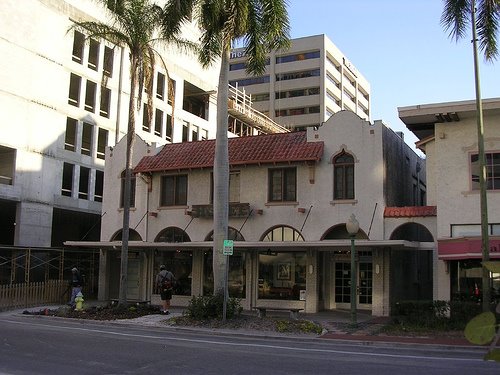 The DeMarcay Hotel, at the left, is a great remaining example of Palm Ave from the mid-1920's. The architecture and scale fit beautifully with the portion of the Miramar building that still exists on Palm.
There is a developer proposal to build a high rise condo on the DeMarcay site. Apparently the developer will retain the DeMarcay facade. Details are not clear at this time.
What is apparent is that just retaining the facade, without some attempt at retaining the scale, would be a loss to Sarasota.

As seen in the second photo, this block of of Palm retains its original character and scale - at least up to the high rise at 1350 Main, seen looming over Palm in the background.
Sarasota needs to make a determined effort to retain the character of this important reminder of our past.
(Thanks to Joe Moraca for the photos).
Thursday, March 09, 2006
Accountability and City Government
I (and many others) received this e-mail from Commissioner Shelin today:
The City Commission and Charter officials held an informal meeting recently to discuss the ideas and concerns that were documented during the accountability community conversations of last October at New College. There was considerable discussion about the themes that ran through the ideas and the group concluded that much of the participants concerns centered on a lack of understanding of governmental processes including a misunderstanding of legal and constitutional issues especially as they relate to land development issues where the City can't simply stop projects because some citizens don't like them.
There was a strong belief amongst those participating in the meeting that while the City of Sarasota provides for an unusual level of public in-put into its decision-making, that still hasn't resulted in a better understanding of how government works. That lack of understanding leads to unhappiness with government decision making and a negative perception of the quality of the decisions and those making them.
The recent, very successful completion of the Citizen's Academy provided a model for further discussion because of the uniformly positive response to it by attendees. Noteworthy amongst those responses was that a number of people said that they now understood better why and how decisions were made. In fact, there seemed to be an ah-ha moment for several people when they connected Constitution provisions to the way in which the various constituencies are served by the City Commission and Administration. In other words, all the city government customers deserve equitable treatment at the hands of city government.
Because of the negative character that often characterizes the public debate in Sarasota, discussion ensured about how to turn that into a constructive debate. A conclusion was reached that the City Commission would charge Charter Officials with the development of approaches similar to the Citizen's Academy so that constructive ideas and suggestions would be more apt to be brought to the public debate rather than complaints. The public would be encouraged to use their assets to develop constructive problem solving actions.
The discussion will continue.
Ken Shelin
_________________
The original invitation to this "conversation" was:
For several years, there have been discussions and calls for better accountability from all levels of our city government. This community has become a more urban and sophisticated city than in the past and is attracting people from all over the world used to amenities not often found in communities of our physical size and population.
This conversation to which you are being invited jointly by me (Ken Shelin), The Downtown Partnership and the Coalition of City Neighborhood Associations, is deliberately intended to be a wide-ranging discussion of all kinds of ideas, some of which may be developed into recommendations for change in our city government so that it can meet the challenges of today as well as the future.
_________________
Previous postings concerning the "Accountability Conversations" are here and here.
_________________
Commissioner Shelin sent an approximate 10 page document detailing the suggestions that were made during the three sessions that he held with residents in Oct of 2005. The executive summary of this document is printed here:
Accountability Suggestions
Executive Summary
Because the issue of accountability has been the subject of political concerns and elections for several years in the City of Sarasota; and because the City now appears to be in the throes of significant change in terms of it demographics, its land development, and its character as an urban entity, it seemed time to engage in a series of community conversations about what accountability meant to members of the community as it related to its government.
Therefore, three such conversations were sponsored by The Downtown Partnership, the Coalition of City Neighborhood Associations and City Commissioner Ken Shelin to answer the question, "What possibilities inspire you to assure accountability in City of Sarasota government?" Those conversations were held at the Sudakoff Center of New College on October 27th, 2005 (2 sessions) and on October 30th, 2005.
Numerous individual suggestions were made during the discussions, but several themes emerged which justify further exploration especially those which suggest a change in the form of government. Those themes were:
_________________
I also received the following message on Jan 18. No message about this informal meeting was received and no agenda concerning this meeting is posted on the city web site.
The City Commission received the suggestions from the Accountability community conversations in a positive light and decided to refer the suggestions for the City Manager, City Administration and City Auditor and Clerk to each for internal review, discussion and an eventual report back to the Commission on what was done with the suggestions for their areas of responsibility. The City Commission decided to initiate discussions of the suggestions for it during informal meetings that are held periodically to discuss a wide variety of topics. There is no public in-put during those meetings, but I will advise you of the time and place of the next one since the public may attend.
Ken Shelin
The City Commission and Charter officials held an informal meeting recently to discuss the ideas and concerns that were documented during the accountability community conversations of last October at New College. There was considerable discussion about the themes that ran through the ideas and the group concluded that much of the participants concerns centered on a lack of understanding of governmental processes including a misunderstanding of legal and constitutional issues especially as they relate to land development issues where the City can't simply stop projects because some citizens don't like them.
There was a strong belief amongst those participating in the meeting that while the City of Sarasota provides for an unusual level of public in-put into its decision-making, that still hasn't resulted in a better understanding of how government works. That lack of understanding leads to unhappiness with government decision making and a negative perception of the quality of the decisions and those making them.
The recent, very successful completion of the Citizen's Academy provided a model for further discussion because of the uniformly positive response to it by attendees. Noteworthy amongst those responses was that a number of people said that they now understood better why and how decisions were made. In fact, there seemed to be an ah-ha moment for several people when they connected Constitution provisions to the way in which the various constituencies are served by the City Commission and Administration. In other words, all the city government customers deserve equitable treatment at the hands of city government.
Because of the negative character that often characterizes the public debate in Sarasota, discussion ensured about how to turn that into a constructive debate. A conclusion was reached that the City Commission would charge Charter Officials with the development of approaches similar to the Citizen's Academy so that constructive ideas and suggestions would be more apt to be brought to the public debate rather than complaints. The public would be encouraged to use their assets to develop constructive problem solving actions.
The discussion will continue.
Ken Shelin
_________________
The original invitation to this "conversation" was:
For several years, there have been discussions and calls for better accountability from all levels of our city government. This community has become a more urban and sophisticated city than in the past and is attracting people from all over the world used to amenities not often found in communities of our physical size and population.
This conversation to which you are being invited jointly by me (Ken Shelin), The Downtown Partnership and the Coalition of City Neighborhood Associations, is deliberately intended to be a wide-ranging discussion of all kinds of ideas, some of which may be developed into recommendations for change in our city government so that it can meet the challenges of today as well as the future.
_________________
Previous postings concerning the "Accountability Conversations" are here and here.
_________________
Commissioner Shelin sent an approximate 10 page document detailing the suggestions that were made during the three sessions that he held with residents in Oct of 2005. The executive summary of this document is printed here:
Accountability Suggestions
Executive Summary
Because the issue of accountability has been the subject of political concerns and elections for several years in the City of Sarasota; and because the City now appears to be in the throes of significant change in terms of it demographics, its land development, and its character as an urban entity, it seemed time to engage in a series of community conversations about what accountability meant to members of the community as it related to its government.
Therefore, three such conversations were sponsored by The Downtown Partnership, the Coalition of City Neighborhood Associations and City Commissioner Ken Shelin to answer the question, "What possibilities inspire you to assure accountability in City of Sarasota government?" Those conversations were held at the Sudakoff Center of New College on October 27th, 2005 (2 sessions) and on October 30th, 2005.
Numerous individual suggestions were made during the discussions, but several themes emerged which justify further exploration especially those which suggest a change in the form of government. Those themes were:
- Elected mayor
- Strategic leadership by the City Commission
- Well-documented actions by all levels of city government
- Skilled management by the City Manager and Administration
- Outreach by all levels of City government to educate citizens on its processes and decision making
- Opportunities for public input into government decision-making processes.
- Proactive public information activities
_________________
I also received the following message on Jan 18. No message about this informal meeting was received and no agenda concerning this meeting is posted on the city web site.
The City Commission received the suggestions from the Accountability community conversations in a positive light and decided to refer the suggestions for the City Manager, City Administration and City Auditor and Clerk to each for internal review, discussion and an eventual report back to the Commission on what was done with the suggestions for their areas of responsibility. The City Commission decided to initiate discussions of the suggestions for it during informal meetings that are held periodically to discuss a wide variety of topics. There is no public in-put during those meetings, but I will advise you of the time and place of the next one since the public may attend.
Ken Shelin
Wednesday, March 08, 2006
CONA Comments
From the recent CONA Newsletter an article by Bill Zoller:
How can you help?
CONA’s board recently met with the South Venice 2010 board at the Jacaranda Library. It was a great meeting, attended by members of the Alliance in Englewood and by representatives from Richardson Road (north of Fruitville Rd.) and from all areas in between. It was an opportunity to dialogue and exchange information on our dealings with the County.
As planning issues become ever more complex; as traffic congestion becomes, seemingly, ever more insoluble; as concerns over our water supply become ever greater; as we wonder what is going to happen with the affordable housing issue; as we worry about sprawl, pollution of our waters, and about an almost endless string of problems, we face an ever greater need to band together to be proactive in addressing these issues. We need to let our elected representatives know, in a thoughtful way, what we want and need for them to do to make this area a better place, not a worse place, as we rush into the future.
If we had enough confidence in our elected officials just to let them "do it on their own", there would be no need for CONA, CCNA, the Alliance, or any other citizen and neighborhood organizations. We could just leave it in the hands of our elected officials and trust them to be able to filter out all the bad ideas that might be proposed by special interests, and to protect us from any bad possible outcomes. It would surely be a heck of a lot easier! Unfortunately, as we look around us, we can see that that just hasn’t worked. Without the input from our public interest organizations, how much worse might things be? We know that our elected officials work to do the right thing. We know they want this to be a better community. We know they need our help to make sure that a better community is what we get.
Sometimes our elected officials think, because they have the benefit of staff input and information from those seeking a land-use change, that they are more knowledgeable than the citizens who appear at the hearings, at the very end of the process. The courts have ruled, however, that we citizens are experts on our neighborhoods and are, therefore, able to give "competent and substantial" testimony about issues affecting them. Our obligation is to be informed… to learn about the issues. Along with Thomas Jefferson, I have great faith in the citizens … I believe the citizens can be trusted to bring critical and important information to the process. This is the work we need to do together through CONA and through our neighborhood and homeowner associations.
We need to hear from you. We can only be as effective as our members are willing to work. We need your insights, your concerns, your ideas. Let us know how you think we can be more helpful. I think we need to get a lot more of us "at the table" to do the heavy lifting. Will you come to the table?
Save Our Sarasota would echo these thoughts. Our elected officials cannot do what the citizens want unless they know what is wanted. Even then, the pressure from special interests can be intense. Citizens must demand that elected officials do the right thing, then support them when they do the right thing. We all need to make sure that our elected officials hear our insights, concerns and ideas. If we don't speak, only those that do speak will be heard.
Tuesday, March 07, 2006
Commuting Around Florida
From this month's issue of Florida Trend
City planners say that a healthy downtown depends on having a strong residential component along with the commercial center: Cities where high percentages of workers commute in from outside the city limits may look vibrant during the day but tend to resemble ghost towns at night.
The chart at right shows the percentage by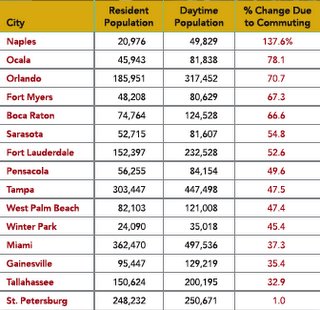 which some city populations in Florida increase as a result of work-related commuting — in other words, how many people who work downtown live outside the city limits. In Orlando’s case, the city’s population almost doubles during the daytime, swelling by 131,501 commuters, an increase of more than 70%.
No wonder the traffic is so bad in the Ft Myers - Naples area. I wonder if we are headed higher or lower on the list. My guess is we are headed higher.
Also I wonder if our summers will still resemble a ghost town, despite all the condo construction in and near downtown.
City planners say that a healthy downtown depends on having a strong residential component along with the commercial center: Cities where high percentages of workers commute in from outside the city limits may look vibrant during the day but tend to resemble ghost towns at night.
The chart at right shows the percentage by
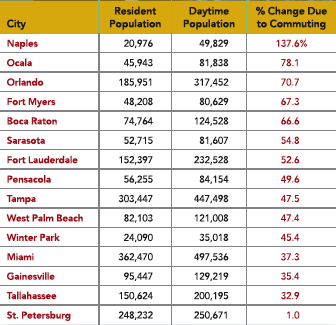 which some city populations in Florida increase as a result of work-related commuting — in other words, how many people who work downtown live outside the city limits. In Orlando’s case, the city’s population almost doubles during the daytime, swelling by 131,501 commuters, an increase of more than 70%.
No wonder the traffic is so bad in the Ft Myers - Naples area. I wonder if we are headed higher or lower on the list. My guess is we are headed higher.
Also I wonder if our summers will still resemble a ghost town, despite all the condo construction in and near downtown.
Monday, March 06, 2006
CCNA Asks City To Delay Decision on Density Bonus Proposal
At Saturday's Coalition of City Neighborhood Association (CCNA) meeting, the members voted to ask the city to remove the proposed "attainable housing density bonus" comprehensive plan amendment from the current comp plan change cycle.
There are several related issues at the current time and the feeling of the CCNA members was that this particular proposed amendment was too complicated, not understood by the public, the benefit was unclear and there was considerable question about whether our current infrastructure could support this amount of increased housing.
In addition a comment from the consultants report makes one wonder about this approach: "This analysis leads to the conclusion that under current and foreseeable market conditions, even a significant density bonus is unlikely to result in new development of attainable units downtown."
Concurrently there are proposed downtown zoning district changes for several "downtown edge" areas. These proposals are pushing downtown zoning further into the neighborhoods - downtown creep, if you will. The Comp Plan amendment would allow a 4X density increase in exchange for 10% of units being affordable to residents whose income is 60% - 120% of the area median income.
A proposal for the Scottie's property on the east side of Payne Park is an example. This approximate 9.2 acre site could have about 170 units under its current zoning. If the future land use and zoning is changed, as the developer is asking, the new Downtown Core zone designation would allow 460 units. If the attainable housing density bonus were also allowed this would go to 1840 units. Of these 10%, or 184, would have to be "attainable."
This would result in a major change in the quality of life for the residents of the Alta Vista neighborhood where this is located.
The ERA Report (consultant hired by the city to draft a proposed amendment to the Comp Plan) indicates that if this amendment were enacted, it could result in an additional 28,000+ units downtown. It was estimated by the consultant that a maximum of 230-470 of these would meet the attainable housing cost requirement. This seems to be an inefficient way to achieve more attainable housing units. The comment was made that it would be less costly to the city (when infrastructure is accounted for) to just purchase the land and subsidize a developer to build 200-400 attainable units in or near downtown.
John Susce, from the Park East neighborhood, voted against the request for removing the proposal from this year's cycle. The Park East neighborhood is working with Harvey Vengroff on a large affordable housing project. Susce indicated that he had concern that if this proposal was not enacted, his neighborhood's project might not go forward.
Friday, March 03, 2006
Downtown Density "Bonus"
A note from a regular reader of this blog:
-------------------
They've had several good editorials lately. Referring to the "density bonus" discussion, I am really interested in the "in lieu" of option. At CRA Advisory Board meeting David Smith explained, in response to questions from the committee about "in lieu of" options, that the consultants (ERA) are against them. They do not like having affordable units built in other places in the city and think they are best if successfully integrated into a larger project.
However, Smith said, the planning department wanted the "in lieu of" option and had consultants prepare one as an addendum. At that point there was discussion of "in lieu" and it was nothing like what was in the newspaper. There was no reference to the cost of building downtown being too much for a developer. One developer and two realtors talked about it being too hard to sell a project with affordable units in it.
I was really offended that I might live in a city where there are people who would refuse to live in the same building as the people who vacuum their carpets, wait on them at restaurants, play beautiful music for them at orchestra concerts, dance for them as part of the ballet, choose to be social workers, etc. for idealistic reasons rather than choosing a more lucrative profession. I can handle high buildings and loss of greenspace more easily that the sentiments I heard expressed at that meeting. Say it isn't so!
And, again, am really interested in hearing from those who have thought a lot about this. Another question: If you choose the "in lieu" option...should you really be allowed the huge density bonus?
----------------
Today's SHT editorial is about the affordable housing density bonus idea for downtown Sarasota.
The editorial says "take off the rose colored glasses." Some excerpts:
The city is clearly trying to do the right thing by encouraging the construction of lower-cost housing. But the consultants' report suggests that even if the city were to double or quadruple allowable density in downtown zoning districts -- a big boon to developers -- little affordable housing would result unless additional incentives were provided. In essence the report concludes that, because of high costs and other construction hurdles downtown, density bonuses aren't enough to persuade most developers to build affordable units within their projects.
With astronomical real estate prices, the downtown is becoming an enclave for the rich. Mixing in some units that working people can afford has appeal because it would preserve demographic diversity. But in the downtown, "affordable" units would likely be small ones -- which would leave out many families.
An "in lieu of" option, where developers pay for the privilege of the density bonus but don't build the affordable units within their own project, might prove more effective at broadening the supply of work-force housing. As the consultants noted, the in-lieu-of fee would have to be carefully calibrated (in their example it exceeded $330,000). But its use would be flexible, funding anything from nonprofit housing construction to down-payment assistance and rental subsidies on homes outside the downtown.
The editorial points out that this is a complex issue and needs to have public understanding, public input. We would add that a good measure of listening and questioning by the commissioners will be greatly appreciated. This should not be a rushed process.
Thursday, March 02, 2006
16TH ANNUAL SARASOTA HISTORIC HOMES TOUR SHOWCASES LAUREL PARK
 The Sarasota Alliance for Historic Preservation is proud to present the 16th Annual Historic Homes Tour on Sunday March 5 from 11 AM to 5 PM.
The five homes featured on the tour are located in historic Laurel Park. Laurel Park, one of the oldest neighborhoods in the city of Sarasota, is pursuing National Historic Designation and has been working closely with the Alliance for support in their efforts to maintain the streetscape and original character of their neighborhood.
“At the Alliance, we felt the timing was right to support their efforts and bring the communities attention to the value of this colorful neighborhood.” says Alliance President, David Jennings, of the decision to showcase only Laurel Park homes on this years tour.
1841 Oak Street
This two story Dutch colonial was moved to its present location from 17th Street in 1933 by then owner John Early. Early was a longtime Sarasota attorney who over the course of his career served as mayor of the city of Sarasota and as Sarasota’s first municipal judge. The home has been beautifully restored by the current owners.
642 Ohio Place
Owned by Michele Mancini, a well know designer and purveyor of vintage fabrics marketed under the company name of “Full Swing Textiles”. Mancini’s work has been featured in Metropolitan Home, Elle and the New York Times. She has recently co-authored a book entitled Fabulous Fabrics of the 50’s. Samples of her work will be on display in this charming 1920’s bungalow.
1716 Oak Street
This craftsman style bungalow has been historically designated as the Ella Dula Westermann Tenant house. A two story garage addition has recently been completed. It illustrates how infill construction can be done with sensitivity to an existing historic resource.
1675 Oak Street
Another historically designated home, the Jerome K. Martin House was named after the man who built it. Martin, one of three sons of well known Sarasota architect Thomas Reed Martin, was associated with his father for many years as a supervising architect.
1637 Oak Street
Historically designated in the 1980’s, the boom time, Mediterranean Revival style Spanish Oaks Apartments were historically known as Katahdin Court, presumably deriving its name from the mountain peak in Maine. Two apartments at Spanish Oaks will be open for viewing.
The $20 tickets can be purchase in advance at Davidson Drugs, Main Books, The Sarasota County History Center, Sarasota Architectural Salvage and Historic Spanish Point. Tickets may also be purchased the day of the tour at any of the tour homes.
The mission of the Sarasota Alliance for Historic Preservation is to preserve and enhance our historic places. We invite you to celebrate Sarasota’s rich architectural heritage and diversity by visiting these beautiful homes in Laurel Park. For more information, call the Alliance at 953-8727.
Bonus Tour
Concurrent with the tour sponsored by the Sarasota Alliance for Historic Preservation, some hardworking residents of the neighborhood are planning to conduct a walking tour of some additional historic properties in Laurel Park.
Walking tour houses will all be marked by balloons and roped off from the Sidewalk, so that people don't get confused about which houses are open.
About 400 copies of the tour itinerary will be printed. Chilled water available for sale and t-shirts for donations (look for this at the park or Melody's Day Spa).
Tables and chairs will be set up in the park for those who want to rest or picnic.
Special thanks go to Jolie McInnis, Jude Levy, and Deb Dart for their efforts!
Properties to be includes in this walking tour are:
1840 Oak Street: 1939 frame vernacular. This house was a duplicate of the demonstration home in the 1940 New York World’s Fair Town of Tomorrow. French windows and doors, double hung windows, and two porches give the house an open feel. The house also has an open floor plan, considered very innovative at the time.
1876 Oak Street: Dr. Walter C. Kennedy house, c. 1926 Mediterranean revival. This is the only house listed on the National Historic Register (34 others qualify for such designation). The house was designed by noted New York and Sarasota architect Dwight James Baum who came to Sarasota to design the Ringling’s mansion, Ca' d' Zan, and was built by Owen Burns as part of his Washington Park subdivision. It has hollow clay tile walls, Spanish Mission tile and asphalt roof, and pecky cypress throughout.
527 Madison Court: 1925 Mediterranean revival. One of four duplexes built by Woods & Schneider Contractors for R.R. Rhodes and Dr. Wallace Barr of Bowling Green, Kentucky (two on either side of the street). They all had the same interior layout but with slightly different street facades. All but 527 a re now single family homes. Note the brick peeking through the asphalt on this street.
1927 Laurel Street: Katie Hale home, c. 1926 frame vernacular. The first owner of this house was Katie Mae Hale, the wife of local builder/developer Henry Hale. They lived at 326 Ohio, also on the walking tour. She sold this house in 1937. Note the decorative milled sunburst motif at the gable peak of the porch roof. This motif is derived from the late 19th Century English Arts and Crafts movement.
1936 Morrill Street: The Kimmel-Chapman house, c.1925 bungalow. The first known resident was J.G. Kimmel, a civil engineer for the Palmer Corporation, who worked on the Sarasota-Fruitville and Hyde Park drainage projects. The Chapmans owned the house for 61 years. The columns and porch were added in 2000, a sensitive - neighborhood friendly - addition.
320-326 Ohio Place: c. 1925 bungalow and Mediterranean revival. Homes of developers/contractors Bernard Rhodes (320) and Henry Hale (326), who built numerous other buildings in the neighborhood, including the Mediterranean revival style apartments across the street at 325 Ohio Place, 404 S. Osprey, 1759 Morrill, and 1685 Laurel Street (now remodeled.)
542 Ohio Place: c. 1941 frame vernacular. This is the Laurel Park house most recently designated with the City of Sarasota as historically significant. Sixteen other houses are locally designated and 75 are eligible. A typical World War II era cottage, its distinctive architectural features include the corner windows and hip roof design. Two additions to the residence were made in the 50s to accommodate a growing family and to create the look of the latest style in home building--the ranch house.
1702 Laurel Street: 1926 Mediterranean revival. Built by the original congregation of the Seventh Day Adventist using architectural plans that many other churches across the state also used. Preserved as a private home in 2003.
1677 Laurel Street: c. 1890 folk Victorian. Local lore has it that this home was built on Gulfstream Avenue facing the bayfront and moved to this site in the 1920s to make room for a large boom time era home. At some point in the 20s, the house belonged to a tombstone carver who left a selection of unclaimed markers under the house. The current owners, as children, were certain the house was built on a cemetery.
1630 Laurel Street: c. 1925 craftsman bungalow. Note the massive boxed columns, casement windows, and wide eaves with exposed rafter ends. The Cuban Laurel is estimated to be over 100 years old. (The interior still has the original wood floors and fireplace.) The adjacent street, Rawls Avenue, is brick below the asphalt. We hope to see these streets return to their original brick in the future.
Subscribe to:
Posts (Atom)

