Here’s an original idea. "Sarasota Originals," the group of restaurants listed below, are all local suncoast establishments. They have banded together to promote the fact that they are unique and local. While this is part of a marketing campaign (trying to compete against the chain restaurants) it carries a larger message - these and other local businesses make up the unique fabric of Sarasota (and nearby communities).
During the summer doldrums, these businesses struggle as many of their clientele head north for a cool time. Why not help our local businesses by patronizing them and supporting their unique place in our community. Many of these restaurants have summer specials as an added bonus. Get to know them, they live here and are likely to be neighbors and friends.
This list, of course is not exhaustive. There are many neighborhood establishments as well as local businesses that are not part of this marketing venture. But by seeking out our local flavor, we will help insure they remain for a long time into the future. Help keep Sarasota's unique, local flavor.
15 South
Bayou Bleu
Beach House
Bijou Café
Blasé Café
Broken Egg
Café Baci
Café L'Europe
Café on the Bay
Caragiulo's
China Palace Express
Colony Restaurants
Crow's Nest
Euphemia Haye
Galileo Ristorante
Gitane
Harry's Continental
Hillview Grill
Jonathan's/Smokin' Martini
Latitude 23.5 Coffee and Tea
Lobster
Lynches Pub & Grub
Madfish
Manhattan Bar & Grill
Marie's Italian Kitchen
MarVista
Mattison's City Grille
Mattison's Siesta Grille
Mattison's Steak House
Maureen's Palm Grille
Mediterraneo
Michael's On East
Pattigeorge
Roessler's
Sandbar
Selva Grill
Siesta Key Oyster Bar
Silver Cricket
Sun House Restaurant &
Tuesday, July 05, 2005


Monday, July 04, 2005
Community Dialogue
In Sunday’s lead editorial in the Sarasota Herald Tribune, the editors say:
Every American city and county needs good government in order to establish and maintain a pleasant quality of life for the vast majority of its people. But government cannot create communities or good citizens. It is up to individuals, and the associations they form, to fashion a sense of community and promote causes that benefit the greater good. In strong cities and counties, governments, communities and citizens take additional steps -- forming partnerships, engaging in dialogue, leading when necessary and following when beneficial.
We couldn’t agree more fully. Thoughtful, well researched dialogue concerning civic well being is the key to a quality lifestyle for all. Sarasota is fortunate to have many excellent institutions that are willing and able to positively contribute to our community.
One of these, SCOPE, has engaged the community in discussions on a number of issues we face. SCOPE's methodology starts with researching the issue, then looks for best practices and tries to find ways to apply this knowledge to our community. SCOPE has been very successful in these endeavors and is a model well worth following.
Save Our Sarasota tries to follow this model. We engage in public discourse, we formulate a position on a topic that we believe Sarasotans have a high degree of concern about, and we try to find better ways to move forward. Along the way, we point out "mistakes" we believe have been made. We do this in an attempt to show the effect of changes that have been allowed with apparently little discussion or community involvement.
As we move into our second year of existence, we would hope that our discussions with civic leaders have been fruitful. We believe Save Our Sarasota has been the spark for some change that is positive. We will continue to fashion a sense of community and promote causes that benefit the greater good.
Every American city and county needs good government in order to establish and maintain a pleasant quality of life for the vast majority of its people. But government cannot create communities or good citizens. It is up to individuals, and the associations they form, to fashion a sense of community and promote causes that benefit the greater good. In strong cities and counties, governments, communities and citizens take additional steps -- forming partnerships, engaging in dialogue, leading when necessary and following when beneficial.
We couldn’t agree more fully. Thoughtful, well researched dialogue concerning civic well being is the key to a quality lifestyle for all. Sarasota is fortunate to have many excellent institutions that are willing and able to positively contribute to our community.
One of these, SCOPE, has engaged the community in discussions on a number of issues we face. SCOPE's methodology starts with researching the issue, then looks for best practices and tries to find ways to apply this knowledge to our community. SCOPE has been very successful in these endeavors and is a model well worth following.
Save Our Sarasota tries to follow this model. We engage in public discourse, we formulate a position on a topic that we believe Sarasotans have a high degree of concern about, and we try to find better ways to move forward. Along the way, we point out "mistakes" we believe have been made. We do this in an attempt to show the effect of changes that have been allowed with apparently little discussion or community involvement.
As we move into our second year of existence, we would hope that our discussions with civic leaders have been fruitful. We believe Save Our Sarasota has been the spark for some change that is positive. We will continue to fashion a sense of community and promote causes that benefit the greater good.
Sunday, July 03, 2005
Save Our Sarasota Has A Birthday
Dear Friends,
This month, Save Our Sarasota is celebrating its First Birthday!
From the very beginning, when concerned citizens filled the Selby Library meeting room to capacity, you told us our primary focus should be saving trees and opposing runaway growth downtown. We are working to meet those challenges. And as issues have arisen a common purpose has become clear---we are protecting public space that is being gifted for development.
The survival of trees on public sidewalks, the massive downtown arcades and three stories of habitable space to be built in the public air rights above the sidewalks, proposed privatization of Five Points Park, the idea of a Conference Center on public bayfront property, the possible vacation of State Street for a regional shopping mall, the taking away of newly planted green space on Lemon Avenue, the intrusion of the porte cochere at 100 Central into the very roadway…and more…ALL are issues of publicly owned space.
If you are interested in any of these issues, please write or call to let us know you want to help. We need more working members, and some of the simplest tasks are important to our success. Planning programs, making phone calls, copying reports, ordering and picking up documents from City Hall….are all valuable help we could use. Knowing your preferences on programs is very important to us. We plan another public meeting this July. Please call Carol Reynolds at 362-9779 to volunteer.
Lastly, we are very proud of our new Save Our Sarasota blog. SRQ Magazine recently cited it as one of the best local blogs. It is an intelligent and lively take on current issues and a daily "must read" for a lot of us. Be sure to look at not only the most current posting, but previous articles and pictures, all cached on the site. It can be accessed at Saveoursarasota.blogspot.com.
We thank you for caring about the future of our wonderful city. We all regret what has been lost, but there is much to save. We all look forward to an even more active "Year Two" for Save Our Sarasota.
Sincerely,
Janice Green
Chair
Save Our Sarasota
This month, Save Our Sarasota is celebrating its First Birthday!
From the very beginning, when concerned citizens filled the Selby Library meeting room to capacity, you told us our primary focus should be saving trees and opposing runaway growth downtown. We are working to meet those challenges. And as issues have arisen a common purpose has become clear---we are protecting public space that is being gifted for development.
The survival of trees on public sidewalks, the massive downtown arcades and three stories of habitable space to be built in the public air rights above the sidewalks, proposed privatization of Five Points Park, the idea of a Conference Center on public bayfront property, the possible vacation of State Street for a regional shopping mall, the taking away of newly planted green space on Lemon Avenue, the intrusion of the porte cochere at 100 Central into the very roadway…and more…ALL are issues of publicly owned space.
If you are interested in any of these issues, please write or call to let us know you want to help. We need more working members, and some of the simplest tasks are important to our success. Planning programs, making phone calls, copying reports, ordering and picking up documents from City Hall….are all valuable help we could use. Knowing your preferences on programs is very important to us. We plan another public meeting this July. Please call Carol Reynolds at 362-9779 to volunteer.
Lastly, we are very proud of our new Save Our Sarasota blog. SRQ Magazine recently cited it as one of the best local blogs. It is an intelligent and lively take on current issues and a daily "must read" for a lot of us. Be sure to look at not only the most current posting, but previous articles and pictures, all cached on the site. It can be accessed at Saveoursarasota.blogspot.com.
We thank you for caring about the future of our wonderful city. We all regret what has been lost, but there is much to save. We all look forward to an even more active "Year Two" for Save Our Sarasota.
Sincerely,
Janice Green
Chair
Save Our Sarasota
Saturday, July 02, 2005
Eyes on the Garage, Back to the Street
"Eyes on the street", is a phrase coined by the legendary urban sociologist, Jane Jacobs, in her landmark book: Death and Life of Great American Cities. This phrase is fundamental when planners think about public safety. It is the fundamental concept for CPTED (Crime Prevention Through Environmental Design).
Jane Jacobs words: "There must be eyes on the street, eyes belonging to those we might call the natural proprietors of the street. The buildings on a street equipped to handle strangers and to insure the safety of both residents and strangers, must be oriented to the street. They cannot turn their backs or blank sides on it and leave it blind. The sidewalk must have users on it fairly continuously, both to add to the number of effective eyes on the street and to induce a sufficient number of people in buildings along the street to watch the sidewalks."
Where do you suppose the designers of Whole Foods in downtown Sarasota came up with the idea that having blank walls (adorned by some artistically placed paint) on three sides of their building makes for good urban design? No windows, just walls. How did our Planning staff decide to agree with this? How did our CRA Advisory Board and Commissioners decide to give an incentive in terms of TIF dollars for this "walkable, street friendly" addition to downtown? Did they once again succumb to the developer’s pretty pictures that have no relationship to reality?
Maybe I am too cynical. I guess having the front entrance on an alley with a parking garage entrance across the alley makes up for poor design. This certainly put eyes on the parking garage. Maybe this is part of the new smart growth movement or our smart code? It certainly "smarts" when I think about this design.
I guess I need to keep searching urban design best practices for this principle: "eyes on the garage, back to the street". I just haven’t come across it yet.
Jane Jacobs words: "There must be eyes on the street, eyes belonging to those we might call the natural proprietors of the street. The buildings on a street equipped to handle strangers and to insure the safety of both residents and strangers, must be oriented to the street. They cannot turn their backs or blank sides on it and leave it blind. The sidewalk must have users on it fairly continuously, both to add to the number of effective eyes on the street and to induce a sufficient number of people in buildings along the street to watch the sidewalks."
Where do you suppose the designers of Whole Foods in downtown Sarasota came up with the idea that having blank walls (adorned by some artistically placed paint) on three sides of their building makes for good urban design? No windows, just walls. How did our Planning staff decide to agree with this? How did our CRA Advisory Board and Commissioners decide to give an incentive in terms of TIF dollars for this "walkable, street friendly" addition to downtown? Did they once again succumb to the developer’s pretty pictures that have no relationship to reality?
Maybe I am too cynical. I guess having the front entrance on an alley with a parking garage entrance across the alley makes up for poor design. This certainly put eyes on the parking garage. Maybe this is part of the new smart growth movement or our smart code? It certainly "smarts" when I think about this design.
I guess I need to keep searching urban design best practices for this principle: "eyes on the garage, back to the street". I just haven’t come across it yet.
Friday, July 01, 2005
Leadership and Vision - Here's an Excellent View
Neil Pierce is a nationally syndicated columnist who writes about various issues. A recent column focuses on a major issue facing Sarasota - housing and our sense of place. An excerpt from Pierce’s column written while attending the Urban Land Institute's World Cities Forum in London last week:
"I can't think of one U.S. national politician who mentions cities or urban environment in any meaningful way," noted Urban Land Institute President Richard Rosan. "Not one of them is out there talking seriously about critical issues of transportation and housing, metropolitanwide planning, viability of communities — all ways that national government, even without dictating quite the way London does, could at least encourage a more secure and livable urban future."
Like the amazing run-up of housing costs that started around such U.S. hot spots as San Francisco and Boston and is now spreading nationwide, the London metro region escalation means fantastic wealth gain for some, but housing unaffordability for millions more.
Deputy Prime Minister John Prescott vows not to repeat the errors; he talks instead of "sustainable" communities that don't just incorporate good environmental standards but assure a sense of place, low crime, transportation choices, citizen participation, economic development and "life chances for all." Such places, he argues, "create superb buildings and open spaces — where people want to be together and feel real pride in their own community."
Prescott's premier test of a sustainable community: housing opportunities and a welcome mat for people of many income groups. He sees deep divisions of income and class as the scourge of our time, to be attacked aggressively with public power and the public purse.
It's a stunning vision, extraordinarily tough to execute, even by a determined national government. The tragedy is that we Americans aren't even dreaming it."
Quite the vision indeed. You’d think maybe our leaders would think in these terms instead of the more narrow "local entity" role they only consider. You’d also think that maybe our state and national representatives would get a clue about what the real domestic issues are, instead of listening only to the big time lobbyists about issues that will make them more money. You might even think our local leaders would be pushing for these solutions for these very issues: transportation, housing, viable communities - all connected on a regional basis.
Unless we have a vision that includes all of us, we will stay stuck in the quagmire. Many Floridians and even Sarasotans see themselves primarily as keepers of the tourism economy and profiteers in the land business. We need to see ourselves as a community of people from many backgrounds and economic levels that contribute to the community in a wide variety of ways. We can not afford to include only the wealthiest. We need to find a place for all the community contributors. We will all be richer because of it.
Where is our leadership? What does their vision include? Is it a vision for all of us or can only select groups buy into it?
"I can't think of one U.S. national politician who mentions cities or urban environment in any meaningful way," noted Urban Land Institute President Richard Rosan. "Not one of them is out there talking seriously about critical issues of transportation and housing, metropolitanwide planning, viability of communities — all ways that national government, even without dictating quite the way London does, could at least encourage a more secure and livable urban future."
Like the amazing run-up of housing costs that started around such U.S. hot spots as San Francisco and Boston and is now spreading nationwide, the London metro region escalation means fantastic wealth gain for some, but housing unaffordability for millions more.
Deputy Prime Minister John Prescott vows not to repeat the errors; he talks instead of "sustainable" communities that don't just incorporate good environmental standards but assure a sense of place, low crime, transportation choices, citizen participation, economic development and "life chances for all." Such places, he argues, "create superb buildings and open spaces — where people want to be together and feel real pride in their own community."
Prescott's premier test of a sustainable community: housing opportunities and a welcome mat for people of many income groups. He sees deep divisions of income and class as the scourge of our time, to be attacked aggressively with public power and the public purse.
It's a stunning vision, extraordinarily tough to execute, even by a determined national government. The tragedy is that we Americans aren't even dreaming it."
Quite the vision indeed. You’d think maybe our leaders would think in these terms instead of the more narrow "local entity" role they only consider. You’d also think that maybe our state and national representatives would get a clue about what the real domestic issues are, instead of listening only to the big time lobbyists about issues that will make them more money. You might even think our local leaders would be pushing for these solutions for these very issues: transportation, housing, viable communities - all connected on a regional basis.
Unless we have a vision that includes all of us, we will stay stuck in the quagmire. Many Floridians and even Sarasotans see themselves primarily as keepers of the tourism economy and profiteers in the land business. We need to see ourselves as a community of people from many backgrounds and economic levels that contribute to the community in a wide variety of ways. We can not afford to include only the wealthiest. We need to find a place for all the community contributors. We will all be richer because of it.
Where is our leadership? What does their vision include? Is it a vision for all of us or can only select groups buy into it?
Thursday, June 30, 2005
Keeping Time with William Murtagh
A couple months ago, we posted (March 11) information about the Sarasota Alliance for Historical Preservation meeting that featured a talk by Dr. William Murtagh. Dr. Murtagh is the founder of the National Registrar of Historic Places. He has been known as the "Keeper of the National Registry."
In an interview with him, printed Tuesday in the SHT, he discussed his life long love affair with historical places. He has developed a keen awareness of the relationship of older structures and their ability to speak to future generations about their own time and place. This connection to the past is vital if we are to build upon the best that has come before us.
Murtagh is quoted as saying "I’m appalled at what little attention Sarasota has paid to the concept of preservation. There’s not been much of a sense of community identity and maybe it’s because of the snowbirds; I don’t know. It may also be the problem that they’re older people, and the older people only look upon where they came from as historic." He added "Also, most (real estate developers) are really in the business of making money. I have never seen this to the excess it is in Florida, where people are turning properties on a spade."
Sarasota has organizations that try very hard to preserve the best of our past. We are fortunate to have several organizations that have many dedicated members striving to do just that. However, the pressure of real estate development profits is extremely strong here. Without a commitment of dollars by local governments to save historical places they succumb to the development pressure.
We are getting better at this, but the process needs more help. Opportunities are all around us for involvement - currently a group is working very hard to find a permanent place for the Crocker Church and the Luke-Bidwell House, both important structures with stories to tell about the early days of Sarasota.
See if you can find a way to help. We need to up the ante for preservation.
In an interview with him, printed Tuesday in the SHT, he discussed his life long love affair with historical places. He has developed a keen awareness of the relationship of older structures and their ability to speak to future generations about their own time and place. This connection to the past is vital if we are to build upon the best that has come before us.
Murtagh is quoted as saying "I’m appalled at what little attention Sarasota has paid to the concept of preservation. There’s not been much of a sense of community identity and maybe it’s because of the snowbirds; I don’t know. It may also be the problem that they’re older people, and the older people only look upon where they came from as historic." He added "Also, most (real estate developers) are really in the business of making money. I have never seen this to the excess it is in Florida, where people are turning properties on a spade."
Sarasota has organizations that try very hard to preserve the best of our past. We are fortunate to have several organizations that have many dedicated members striving to do just that. However, the pressure of real estate development profits is extremely strong here. Without a commitment of dollars by local governments to save historical places they succumb to the development pressure.
We are getting better at this, but the process needs more help. Opportunities are all around us for involvement - currently a group is working very hard to find a permanent place for the Crocker Church and the Luke-Bidwell House, both important structures with stories to tell about the early days of Sarasota.
See if you can find a way to help. We need to up the ante for preservation.
WalMart’s Coming to Town - Newtown That Is
A recent "neighborhood workshop" gave WalMart representatives the opportunity to explain to the Newtown community what might be in the cards. WalMart is considering a Super Center at the NE corner of 301 and MLK Way.
An article in the SHT described the confab in these terms: "Wal-Mart hasn't presented a formal offer to the city. Thursday night's meeting at Booker High School was part of the company's research process, to ensure any store built is a reflection of the community."
Attorney Brenda Patten, the local WalMart development rep, painted a pretty picture of what WalMart could be. "What would you like to see Wal-Mart do for this community?" she said. Wal-Mart would "kick start" the Newtown revitalization process, working to "draw people into your community," Patten said. "They'll come with their dollars."
Every suggestion was answered with something like "that can be done" or "we’ll look into that", although no commitments were made.
This group of interested residents had done their homework and much skepticism was expressed. Job training, jobs for Newtown residents, health care benefits, child care, traffic and many other issues were brought up. The issue of using the 18 acre brown-field site and its clean up cost was also discussed.
In the end it seemed that while most could see some benefit (after all the picture was pretty), the sense was that it would take a lot of community involvement to get real benefit for the Newtown community. There are potential pluses and there are definite minuses in the WalMart equation. To tip the balance to favor the community will require much effort, involvement and creativity. The community made a good start by showing up in force and asking tough questions.
Commissioner Fredd Atkins closed the meeting with an animated summation: "this is the beginning of a process "... he referred to as "a negotiation with a gorilla." " This struggle is going to require all of us to get ropes around it, so it works for us."
Amen, Fredd!
An article in the SHT described the confab in these terms: "Wal-Mart hasn't presented a formal offer to the city. Thursday night's meeting at Booker High School was part of the company's research process, to ensure any store built is a reflection of the community."
Attorney Brenda Patten, the local WalMart development rep, painted a pretty picture of what WalMart could be. "What would you like to see Wal-Mart do for this community?" she said. Wal-Mart would "kick start" the Newtown revitalization process, working to "draw people into your community," Patten said. "They'll come with their dollars."
Every suggestion was answered with something like "that can be done" or "we’ll look into that", although no commitments were made.
This group of interested residents had done their homework and much skepticism was expressed. Job training, jobs for Newtown residents, health care benefits, child care, traffic and many other issues were brought up. The issue of using the 18 acre brown-field site and its clean up cost was also discussed.
In the end it seemed that while most could see some benefit (after all the picture was pretty), the sense was that it would take a lot of community involvement to get real benefit for the Newtown community. There are potential pluses and there are definite minuses in the WalMart equation. To tip the balance to favor the community will require much effort, involvement and creativity. The community made a good start by showing up in force and asking tough questions.
Commissioner Fredd Atkins closed the meeting with an animated summation: "this is the beginning of a process "... he referred to as "a negotiation with a gorilla." " This struggle is going to require all of us to get ropes around it, so it works for us."
Amen, Fredd!
Tuesday, June 28, 2005
Profit, Profit, Profit
"They come here to buy and flip," she said.
This comment is from a story in the SHT yesterday about (what else?) booming real estate prices. This time it was referring to overseas buyers, particularly from Europe. "Many foreign buyers are investors who send representatives to closings, never setting foot in a property" the article says.
That is the reality today. Instead of investing in your community, your community becomes the latest speculative sandbox in which to play. For those investors it matters not what happens in the community, only the expected profit matters.
It used to be that real estate folks preached location, location, location. Now the mantra is likely to be profit, profit, profit.
The real estate folks also complain about the lack of "inventory" (makes it easier to sell "profit" by using business terms instead of life style terms). Of course if you put your house into the "inventory", where will you find a place to live? Maybe the lack of inventory is a good thing. Forces the speculators to chase the same houses around and around.
Makes you wonder about the end game.
This comment is from a story in the SHT yesterday about (what else?) booming real estate prices. This time it was referring to overseas buyers, particularly from Europe. "Many foreign buyers are investors who send representatives to closings, never setting foot in a property" the article says.
That is the reality today. Instead of investing in your community, your community becomes the latest speculative sandbox in which to play. For those investors it matters not what happens in the community, only the expected profit matters.
It used to be that real estate folks preached location, location, location. Now the mantra is likely to be profit, profit, profit.
The real estate folks also complain about the lack of "inventory" (makes it easier to sell "profit" by using business terms instead of life style terms). Of course if you put your house into the "inventory", where will you find a place to live? Maybe the lack of inventory is a good thing. Forces the speculators to chase the same houses around and around.
Makes you wonder about the end game.
Monday, June 27, 2005
RE:View of the Bay
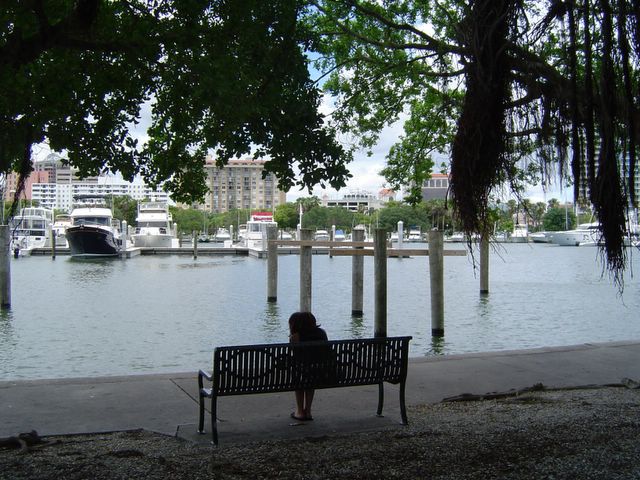
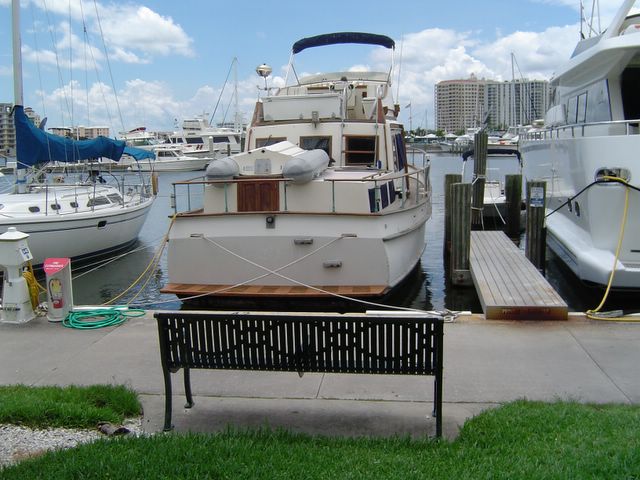
Views of the bay at Island Park are rapidly becoming extinct - see the pictures below. We used to be able to see the bay, look across the water at the city skyline or see people walking along side the water. Interesting and nice views. Now we see the back end of boats. And more of this type view is coming. The docks are creeping closer to the end of the peninsula.
Apparently this is another effect of growth. Parking for the cars and parking for the boats. We hear about the need for more boating access in Sarasota and how Marina Jack is helping address this. If so, why are most of the boats registered in far-away places and hardly ever taken from their dock. It would appear that they are owned by out of town (rich) people that take up space in case they want to visit.
We all hear that growth happens. And we hear the market speaking to us again: sold to the highest bidder!. This view belongs only to those that can afford it. The rest can look at the back of the boat.
Apparently this is another effect of growth. Parking for the cars and parking for the boats. We hear about the need for more boating access in Sarasota and how Marina Jack is helping address this. If so, why are most of the boats registered in far-away places and hardly ever taken from their dock. It would appear that they are owned by out of town (rich) people that take up space in case they want to visit.
We all hear that growth happens. And we hear the market speaking to us again: sold to the highest bidder!. This view belongs only to those that can afford it. The rest can look at the back of the boat.
Model Behavior
Downtown Sarasota has seen a number of very questionable developments. The current list includes giving away four stories of public space above the sidewalk at 1350 Main St, the give away of a portion of the public street (as well as the sidewalk) as part of the concession for 100 Central, the extremely narrow sidewalk abutting Fruitville in front of Marquee En Ville, and the poor design of the Whole Foods loading dock that forces trucks to drive up onto the sidewalk across Second St in order to back into the dock space.
Architectural drawings and renderings are apparently inadequate to prevent visualization of poor design. As we noted in a recent post, The Pelican Press quoted:
[Sarasota City Planner] Murphy countered, “We struggle with drawings. Developers want certainty. We could probably get a model out of them, but drawings, they’re not prepared to spend $350,000 to do that.” Board member Carl Meyer said he “feels the tail is wagging the dog. It’s a cost of doing business for developers. What we need is a process in this city so developers don’t run over our city."
Save Our Sarasota strongly recommends that our Planning Department require scale models of proposed major buildings in their downtown site to prevent future problems.
This is particularly important for the proposed Pineapple Square project. With no details presented, we hope problems like we have already seen are not repeated.
How proposed and current buildings fit together in our downtown space has not been addressed. We need to be able to see how downtown will be shaping up - this can only be done with the use of scale models of a size that can show interrelationships within the built environment.
We need an accurate model of our downtown that shows all the impacts of development.
Architectural drawings and renderings are apparently inadequate to prevent visualization of poor design. As we noted in a recent post, The Pelican Press quoted:
[Sarasota City Planner] Murphy countered, “We struggle with drawings. Developers want certainty. We could probably get a model out of them, but drawings, they’re not prepared to spend $350,000 to do that.” Board member Carl Meyer said he “feels the tail is wagging the dog. It’s a cost of doing business for developers. What we need is a process in this city so developers don’t run over our city."
Save Our Sarasota strongly recommends that our Planning Department require scale models of proposed major buildings in their downtown site to prevent future problems.
This is particularly important for the proposed Pineapple Square project. With no details presented, we hope problems like we have already seen are not repeated.
How proposed and current buildings fit together in our downtown space has not been addressed. We need to be able to see how downtown will be shaping up - this can only be done with the use of scale models of a size that can show interrelationships within the built environment.
We need an accurate model of our downtown that shows all the impacts of development.
Saturday, June 25, 2005
Wednesday, June 22, 2005
EAR - Can You Hear?
Tonight the Planning Board reviewed the draft of the Evaluation and Appraisal Report (EAR) - long title for suggested changes to our Comprehensive Plan. The most discussion was generated about Laurel Park.
Kate Lowman, Julliett Reynolds, Ed Chase and Bruce Franklin all spoke eloquently about the draft recommendation to keep the same land use currently in place, and not change to the new Downtown Code. All of these people live in Laurel Park. And yes, it was that Bruce Franklin, the developer's agent, actually siding with the residents. In public! In front of the Planning Board! Wow!
As described in a previous post, the residents living in Laurel Park have overwhelmingly indicated their preference to keep the current land use classification and zoning as it represents the best way to protect this neighborhood.
It was interesting to hear Bruce Franklin speaking as a resident and presenting the case for keeping the status quo. Mr. Franklin was involved in crafting the current land use classification and zoning in the early 90's and says that what has resulted is exactly what the city and residents wanted to happen. He echoed the other residents by saying "Stop! Leave us alone!" at any hint of suggestions to change the zoning.
Of course Diana Hamilton again brought up her pitch to change the neighborhood to allow more surface coverage, higher houses, more density and more commercial - all of which have been rejected by more than 3/4 of the residents. And we read in today’s SHT, Devin Rutkowski’s (the "premier" Laurel Park developer) pitch to change Laurel park so he can build higher, build more and commercialize.
Later in the discussion Planning Board chair, Michael Shelton asked of the Planning staff "How can we put this issue to bed? So it doesn’t keep coming back?" We all know what the residents want, why keep bringing it up again? We all agree with them. How do we put it to bed?
So what happens? New board member Shawn Fulker raising the issue again. He indicated that he had spoken with the residents and was glad to hear "the other side" of the issue (apparently he had only heard the developer side until then). He said that while he understood perfectly the residents desire to preserve what they had, he first questioned whether the "sampling" was high enough to really indicate the residents’ desire. Further, he said he thought the best way to "protect" the neighborhood was to first change to the downtown neighborhood land use then look at a secondary change to the interior of the neighborhood - apparently to allow higher houses, commercial and more density on the edges.
Apparently Mr Fulker couldn’t hear the residents very well and he couldn’t hear the rest of the board and planning staff. He certainly listened to the developers quite well. Time and time again the residents say clearly what they want. However those whose interests are speculating and profiting from changing land use for their own personal benefit do not hear the residents, they listen only to the dollar.
For openers, it does not appear that Mr. Fulker will listen to all sides of the issue. Instead it appears that his interest is narrowly defined and was set before the public hearing. We hope he can become more open and listen to the residents. Otherwise we will be heading down a troubling path.
Kate Lowman, Julliett Reynolds, Ed Chase and Bruce Franklin all spoke eloquently about the draft recommendation to keep the same land use currently in place, and not change to the new Downtown Code. All of these people live in Laurel Park. And yes, it was that Bruce Franklin, the developer's agent, actually siding with the residents. In public! In front of the Planning Board! Wow!
As described in a previous post, the residents living in Laurel Park have overwhelmingly indicated their preference to keep the current land use classification and zoning as it represents the best way to protect this neighborhood.
It was interesting to hear Bruce Franklin speaking as a resident and presenting the case for keeping the status quo. Mr. Franklin was involved in crafting the current land use classification and zoning in the early 90's and says that what has resulted is exactly what the city and residents wanted to happen. He echoed the other residents by saying "Stop! Leave us alone!" at any hint of suggestions to change the zoning.
Of course Diana Hamilton again brought up her pitch to change the neighborhood to allow more surface coverage, higher houses, more density and more commercial - all of which have been rejected by more than 3/4 of the residents. And we read in today’s SHT, Devin Rutkowski’s (the "premier" Laurel Park developer) pitch to change Laurel park so he can build higher, build more and commercialize.
Later in the discussion Planning Board chair, Michael Shelton asked of the Planning staff "How can we put this issue to bed? So it doesn’t keep coming back?" We all know what the residents want, why keep bringing it up again? We all agree with them. How do we put it to bed?
So what happens? New board member Shawn Fulker raising the issue again. He indicated that he had spoken with the residents and was glad to hear "the other side" of the issue (apparently he had only heard the developer side until then). He said that while he understood perfectly the residents desire to preserve what they had, he first questioned whether the "sampling" was high enough to really indicate the residents’ desire. Further, he said he thought the best way to "protect" the neighborhood was to first change to the downtown neighborhood land use then look at a secondary change to the interior of the neighborhood - apparently to allow higher houses, commercial and more density on the edges.
Apparently Mr Fulker couldn’t hear the residents very well and he couldn’t hear the rest of the board and planning staff. He certainly listened to the developers quite well. Time and time again the residents say clearly what they want. However those whose interests are speculating and profiting from changing land use for their own personal benefit do not hear the residents, they listen only to the dollar.
For openers, it does not appear that Mr. Fulker will listen to all sides of the issue. Instead it appears that his interest is narrowly defined and was set before the public hearing. We hope he can become more open and listen to the residents. Otherwise we will be heading down a troubling path.
Monday, June 20, 2005
Greed vs the Common Good in a Civil Society
Where are we headed?
A recent SHT editorial took downtown landowners to task.
"Landowners and business interests challenged the Duany plan in 2002. The city made concessions to keep the master plan from bogging down in legal mud.
But now, with the regulations still in limbo and more challenges threatened, it appears that the "settlement" was just a temporary reprieve.
Must this disputatious ground be plowed over and over? Will the community's vision ever be realized?
Property rights are vital to a civil society, but so is the voice of consensus -- and the people spoke plainly five years ago. We urge potential challengers to aim for the common good. The master plan can serve it, if given a chance."
Save Our Sarasota agrees wholeheartedly with these statements. Why are these land owners denying the rights of the residents to bring about the vision we have for our city.? Does greed trump vision? Those "civic leaders" who are rushing to cash in on the old code allowance for 16 story buildings are also greedily pushing the system to establish their place in the line waiting to cash in on what is left of Sarasota.
A few days later we read about David Band and Wayne Ruben’s project for twin 16 story towers at Fruitville and Washington. Of course this version has many more condos than announced previously. A city planning staff is quoted: "It's a really excellent plan for one of the premier downtown intersections in all the city," said Allen Parsons, a senior city planner. "We want to see this corner celebrated."
Creating a major traffic problem and tying it up with more parking issues is not an excellent plan and hardly a way of celebrating. I suppose that the developers are celebrating their expected profits, and once again their ability to say "screw the residents, I have my rights.’"
Then we read that Michael Saunders is going to be nice and buffer her 16 story building from Laurel Park. It was great of Bruce Franklin to advise her to forget the commercial space idea and go for condos. After all, the market speaks louder than the residents.
Apparently they all know the speculators are lined up to purchase condos.
But, there’s that nagging vision thing. The residents (read voters) are not thrilled at all by the massive building and disregard for traffic, green space, good planning, and affordable housing. Instead we get excuses and inaction.
We urge City Commissioners to say "enough!" If the developers want to take the city to court, stop all development downtown until the code is in place and all challenges have been disposed. Hire the best legal team we can find to preserve our vision and our rights. We believe there is plenty of support for this approach.
A recent SHT editorial took downtown landowners to task.
"Landowners and business interests challenged the Duany plan in 2002. The city made concessions to keep the master plan from bogging down in legal mud.
But now, with the regulations still in limbo and more challenges threatened, it appears that the "settlement" was just a temporary reprieve.
Must this disputatious ground be plowed over and over? Will the community's vision ever be realized?
Property rights are vital to a civil society, but so is the voice of consensus -- and the people spoke plainly five years ago. We urge potential challengers to aim for the common good. The master plan can serve it, if given a chance."
Save Our Sarasota agrees wholeheartedly with these statements. Why are these land owners denying the rights of the residents to bring about the vision we have for our city.? Does greed trump vision? Those "civic leaders" who are rushing to cash in on the old code allowance for 16 story buildings are also greedily pushing the system to establish their place in the line waiting to cash in on what is left of Sarasota.
A few days later we read about David Band and Wayne Ruben’s project for twin 16 story towers at Fruitville and Washington. Of course this version has many more condos than announced previously. A city planning staff is quoted: "It's a really excellent plan for one of the premier downtown intersections in all the city," said Allen Parsons, a senior city planner. "We want to see this corner celebrated."
Creating a major traffic problem and tying it up with more parking issues is not an excellent plan and hardly a way of celebrating. I suppose that the developers are celebrating their expected profits, and once again their ability to say "screw the residents, I have my rights.’"
Then we read that Michael Saunders is going to be nice and buffer her 16 story building from Laurel Park. It was great of Bruce Franklin to advise her to forget the commercial space idea and go for condos. After all, the market speaks louder than the residents.
Apparently they all know the speculators are lined up to purchase condos.
But, there’s that nagging vision thing. The residents (read voters) are not thrilled at all by the massive building and disregard for traffic, green space, good planning, and affordable housing. Instead we get excuses and inaction.
We urge City Commissioners to say "enough!" If the developers want to take the city to court, stop all development downtown until the code is in place and all challenges have been disposed. Hire the best legal team we can find to preserve our vision and our rights. We believe there is plenty of support for this approach.
Sunday, June 19, 2005
Live Shade
Recently (Jun 6) the city received a report from the Public Works Dept concerning trees and downtown. This was a follow up to the report of the "ad hoc Tree Committee". Two options for adding trees, as recommended by the ad hoc Tree Committee, were given.
Public Works reported that the cost of a bulb out, an irrigation system (using re-cycled water as requested) and moving a city water line would cost about $17K per tree. Our mayor was surprised at this cost - apparently assuming it would be much lower. After all, the city had recently upped the required payment for removing a downtown tree from $250 to $2500. This was all sparked by Barnacle Bill’s desire for an awning instead of a tree and was supposed to be the replacement cost for a tree.
Now that we know the real cost of adding a tree, we would suggest the city re-visit their off-the-cuff $2500 fee and consider something more realistic (and based on data). If a property owner wishes to remove a downtown tree, the true cost for replacement is a reasonable charge. After all, the city did pay for the installation of all the trees on Main St and all are thriving.
The Commissioners indicated that now was not the time to proceed with installing the new bulb outs and trees since a number of Main St parking places have been temporarily lost because of construction and because the city has not yet constructed enough off-street parking - although it is interesting to note that the Whole Foods public parking always has lots of empty spaces.
We have no problem with delaying the installation of the new trees in bulb outs. We know the Commissioners committed to installing these trees and they will eventually make good on their promise.
Right?
Public Works reported that the cost of a bulb out, an irrigation system (using re-cycled water as requested) and moving a city water line would cost about $17K per tree. Our mayor was surprised at this cost - apparently assuming it would be much lower. After all, the city had recently upped the required payment for removing a downtown tree from $250 to $2500. This was all sparked by Barnacle Bill’s desire for an awning instead of a tree and was supposed to be the replacement cost for a tree.
Now that we know the real cost of adding a tree, we would suggest the city re-visit their off-the-cuff $2500 fee and consider something more realistic (and based on data). If a property owner wishes to remove a downtown tree, the true cost for replacement is a reasonable charge. After all, the city did pay for the installation of all the trees on Main St and all are thriving.
The Commissioners indicated that now was not the time to proceed with installing the new bulb outs and trees since a number of Main St parking places have been temporarily lost because of construction and because the city has not yet constructed enough off-street parking - although it is interesting to note that the Whole Foods public parking always has lots of empty spaces.
We have no problem with delaying the installation of the new trees in bulb outs. We know the Commissioners committed to installing these trees and they will eventually make good on their promise.
Right?
Saturday, June 18, 2005
Concrete Chunk Appears in the Middle of Central Ave!
Finally some newspaper coverage about a problem we have been harping about for some time now!
Giving away public space has reached a new high (or low depending on your view). The Pelican Press has a great article about the lack of design input and expertise for many of our downtown projects. Dale Parks, architect for the superb bus transfer station, also is a member of the CRA Advisory Board and has been trying for a long time to inject some design sense into our downtown redevelopment.
The latest screw up is the realization that we have somehow given away a portion of the street so condo owners can have easier access to their private residences. When SOS asked Commissioner Ken Shelin recently about this issue, he said that when this project was reviewed by the Planning Board - he was a member of the PB at that time - the porte-cochere was not on the plans. He indicated that somehow it showed up after their review and he does not know why.
We read in the Pelican article:
That way, the board hopes, it won’t have "the wool pulled over its eyes," as has happened in the past, according to Parks. He gives, as a most recent example, the porte cochere presently rising out of Central Avenue as part of the 100 Central project.
When that was mentioned at a recent advisory panel meeting, city redevelopment specialist Karin Murphy rose to the porte cochere’s defense. "I went over and took a look," Murphy said, "and it depends somewhat on how we measured the 24 feet. I think it [Central Avenue] will end up the same width as Lemon."
"If so, that’s insane," Park replied of the new narrow-appearing street between the new bus station and Whole Foods Market.
Sarasota’s Chief Planner John Burg commented, "All of us would make changes if we could. But it was a wonderful opportunity bringing Whole Foods to town. We all learned. We’ll all get better.
"Downtown projects are getting larger and developers are coming to town wanting to take over streets – and now we’ve got a chunk of concrete in the middle of Central Avenue."
Murphy countered, "We struggle with drawings. Developers want certainty. We could probably get a model out of them, but drawings, they’re not prepared to spend $350,000 to do that."
Apparently planning found a way to measure the street so that giving away public space is OK, although another planner says they are still learning. It didn’t take Parks long to learn we have a chunk of concrete in the middle of the street.
It’s nice that developers want certainty; we, however, demand certainty. We have the right to expect that screw ups like this do not happen in Sarasota. We have too many of them. Giving away the sidewalk air space at 1350 Main (a first in Florida!), no set backs on Fruitville for a new condo development thus putting the front door 4 feet from 30+mph traffic, a Whole Foods delivery dock design that requires the truck to drive on the sidewalk across the street in order to back into the dock.
What actions will our leaders take to correct this? Are we still learning and can we look forward to more screw ups?
Developers love to show pretty pictures with misleading perspective and fanciful settings. Real life ends up a lot different. This is basic stuff, everyone knows this happens as part of the pitch to sell a project. The amazing thing is how many of our leaders get sucked in by this developer tactic.
Is there any accountability or will our leaders just run for cover?
Giving away public space has reached a new high (or low depending on your view). The Pelican Press has a great article about the lack of design input and expertise for many of our downtown projects. Dale Parks, architect for the superb bus transfer station, also is a member of the CRA Advisory Board and has been trying for a long time to inject some design sense into our downtown redevelopment.
The latest screw up is the realization that we have somehow given away a portion of the street so condo owners can have easier access to their private residences. When SOS asked Commissioner Ken Shelin recently about this issue, he said that when this project was reviewed by the Planning Board - he was a member of the PB at that time - the porte-cochere was not on the plans. He indicated that somehow it showed up after their review and he does not know why.
We read in the Pelican article:
That way, the board hopes, it won’t have "the wool pulled over its eyes," as has happened in the past, according to Parks. He gives, as a most recent example, the porte cochere presently rising out of Central Avenue as part of the 100 Central project.
When that was mentioned at a recent advisory panel meeting, city redevelopment specialist Karin Murphy rose to the porte cochere’s defense. "I went over and took a look," Murphy said, "and it depends somewhat on how we measured the 24 feet. I think it [Central Avenue] will end up the same width as Lemon."
"If so, that’s insane," Park replied of the new narrow-appearing street between the new bus station and Whole Foods Market.
Sarasota’s Chief Planner John Burg commented, "All of us would make changes if we could. But it was a wonderful opportunity bringing Whole Foods to town. We all learned. We’ll all get better.
"Downtown projects are getting larger and developers are coming to town wanting to take over streets – and now we’ve got a chunk of concrete in the middle of Central Avenue."
Murphy countered, "We struggle with drawings. Developers want certainty. We could probably get a model out of them, but drawings, they’re not prepared to spend $350,000 to do that."
Apparently planning found a way to measure the street so that giving away public space is OK, although another planner says they are still learning. It didn’t take Parks long to learn we have a chunk of concrete in the middle of the street.
It’s nice that developers want certainty; we, however, demand certainty. We have the right to expect that screw ups like this do not happen in Sarasota. We have too many of them. Giving away the sidewalk air space at 1350 Main (a first in Florida!), no set backs on Fruitville for a new condo development thus putting the front door 4 feet from 30+mph traffic, a Whole Foods delivery dock design that requires the truck to drive on the sidewalk across the street in order to back into the dock.
What actions will our leaders take to correct this? Are we still learning and can we look forward to more screw ups?
Developers love to show pretty pictures with misleading perspective and fanciful settings. Real life ends up a lot different. This is basic stuff, everyone knows this happens as part of the pitch to sell a project. The amazing thing is how many of our leaders get sucked in by this developer tactic.
Is there any accountability or will our leaders just run for cover?

Tuesday, June 14, 2005
Speculating on Affordable Housing
There is a lot in the news lately about real estate prices, speculators and whether there is a bubble and if it will burst.
On the Sarasota scene we read commentary from William Seider, a real estate lawyer from the firm Williams Parker Harrison Dietz & Getzen. He comments "For the first time since perhaps the 1980s I think that a majority of our condominium product is being sold to speculators, which is a troubling concept. Brokers are showing up not to bring buyers, but just to buy for their own account, and with the intent of never actually closing on the unit but 'flipping' the contract."
He also advises new speculators to be very cautious.
Further away, but still in Florida, the Miami Herald has published an excellent series about the current massive building boom there and the speculation that is going on. Comments like:
On the Sarasota scene we read commentary from William Seider, a real estate lawyer from the firm Williams Parker Harrison Dietz & Getzen. He comments "For the first time since perhaps the 1980s I think that a majority of our condominium product is being sold to speculators, which is a troubling concept. Brokers are showing up not to bring buyers, but just to buy for their own account, and with the intent of never actually closing on the unit but 'flipping' the contract."
He also advises new speculators to be very cautious.
Further away, but still in Florida, the Miami Herald has published an excellent series about the current massive building boom there and the speculation that is going on. Comments like:
- "Citywide, developers are proposing more than 61,000 new condominium units -- eight times the number built during the past decade"
- "Development underway here in Miami that is unprecedented, bigger than anything, bigger than Hong Kong in the boom years of development"
- "It also raises serious concerns. In the absence of a ready plan, how will the city cope with thousands of expected new residents and the traffic they will generate, given antiquated infrastructure, limited public transit and a shortage of parks and open space? Will Miami residents, among the nation's poorest urban dwellers, be displaced or priced out of new housing"
- "Then there is the other factor, anecdotal and unquantifiable: the speculator. "
- ''As much as 85 percent of all condominium sales in [downtown Miami] are accounted for by investors and speculators,'' housing analysts at investment firm Raymond James warned in a March report.
Banks have started to back off lending on condo projects, or have instituted new rules to avoid giving mortgages to investors" - "Spiegelman sold the condo units in the Marina Blue condo going up on Biscayne Boulevard.
''One hundred percent of the buyers were investors and speculators,'' he said. "Anyone who tells you their projects are different are deluding themselves.'' - "Yet there's relatively little in the new downtown priced for working families. ''The missing link here is in creating housing that the middle class can afford,''
What is happening in Miami is mirrored here in Sarasota, albeit on a much smaller scale. We face the same issues: there is no infrastructure in place to handle the expected growth; traffic and parking issues are significant. Affordable housing in far away locations (North Port?) will result in either more cars and parking requirements as workers commute from further away or simply a loss of people willing to work in these conditions.
Meanwhile back in the newspaper we read in Rod Thomson’s opinion column that some in Sarasota are worried that their children will not be able to afford a home here. "The county should dismiss the blathering negativists and look at all options for opening up housing that the next generation can afford while protecting current assets." He offers the concepts of waiving road capacity requirements in the name of affordable housing as well as indicating that our county program of acquiring environmentally sensitive lands adds to the affordable housing crisis.
The real question, of course, is why do people want to live here? The answer is that it is a very desirable place to live, driven in a large part by the environment. Covering the land with concrete will make Sarasota an undesirable place to live and will naturally decrease the housing demand and lower prices. That is not the reason I want to live here. Allowing substandard infrastructure (roads, etc.) is absolutely the wrong way to maintain quality of life (have you read about North Port’s road problems lately?). If this is "blathering negativism" then count me in.
An important factor, if not the major factor, in driving up home prices is the artificial demand created by those who have no intention of living in the home - the speculator. While Mr. Thomson is right about supply and demand, his demand answers need more scrutiny - making Sarasota undesirable and disregarding the effect of speculators is not the way to bring about positive change.
Both the county and city are looking at concepts for making land costs less expensive (land trust); what this does is remove the speculator effect. This is a positive step. My only complaint is that it is taking so long.
Another positive step would be to reduce the cost of housing construction. Density is one way to do this. There is another way to significantly reduce construction costs that does not require density changes. This is to use modern "factory built" home construction techniques. These techniques produce higher quality results than traditional methods and allow a number of styles capable of blending with almost all neighborhoods.
There is a least one very capable fellow in Sarasota working on the concept of forming a non-profit organization that would provide high quality home manufacturing to go along with land trust concepts thus providing an affordable, high quality home for middle class buyers while shutting out the speculators. This is a very positive step indeed, not the usual hand wringing inaction we usually see or the name calling that is used to typecast those that refuse to give in to "business as usual".
Monday, June 13, 2005
Soul to Remain Downtown
We applaud the decision of First United Methodist to remain downtown.
While our reasons are likely different than the church members', both would agree that First United Methodist adds much to our downtown.
Noted architecture critic and historian, Vincent Scully said of buildings "the best ones speak eloquently of human aspirations and human experience".
Scully was quoted as he remarked on the drastic changes in Miami’s skyline ''Cities used to be dominated by churches and public buildings. They had real civic meaning. Think of the dome of St. Peter's in Rome, ....These are just great big cash registers. How can these move you? They can't. You don't associate them with any fundamental meaning. You identify them with making money and people sitting in offices pushing around pieces of paper.''
Our downtown churches provide an anchor for civic life. On the practical side they provide public space, inexpensive and large meeting space for civic events, traditional architecture and the possibility of a quiet and contemplative place. On the spiritual side they provide a very different dimension to the diversity and liveliness of our downtown. We can identify with our downtown churches.
We hope they have at least another 100+ years of success in downtown Sarasota!
While our reasons are likely different than the church members', both would agree that First United Methodist adds much to our downtown.
Noted architecture critic and historian, Vincent Scully said of buildings "the best ones speak eloquently of human aspirations and human experience".
Scully was quoted as he remarked on the drastic changes in Miami’s skyline ''Cities used to be dominated by churches and public buildings. They had real civic meaning. Think of the dome of St. Peter's in Rome, ....These are just great big cash registers. How can these move you? They can't. You don't associate them with any fundamental meaning. You identify them with making money and people sitting in offices pushing around pieces of paper.''
Our downtown churches provide an anchor for civic life. On the practical side they provide public space, inexpensive and large meeting space for civic events, traditional architecture and the possibility of a quiet and contemplative place. On the spiritual side they provide a very different dimension to the diversity and liveliness of our downtown. We can identify with our downtown churches.
We hope they have at least another 100+ years of success in downtown Sarasota!
Sunday, June 12, 2005
City "Planning"?
During the last couple years as Sarasota’s downtown has exploded with growth, a number of issues have come up that cause us to wonder whether future construction will cause more problems. If our recent past is an indicator of what lies ahead, we are in trouble.
The Whole Foods delivery truck dock space is poorly designed. The standard semi-trucks cannot back into the loading dock without first driving onto the sidewalk across Second St from the loading dock. This is highly unusual as well as unsafe and likely to cause an ongoing maintenance issue.
The condos on the south side of Fruitville (Marquee en Ville) abut the very narrow sidewalk giving no space between the sidewalk and the building front. This seems like a very poorly designed sidewalk interface as well as a safety issue. Where is the needed setback?
The project at 1350 Main was given 4 floors of public space, 12 ft wide, above the sidewalk on Main St. Not only is this giveaway valued at $3.5M, it also brings the building almost to the curb (to within 3 ft). Visually this will present a narrowing of Main, create a canyon and will reduce the small town ambience of tree shaded lively streets. It will stick out like a sore thumb.
Over on Central, the entry way to the 100 Central building has a porte-cochere sticking out from the building past the sidewalk into a downtown street. This is on a public street! What is going on here?
Our code will allow developers to by-pass the Duany requirement that the downtown buildings be stepped back at the 4th floor - to avoid the canyon effect. Instead it was changed to allow the developer the option of stepping-forward with an arcade with 3 floors of habitable space (at least 12 ft wide and the length of the building) as an incentive to build here. This is in the most desirable city in the entire state of Florida. We make our already narrow streets into canyons to entice developers who are chomping at the bit to build here. We have talked with numerous planning officials all over Florida and all are amazed at this; it is a first as far as anyone knows. Is something wrong with this picture?
We have allowed Marina Jack to build many more docks and mooring spots. The result is that it is no longer possible to see the water from Bayfront Dr until you drive south past Ringling Dr. In addition, out on the peninsula many more docking spots have been added along the park walking path. Again blocking the view. Now instead of water views we have a used boat lot to look at. Why do we allow this? Is this construed to be some kind of investment in Sarasota's future?
Is this the kind of "planning" that Sarasota deserves. Do we need to continue to give away public property to developers, allow poorly designed buildings and close off water views so out of town people can have a convenient place to park their boats? Save Our Sarasota believes that our city leaders - elected and hired - need to think a whole lot more about what is happening and where we are headed. We also hope it doesn’t take long to get on a new track. A track that preserves what is admired and cherished about Sarasota instead of selling every piece of space that can generate some cash. We do not need "investments", we need to hold tightly to the treasures we already have.
The Whole Foods delivery truck dock space is poorly designed. The standard semi-trucks cannot back into the loading dock without first driving onto the sidewalk across Second St from the loading dock. This is highly unusual as well as unsafe and likely to cause an ongoing maintenance issue.
The condos on the south side of Fruitville (Marquee en Ville) abut the very narrow sidewalk giving no space between the sidewalk and the building front. This seems like a very poorly designed sidewalk interface as well as a safety issue. Where is the needed setback?
The project at 1350 Main was given 4 floors of public space, 12 ft wide, above the sidewalk on Main St. Not only is this giveaway valued at $3.5M, it also brings the building almost to the curb (to within 3 ft). Visually this will present a narrowing of Main, create a canyon and will reduce the small town ambience of tree shaded lively streets. It will stick out like a sore thumb.
Over on Central, the entry way to the 100 Central building has a porte-cochere sticking out from the building past the sidewalk into a downtown street. This is on a public street! What is going on here?
Our code will allow developers to by-pass the Duany requirement that the downtown buildings be stepped back at the 4th floor - to avoid the canyon effect. Instead it was changed to allow the developer the option of stepping-forward with an arcade with 3 floors of habitable space (at least 12 ft wide and the length of the building) as an incentive to build here. This is in the most desirable city in the entire state of Florida. We make our already narrow streets into canyons to entice developers who are chomping at the bit to build here. We have talked with numerous planning officials all over Florida and all are amazed at this; it is a first as far as anyone knows. Is something wrong with this picture?
We have allowed Marina Jack to build many more docks and mooring spots. The result is that it is no longer possible to see the water from Bayfront Dr until you drive south past Ringling Dr. In addition, out on the peninsula many more docking spots have been added along the park walking path. Again blocking the view. Now instead of water views we have a used boat lot to look at. Why do we allow this? Is this construed to be some kind of investment in Sarasota's future?
Is this the kind of "planning" that Sarasota deserves. Do we need to continue to give away public property to developers, allow poorly designed buildings and close off water views so out of town people can have a convenient place to park their boats? Save Our Sarasota believes that our city leaders - elected and hired - need to think a whole lot more about what is happening and where we are headed. We also hope it doesn’t take long to get on a new track. A track that preserves what is admired and cherished about Sarasota instead of selling every piece of space that can generate some cash. We do not need "investments", we need to hold tightly to the treasures we already have.
Saturday, June 11, 2005
Space - Downtown's Last Frontier
Our downtown is a fairly large area, yet we have only a few open or public spaces.
We have the small fountain and a few benches at the Main and Links corner, we have the small fountain with a couple benches at Pineapple and Lemon, we have the 5-Points Plaza which may be the largest of the public spaces but is usually vacant and we have the small plaza on Lemon just north of Mattison’s.
None of these provide a place to comfortably sit in the shade - to read a book or watch people. Probably the liveliest place is the Links Ave area, it has nearby stores to get something to drink or read and has lots of people passing by (at least at noon). The other spaces are nearly always vacant. Of course during the Farmers Market the Lemon St plaza is quite lively.
We do have the large public space at the western edge of downtown - between Gulfstream and Bayfront Dr. But there is never anyone there. It has trees, fountains, ponds but no people.
Just across Bayfront Dr (Hwy 41) is Island Park. This is generally quite lively with benches, trees, O’Leary’s "restaurant’, the kid’s fountain, the dolphin fountain and the nice walk around the point, the bay views and water splashing on the shore line.
So why are some of these places great people spaces and others a waste of space? Primarily it is related to the diversity of things happening that in turn draws a diverse crowd of people. While there is a need for small, quiet contemplative places; there is also a need for vibrant, busy places. The key is to include a variety of things to do (think of Island Park on a larger scale and the Links space on a small scale. Both have some degree of success. Of course when Lemon is packed with vendors at the Saturday morning Farmer’s Market, the same thing occurs. Concern for safety is another factor. This may be a factor in the space between Gulfstream and Hwy 41.
We need more lively public spaces in downtown. We need more green space and shade. In our vision for downtown it would seem that more attention needs to be placed on this. Lively downtowns need people on the street. This means public space that people want to be in. Instead of "selling" the publically owned land downtown, we really need to find ways to increase publically owned great places downtown.
We have the small fountain and a few benches at the Main and Links corner, we have the small fountain with a couple benches at Pineapple and Lemon, we have the 5-Points Plaza which may be the largest of the public spaces but is usually vacant and we have the small plaza on Lemon just north of Mattison’s.
None of these provide a place to comfortably sit in the shade - to read a book or watch people. Probably the liveliest place is the Links Ave area, it has nearby stores to get something to drink or read and has lots of people passing by (at least at noon). The other spaces are nearly always vacant. Of course during the Farmers Market the Lemon St plaza is quite lively.
We do have the large public space at the western edge of downtown - between Gulfstream and Bayfront Dr. But there is never anyone there. It has trees, fountains, ponds but no people.
Just across Bayfront Dr (Hwy 41) is Island Park. This is generally quite lively with benches, trees, O’Leary’s "restaurant’, the kid’s fountain, the dolphin fountain and the nice walk around the point, the bay views and water splashing on the shore line.
So why are some of these places great people spaces and others a waste of space? Primarily it is related to the diversity of things happening that in turn draws a diverse crowd of people. While there is a need for small, quiet contemplative places; there is also a need for vibrant, busy places. The key is to include a variety of things to do (think of Island Park on a larger scale and the Links space on a small scale. Both have some degree of success. Of course when Lemon is packed with vendors at the Saturday morning Farmer’s Market, the same thing occurs. Concern for safety is another factor. This may be a factor in the space between Gulfstream and Hwy 41.
We need more lively public spaces in downtown. We need more green space and shade. In our vision for downtown it would seem that more attention needs to be placed on this. Lively downtowns need people on the street. This means public space that people want to be in. Instead of "selling" the publically owned land downtown, we really need to find ways to increase publically owned great places downtown.
Sunday, June 05, 2005
Vultures Circling
Two articles juxtaposed in today’s Sarasota Herald-Tribune real Estate section tell a great deal about our times.
One article talks about how investing in real estate in Florida has beat the stock market returns for several years. Several stories relate how real estate agents are delivering the goods to investors and speculators. We read such comments as:
"I get calls from builders and developers because they know I have the buyers," he said. "With new product, you make money if you're the first in."
"It was appreciating for buyers while it was being built," said Riley, who has handled 51 resales. "We've seen the first resale there at $1 million." His client originally bought it for $552,000 and resold it for about $825,000. That buyer then made about $175,000 on it. Riley was involved in all three sales."
"I've been watching the same bubble for 20 years. Sarasota has the quality of life, the arts, location, environment and resort living everyday. Investment opportunities are not going to stop."
On the same page is the headline "Entrepreneurs preparing to snap up bargains if prices fall". Here we read about the expected slow down or fall in real estate values and the new breed of speculators that are waiting for this to happen.
"Yale economist Robert Shiller, who forecast the stock market decline and the dot-com implosion in his book "Irrational Exuberance," says that significant corrections in housing prices in some of the fastest-appreciating markets are now virtually inevitable."
"Jack McCabe of McCabe Research & Consulting, a project feasibility adviser to large residential developers and apartment owners, shares Shiller's bearish views. But he's getting ready to pick up the pieces after the storm. He is putting together a series of what he calls "opportunity funds" -- pools of investor capital -- to acquire new and converted condominium units purchased by speculators."
"Some condo projects in the Miami-Dade County area have sold "70 to 80 percent" of their units to speculators, "who think they're getting into a gold rush and expect to flip" the units within the year. In reality, McCabe believes, many of these investors will lose their shirts trying to resell at ever-inflating prices"
Who will be the winners, and who the losers? Undoubtedly some speculators (née, investors) will lose. For sure, the big losers will include the work force population, the artists, the teachers who will no longer be able to find affordable housing and work for the institutions and corporations that need their talents. Consider the considerable talent volunteered by our retiree community to our terrific non-profit organizations. These institutions and organizations make up our community and they are already seeing the effect of the speculation in the real estate market.
What about the money changers (née, real estate agent) that now want to be called "investor advisor"? They will get rich at the expense of their reputation and their community. Instead of building up their communities they are tearing them down. They will never admit this, but that’s the way money talks. Kind of like vultures circling for the easy pickings.
But we go merrily along. Bright times are most assuredly ahead, as the developers of the Pineapple Square project have proclaimed: "You haven't seen anything yet!"
One article talks about how investing in real estate in Florida has beat the stock market returns for several years. Several stories relate how real estate agents are delivering the goods to investors and speculators. We read such comments as:
"I get calls from builders and developers because they know I have the buyers," he said. "With new product, you make money if you're the first in."
"It was appreciating for buyers while it was being built," said Riley, who has handled 51 resales. "We've seen the first resale there at $1 million." His client originally bought it for $552,000 and resold it for about $825,000. That buyer then made about $175,000 on it. Riley was involved in all three sales."
"I've been watching the same bubble for 20 years. Sarasota has the quality of life, the arts, location, environment and resort living everyday. Investment opportunities are not going to stop."
On the same page is the headline "Entrepreneurs preparing to snap up bargains if prices fall". Here we read about the expected slow down or fall in real estate values and the new breed of speculators that are waiting for this to happen.
"Yale economist Robert Shiller, who forecast the stock market decline and the dot-com implosion in his book "Irrational Exuberance," says that significant corrections in housing prices in some of the fastest-appreciating markets are now virtually inevitable."
"Jack McCabe of McCabe Research & Consulting, a project feasibility adviser to large residential developers and apartment owners, shares Shiller's bearish views. But he's getting ready to pick up the pieces after the storm. He is putting together a series of what he calls "opportunity funds" -- pools of investor capital -- to acquire new and converted condominium units purchased by speculators."
"Some condo projects in the Miami-Dade County area have sold "70 to 80 percent" of their units to speculators, "who think they're getting into a gold rush and expect to flip" the units within the year. In reality, McCabe believes, many of these investors will lose their shirts trying to resell at ever-inflating prices"
Who will be the winners, and who the losers? Undoubtedly some speculators (née, investors) will lose. For sure, the big losers will include the work force population, the artists, the teachers who will no longer be able to find affordable housing and work for the institutions and corporations that need their talents. Consider the considerable talent volunteered by our retiree community to our terrific non-profit organizations. These institutions and organizations make up our community and they are already seeing the effect of the speculation in the real estate market.
What about the money changers (née, real estate agent) that now want to be called "investor advisor"? They will get rich at the expense of their reputation and their community. Instead of building up their communities they are tearing them down. They will never admit this, but that’s the way money talks. Kind of like vultures circling for the easy pickings.
But we go merrily along. Bright times are most assuredly ahead, as the developers of the Pineapple Square project have proclaimed: "You haven't seen anything yet!"
Thursday, June 02, 2005
What's Up at the Marina?
Have you noticed the marina lately? We used to have a nice view out to the bay when you drove south along the Trail from the John Ringling Blvd intersection. Now we have a view of a used boat yard - can’t see the water unless you're south of Ringling Blvd.
On the Island Park peninsula, new boat docks are creeping to the north. Maybe the plan is to just fill the bay with out of town boat parking. Gives a new meaning to the name Island "Park".
The views of the bay have long been blocked by the condos, now the views are blocked by the boats. (You know, back during the "bridge too high controversy" I always thought it was more than a little strange that some condo dwellers complained about their view being blocked). Now I suppose the boat captains will want a gated entry to the sidewalk along the peninsula.
We all love the water views, but too many seem to want to lock their piece up and disregard anyone else. Instead of "nice room with view’ its more like "I got the view, screw you". Money seems to talk like that.
The Marina used to be called "Marina-Mar", I guess it was hitching on to the Mira Mar Hotel name recognition. Now we can call it Marina-Marred.
On the Island Park peninsula, new boat docks are creeping to the north. Maybe the plan is to just fill the bay with out of town boat parking. Gives a new meaning to the name Island "Park".
The views of the bay have long been blocked by the condos, now the views are blocked by the boats. (You know, back during the "bridge too high controversy" I always thought it was more than a little strange that some condo dwellers complained about their view being blocked). Now I suppose the boat captains will want a gated entry to the sidewalk along the peninsula.
We all love the water views, but too many seem to want to lock their piece up and disregard anyone else. Instead of "nice room with view’ its more like "I got the view, screw you". Money seems to talk like that.
The Marina used to be called "Marina-Mar", I guess it was hitching on to the Mira Mar Hotel name recognition. Now we can call it Marina-Marred.
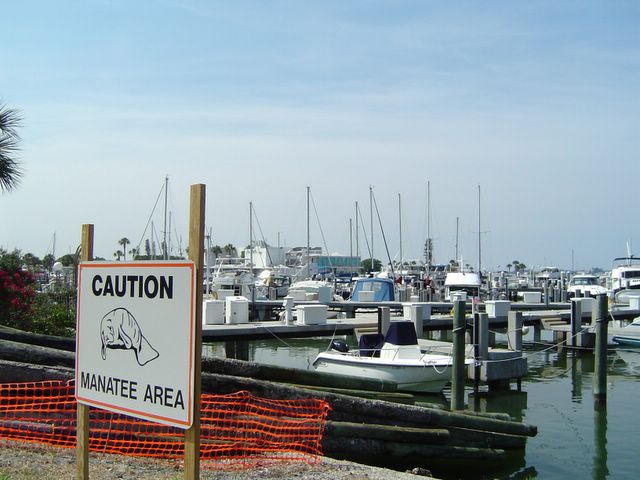
Wednesday, June 01, 2005
The Good Old Days - But How Did We Get to Here?
Charlie Huisking wrote a terrific article in the SHT Sunday about Jeff LaHurd, a Sarasota author and historian who grew up here in the 50's - and hasn’t left yet.
Jeff has just written new book, "Gulf Coast Chronicles: Remembering Sarasota’s Past." Huisking says this book "is an elegy for a Sarasota that no longer exists - a small, uncrowded but sophisticated town with undeveloped offshore islands, distinctive architecture and a character all its own."
LaHurd says in the introduction that Sarasota was not like it is today, "the community had a sense of its identity. We were unique - and we knew it."
The article describes LaHurd’s memories of Sarasota’s past - fishing from the pier at the foot of Main St, living in a small town that had great beaches, a superb Museum, circus winter quarters, an active artist and writer’s colony and major league spring training baseball.
A friend of mine also grew up in Sarasota in the 50's. His recollections and comments:
"Looking around today, it’s tough to be an old timer here, after having the run of Sarasota from the time I was 7 years old. Swamping a boat on the bay, camping and parties on Longboat Key or South Lido. Shucking oysters and eating them during November in Little Sarasota Bay. Watching huge herds of colorful Fiddler Crabs on the bay beaches, or huge flocks of birds flying east to their rookeries in the evening. Life was great.Now, you had better not eat the oysters, the King Mackerel, the large Grouper, Snapper, or any other large fish, because of the high levels of mercury. There are no fiddler crabs, and if you see a few wading birds flying, you are very lucky. There is less of everything in nature including trees. All within my lifetime. It is hard to believe."
Time has not treated Sarasota well. True, many have discovered the pleasures of living here, and that fact continues to stress our small town. We all know that growth puts great pressure on the resources in a community and no community can resist these forces forever. Sarasota has seen such tremendous growth in the last few years that it is overwhelming most people's sensibilities.
A quote from LaHurd puts our growth in perspective:
"Growth was inevitable. But it didn’t have to be unbridled growth. And our leaders should have found ways to protect our landmarks.
You know, I talk to a lot of visitors who have returned to Sarasota after being away for many years. I’ve never heard anyone say, "Wow, we really love what you’ve done with the place.’"
Our sentiment exactly!
Jeff has just written new book, "Gulf Coast Chronicles: Remembering Sarasota’s Past." Huisking says this book "is an elegy for a Sarasota that no longer exists - a small, uncrowded but sophisticated town with undeveloped offshore islands, distinctive architecture and a character all its own."
LaHurd says in the introduction that Sarasota was not like it is today, "the community had a sense of its identity. We were unique - and we knew it."
The article describes LaHurd’s memories of Sarasota’s past - fishing from the pier at the foot of Main St, living in a small town that had great beaches, a superb Museum, circus winter quarters, an active artist and writer’s colony and major league spring training baseball.
A friend of mine also grew up in Sarasota in the 50's. His recollections and comments:
"Looking around today, it’s tough to be an old timer here, after having the run of Sarasota from the time I was 7 years old. Swamping a boat on the bay, camping and parties on Longboat Key or South Lido. Shucking oysters and eating them during November in Little Sarasota Bay. Watching huge herds of colorful Fiddler Crabs on the bay beaches, or huge flocks of birds flying east to their rookeries in the evening. Life was great.Now, you had better not eat the oysters, the King Mackerel, the large Grouper, Snapper, or any other large fish, because of the high levels of mercury. There are no fiddler crabs, and if you see a few wading birds flying, you are very lucky. There is less of everything in nature including trees. All within my lifetime. It is hard to believe."
Time has not treated Sarasota well. True, many have discovered the pleasures of living here, and that fact continues to stress our small town. We all know that growth puts great pressure on the resources in a community and no community can resist these forces forever. Sarasota has seen such tremendous growth in the last few years that it is overwhelming most people's sensibilities.
A quote from LaHurd puts our growth in perspective:
"Growth was inevitable. But it didn’t have to be unbridled growth. And our leaders should have found ways to protect our landmarks.
You know, I talk to a lot of visitors who have returned to Sarasota after being away for many years. I’ve never heard anyone say, "Wow, we really love what you’ve done with the place.’"
Our sentiment exactly!
Tuesday, May 31, 2005
Public Benefit from TIF?
The recent column by Rod Thomson in the Sarasota Herald Tribune makes a clear case for questioning the give-aways city officials seem to think are required to lure developers to downtown Sarasota. This is something we have been questioning also.
What benefit does the public get by giving $9M for public parking to a developer who wants to build here no matter what? Yes, we know the spin that the developer will use: I need this funding to make my project pay, otherwise I can’t do it. And some of our officials will buy into this pitch.
That’s what happens when there is a limited vision for downtown - so far our vision includes more parking, a walkable and lively downtown and mixed use. We have also put limits on building height and design parameters. So as long as a developer promises to fit this limited vision he is free to pitch pretty pictures and should expect at least a majority of commissioners to buy into the concept. Our limited vision is an easy one to buy into.
We don’t have a plan or strategy on how to get there. We talk about public/private partnerships and investment in needed development. But how do we measure the result? What is the target?
What about affordable housing, diversity of residents, traffic patterns for getting to the parking garage, public spaces for lively activity, more businesses downtown, easy access to the bayfront, transportation (other than the car) that people will want to use, more green space in downtown? What is the relationship between the Quay site and downtown - how will this work? There are many issues that face us and it seems there is little effort at defining the issues and moving toward a consolidated vision of where we want to go. With a limited vision it is easy to acquiesce to the first request for dollars. Meanwhile our downtown continues its march toward a place where the wealthy visit for a few months during the year.
Thomson pointedly indicates that developers on the fringes of Sarasota will be paying for the increased strain they put on the infrastructure - mainly road improvement - as a cost of locating at a highly desirable spot. Downtown should do the same.
In a recent Argus Foundation Newsletter opposing the use of TIF funds (for fees, utility construction, landscaping) at the 1350 Main project, they indicated:
"the tax increment finance district was established to fund projects in the downtown that create true public benefit like parking, sidewalks, streetscapes, true "utility relocations," etc. If we approve, or encourage, this kind of public subsidy (i.e., for what 1350 Main wanted) we will have no money left from the tax increment to pay for the projects that are creating the public space of a vibrant downtown. "
We likewise believe that the best use of TIF funds is for required and necessary infrastructure improvements that will benefit all of downtown, public space that adds to the vibrancy of downtown, and parking if necessary (it should also benefit all of downtown).
We need to look at the long term for downtown - how do we insure a lively and livable downtown for the entire year and for many years. We need a long term vision of what makes a livable and lively downtown. Then we need a strategy to accomplish this and that will guide our decision makers as they review projects worthy of TIF funds. If developers are intent on cashing in on the wildly popular Downtown Sarasota Show (Thomson uses the term "event") let them pay for what they need. If they need a street vacation, what will they contribute to the public good? If they require parking, what benefit does the public receive for the $9M they want?
Oh yes, let’s not forget tough negotiating in the sunshine!
What benefit does the public get by giving $9M for public parking to a developer who wants to build here no matter what? Yes, we know the spin that the developer will use: I need this funding to make my project pay, otherwise I can’t do it. And some of our officials will buy into this pitch.
That’s what happens when there is a limited vision for downtown - so far our vision includes more parking, a walkable and lively downtown and mixed use. We have also put limits on building height and design parameters. So as long as a developer promises to fit this limited vision he is free to pitch pretty pictures and should expect at least a majority of commissioners to buy into the concept. Our limited vision is an easy one to buy into.
We don’t have a plan or strategy on how to get there. We talk about public/private partnerships and investment in needed development. But how do we measure the result? What is the target?
What about affordable housing, diversity of residents, traffic patterns for getting to the parking garage, public spaces for lively activity, more businesses downtown, easy access to the bayfront, transportation (other than the car) that people will want to use, more green space in downtown? What is the relationship between the Quay site and downtown - how will this work? There are many issues that face us and it seems there is little effort at defining the issues and moving toward a consolidated vision of where we want to go. With a limited vision it is easy to acquiesce to the first request for dollars. Meanwhile our downtown continues its march toward a place where the wealthy visit for a few months during the year.
Thomson pointedly indicates that developers on the fringes of Sarasota will be paying for the increased strain they put on the infrastructure - mainly road improvement - as a cost of locating at a highly desirable spot. Downtown should do the same.
In a recent Argus Foundation Newsletter opposing the use of TIF funds (for fees, utility construction, landscaping) at the 1350 Main project, they indicated:
"the tax increment finance district was established to fund projects in the downtown that create true public benefit like parking, sidewalks, streetscapes, true "utility relocations," etc. If we approve, or encourage, this kind of public subsidy (i.e., for what 1350 Main wanted) we will have no money left from the tax increment to pay for the projects that are creating the public space of a vibrant downtown. "
We likewise believe that the best use of TIF funds is for required and necessary infrastructure improvements that will benefit all of downtown, public space that adds to the vibrancy of downtown, and parking if necessary (it should also benefit all of downtown).
We need to look at the long term for downtown - how do we insure a lively and livable downtown for the entire year and for many years. We need a long term vision of what makes a livable and lively downtown. Then we need a strategy to accomplish this and that will guide our decision makers as they review projects worthy of TIF funds. If developers are intent on cashing in on the wildly popular Downtown Sarasota Show (Thomson uses the term "event") let them pay for what they need. If they need a street vacation, what will they contribute to the public good? If they require parking, what benefit does the public receive for the $9M they want?
Oh yes, let’s not forget tough negotiating in the sunshine!
Sunday, May 29, 2005
Is Sarasota Becoming "Sky Box" City?
"Are we turning our cities into theme parks for the very rich?" That’s the question posed in an article by Beth Dunlop in the Miami Herald (you may have to register to view the article, but it is painless and well worth it).
In talking about the transformation of Miami to a city of luxury hi-rise condos, she notes that we are pricing out the people that make the city a vibrant lively place where people want to go. A topic we have talked about here on several occasions. The authors, artists, teachers, shopkeepers, social workers, public servants are all being priced out. And it is not just Miami; Sarasota is going down this same road.
Dunlop notes "A real city is filled with people of all incomes and interests, who spend their money in local stores and restaurants run by other local people, and their time out walking on the streets and playing in public parks, sitting in cafes, browsing and window-shopping, strolling and stopping -- after work, after school, after church or temple, before a movie, a play, a concert. That, more than mere commerce, is the time-tested engine that drives urbanism."
She suggests we may be building a "skybox" city - the urban equivalent of the pricey hangouts at stadiums around the country. Are the condos we are building just sky boxes for the wealthy when they want to see the Sarasota Show (the season)?
Sarasota’s downtown master plan is supposed to give us a lively, walkable downtown that meets the needs of the residents without requiring car trips. Is the current building frenzy with its targeted luxury market going to lead us to this vision? When I read articles like this one by Dunlop, I see Sarasota’s likeness embedded in the words. We are heading towards Miami, "skybox" city, built for the wealthy part time visitors, lured here by the adult theme park vision of upscale shopping, fair weather and a very busy social scene.
What happens when we lose the diversity, the shopkeepers go to Bradenton where they can afford to have a small business and live close by? Or when professors, public servants and teachers go to other towns where they can afford to live?
These are troubling questions. Our city leaders need to take a step back and look at what is happening to Sarasota. We need to find a new road to travel on, moving us toward a different vision.
In talking about the transformation of Miami to a city of luxury hi-rise condos, she notes that we are pricing out the people that make the city a vibrant lively place where people want to go. A topic we have talked about here on several occasions. The authors, artists, teachers, shopkeepers, social workers, public servants are all being priced out. And it is not just Miami; Sarasota is going down this same road.
Dunlop notes "A real city is filled with people of all incomes and interests, who spend their money in local stores and restaurants run by other local people, and their time out walking on the streets and playing in public parks, sitting in cafes, browsing and window-shopping, strolling and stopping -- after work, after school, after church or temple, before a movie, a play, a concert. That, more than mere commerce, is the time-tested engine that drives urbanism."
She suggests we may be building a "skybox" city - the urban equivalent of the pricey hangouts at stadiums around the country. Are the condos we are building just sky boxes for the wealthy when they want to see the Sarasota Show (the season)?
Sarasota’s downtown master plan is supposed to give us a lively, walkable downtown that meets the needs of the residents without requiring car trips. Is the current building frenzy with its targeted luxury market going to lead us to this vision? When I read articles like this one by Dunlop, I see Sarasota’s likeness embedded in the words. We are heading towards Miami, "skybox" city, built for the wealthy part time visitors, lured here by the adult theme park vision of upscale shopping, fair weather and a very busy social scene.
What happens when we lose the diversity, the shopkeepers go to Bradenton where they can afford to have a small business and live close by? Or when professors, public servants and teachers go to other towns where they can afford to live?
These are troubling questions. Our city leaders need to take a step back and look at what is happening to Sarasota. We need to find a new road to travel on, moving us toward a different vision.
Thursday, May 26, 2005
A Little Ranting
Those of you that have been following this blog know that one of the issues we have pursued is the give away of public space (downtown) in the form of space above the sidewalk if the developer includes an arcade. See the March 13 blog entry for a graphic and description of arcades.
Apparently what happened is that the Duany Master Plan showed stepbacks of 12' required at the 4th floor level. This was to prevent the canyon effect that 10 story buildings will have when the front facade is at the sidewalk property line.
Well, the property owners and developers objected, saying this was taking their property rights. So a suit was threatened and a "secret" negotiation meeting was held with the city manager and the developer/owners. The result was that a new incentive was included in the code: the developer could keep his vertical space at the property line and the city would give the developers the air space above an arcade. This space will be habitable space that the developer can sell.
What a deal. Now we have a step forward instead of a step back. The canyon is still there but it will be narrower at street level. I’m sure the developers/owners are smiling all the way to the bank and the residents of Sarasota will be frowning on their real narrow streets downtown. No sunshine on Main Street and no sunshine when negotiating.
A simple calculation shows that the value of this give away could be $15M (yes million) for each of the first 3 blocks on Main - if arcades were built along both sides and an estimated $400/sq ft value (very conservative in today’s market) is used.
When we ask planners all over Florida about giving away air space above the sidewalk they are astounded when they hear this tale. We were told early on by our planners that West Palm was the model and pretty pictures of arcades in West Palm were shown in the recommendation for arcades with habitable space. The only problem is that West Palm’s arcades are on private property and no give away was required. In Sarasota we apparently have to have a new model to entice developers to come to our city.
The new building at 1350 Main (across from Sarasota News and Books) will show us what our future may look like. This building will have four floors of habitable space above the sidewalk - given as an incentive to include smaller units (not affordable, just smaller) with their increased density request.
Apparently what happened is that the Duany Master Plan showed stepbacks of 12' required at the 4th floor level. This was to prevent the canyon effect that 10 story buildings will have when the front facade is at the sidewalk property line.
Well, the property owners and developers objected, saying this was taking their property rights. So a suit was threatened and a "secret" negotiation meeting was held with the city manager and the developer/owners. The result was that a new incentive was included in the code: the developer could keep his vertical space at the property line and the city would give the developers the air space above an arcade. This space will be habitable space that the developer can sell.
What a deal. Now we have a step forward instead of a step back. The canyon is still there but it will be narrower at street level. I’m sure the developers/owners are smiling all the way to the bank and the residents of Sarasota will be frowning on their real narrow streets downtown. No sunshine on Main Street and no sunshine when negotiating.
A simple calculation shows that the value of this give away could be $15M (yes million) for each of the first 3 blocks on Main - if arcades were built along both sides and an estimated $400/sq ft value (very conservative in today’s market) is used.
When we ask planners all over Florida about giving away air space above the sidewalk they are astounded when they hear this tale. We were told early on by our planners that West Palm was the model and pretty pictures of arcades in West Palm were shown in the recommendation for arcades with habitable space. The only problem is that West Palm’s arcades are on private property and no give away was required. In Sarasota we apparently have to have a new model to entice developers to come to our city.
The new building at 1350 Main (across from Sarasota News and Books) will show us what our future may look like. This building will have four floors of habitable space above the sidewalk - given as an incentive to include smaller units (not affordable, just smaller) with their increased density request.
Downtown Visioning
We see that the Downtown Partnership is starting a process to clarify their vision for downtown Sarasota. Recently they held a meeting entitled "Enough of the Plan … We Need a Vision.". An on-going series of discussions will include Community Redevelopment/ TIF funds, Parking/ Transportation, Workforce Housing, Retail, and Downtown Architecture.
This is encouraging. Save Our Sarasota encourages community discussion of the issues that face Sarasota. Too often developers sell their projects to Commissioners in a vacuum. There is no community vision against which the proposal can be measured.
True we have a "downtown plan" that identifies "downtown" and what kinds of buildings and uses are allowed in there. It generally follows the principles of "New Urbanism" so that it is pedestrian friendly. However, there is no big picture vision of how everything fits together or even what the citizens of Sarasota want their city to become.
Currently a pitch is being made for a large, high end, retail complex that would change a significant portion of downtown. Our City Commissioners are being pushed to approve the proposal and there is no vision for Sarasota that we can measure this proposal against. For now it is only the developer's ability to market his plan - "make the sale", if you will - to the Commissioners that will determine whether this goes forward. So far at least one Commissioner has been sold on the concept.
We would like to point out some excellent concepts for growth management (are we managing our downtown growth or is it wildly out of control?). As articulated by the organization, 1000 Friends of Florida, planning begins with a citizen based vision. A portion of their comments are given here:
Encouraging vision-based planning, starting at the neighborhood level.
Adequate, directed funding is crucial for effective growth management. Equally important is determining how a community wants to grow. Citizen-based neighborhood planning should be the foundation of a community's comprehensive planning process. Neighbors (citizens representing a mix of residential, school, civic, office and commercial areas in geographic proximity) gathering together with local planning staff can evaluate current development policies and recommend alternative growth scenarios.
Local governments should build on this neighborhood process when creating community-wide visioning strategies. The collaborative process of visioning should be consensus-driven and articulate the desired future of the community. Policy statements on the quality of life and graphic representation of the community's physical form and land use patterns should have the support of the public and politicians.
To ensure accountability, the vision document recommendations should be incorporated into the comprehensive plan, land development regulations and capital expenditures. It also should clearly define the steps for implementation. Additionally, the document should explain why, how, and when amendments to the community's plans are sought. Above all, it must provide for accountability so that measurable implementation is achieved.
To promote vision-based planning, it is essential to:
Support and fund local governments to create vision plans at the neighborhood and community levels.
Provide additional funds, and additional funding alternatives and incentives, for local governments to use in implementing their plans.
We support the Downtown Partnership in their process to begin discussions on the vision for downtown.
This is encouraging. Save Our Sarasota encourages community discussion of the issues that face Sarasota. Too often developers sell their projects to Commissioners in a vacuum. There is no community vision against which the proposal can be measured.
True we have a "downtown plan" that identifies "downtown" and what kinds of buildings and uses are allowed in there. It generally follows the principles of "New Urbanism" so that it is pedestrian friendly. However, there is no big picture vision of how everything fits together or even what the citizens of Sarasota want their city to become.
Currently a pitch is being made for a large, high end, retail complex that would change a significant portion of downtown. Our City Commissioners are being pushed to approve the proposal and there is no vision for Sarasota that we can measure this proposal against. For now it is only the developer's ability to market his plan - "make the sale", if you will - to the Commissioners that will determine whether this goes forward. So far at least one Commissioner has been sold on the concept.
We would like to point out some excellent concepts for growth management (are we managing our downtown growth or is it wildly out of control?). As articulated by the organization, 1000 Friends of Florida, planning begins with a citizen based vision. A portion of their comments are given here:
Encouraging vision-based planning, starting at the neighborhood level.
Adequate, directed funding is crucial for effective growth management. Equally important is determining how a community wants to grow. Citizen-based neighborhood planning should be the foundation of a community's comprehensive planning process. Neighbors (citizens representing a mix of residential, school, civic, office and commercial areas in geographic proximity) gathering together with local planning staff can evaluate current development policies and recommend alternative growth scenarios.
Local governments should build on this neighborhood process when creating community-wide visioning strategies. The collaborative process of visioning should be consensus-driven and articulate the desired future of the community. Policy statements on the quality of life and graphic representation of the community's physical form and land use patterns should have the support of the public and politicians.
To ensure accountability, the vision document recommendations should be incorporated into the comprehensive plan, land development regulations and capital expenditures. It also should clearly define the steps for implementation. Additionally, the document should explain why, how, and when amendments to the community's plans are sought. Above all, it must provide for accountability so that measurable implementation is achieved.
To promote vision-based planning, it is essential to:
Support and fund local governments to create vision plans at the neighborhood and community levels.
Provide additional funds, and additional funding alternatives and incentives, for local governments to use in implementing their plans.
We support the Downtown Partnership in their process to begin discussions on the vision for downtown.
Wednesday, May 25, 2005
Hyping Sarasota
Our Mayor is touting the benefits of the City of Sarasota to the retail development community at their big trade show this week in Las Vegas.
While it is nice to see the Mayor excited about Sarasota, we sure hope she and all the commissioners are open to citizen input concerning the new Pineapple Square project. Fast tracking this project in order to help one developer beat the competition may not be in the best interest of Sarasota.
What do we really know about the effect of this on our downtown and our community? We have lots of questions and we are sure that other individuals and organizations have questions. Things like the effect on other downtown businesses, traffic increases and traffic patterns, scale of the buildings, parking for workers as well as customers, does the requested TIF make sense, is it needed, does Sarasota need this much parking concentrated in one small area, will this magnify the seasonality issues we face as a resort destination?
Our commissioners need to start a process of involving the residents in the decision concerning whether to move forward with this proposal and if so, how fast. It seems like the newspaper favors the proposal (a recent editorial suggests parallel fast tracking for evaluating the PSQ proposal as well as an RFP for the State St parking lot) and we know the Mayor is gung-ho. We would have expected a more neutral response and analysis of whether the community really wants this large development and how our quality of life will change as a result of it.
We believe the recent commissioner elections made a call for change in our downtown building boom. We don’t think the change called for was a speed up of development or as the Manager of the Isaac Group put it - you haven’t seen anything yet!
How about less hype and more realistic thinking.
While it is nice to see the Mayor excited about Sarasota, we sure hope she and all the commissioners are open to citizen input concerning the new Pineapple Square project. Fast tracking this project in order to help one developer beat the competition may not be in the best interest of Sarasota.
What do we really know about the effect of this on our downtown and our community? We have lots of questions and we are sure that other individuals and organizations have questions. Things like the effect on other downtown businesses, traffic increases and traffic patterns, scale of the buildings, parking for workers as well as customers, does the requested TIF make sense, is it needed, does Sarasota need this much parking concentrated in one small area, will this magnify the seasonality issues we face as a resort destination?
Our commissioners need to start a process of involving the residents in the decision concerning whether to move forward with this proposal and if so, how fast. It seems like the newspaper favors the proposal (a recent editorial suggests parallel fast tracking for evaluating the PSQ proposal as well as an RFP for the State St parking lot) and we know the Mayor is gung-ho. We would have expected a more neutral response and analysis of whether the community really wants this large development and how our quality of life will change as a result of it.
We believe the recent commissioner elections made a call for change in our downtown building boom. We don’t think the change called for was a speed up of development or as the Manager of the Isaac Group put it - you haven’t seen anything yet!
How about less hype and more realistic thinking.
Monday, May 23, 2005

Saving Some of Sarasota’s Past
Sarasota has had some wins and some losses when it comes to saving part of what is uniquely Sarasota.
Currently Tampa is struggling with saving the Belleview Biltmore - a site listed on the National Register of Historic Places.
Here we wonder about the fate of the Belle Haven. If it is saved, but moved, what will it look like and where will it be? Could it end up being jacked up on stilts above parking somewhere?
The newly announced Pineapple Square will undoubtedly result in changes to our downtown. Changes in scale, buildings, traffic patterns, light and air and many other aspects of downtown as we now know it.
Sarasota has two historic buildings - the Waterworks Building and the Times Buiding ( downtown) - that are in need of adaptive re-use. These unique buildings offer a great spaces that are in scale with the surrounding environment and keep important links to our past.
On the other hand we have recently lost the historic John Ringling Towers and the Bickel home which were located in downtown.
A city’s downtown is not just a place for commerce, it needs a wide variety of activities for many kinds of people. Sarasota’s downtown has changed and is continuing to change. Building residences downtown is a good idea - more people living downtown will bring diversity and enliven the area. However we continue to wonder how many people will actually live downtown (are speculators driving prices too high for year round residents?). Will our new downtown give us diversity and add to the unique character we have or will we be just another "anywhere, USA" with the same chain retailers we see everywhere.
The picture above shows Lillian Burns (daughter of Owen Burns - builder of this hotel) standing in the John Ringling Towers shortly before it was taken down. When you see the pretty renderings of our bright new world given to us by the developers, think about the reality of losing what is uniquely Sarasota. What will Sarasota become if we lose our past?
(Note: this picture was published in the Jan 2001 Issue of Sarasota Magazine. It was taken by photographer J.B. McCourtney and accompanied an article by Susan Burns).
Currently Tampa is struggling with saving the Belleview Biltmore - a site listed on the National Register of Historic Places.
Here we wonder about the fate of the Belle Haven. If it is saved, but moved, what will it look like and where will it be? Could it end up being jacked up on stilts above parking somewhere?
The newly announced Pineapple Square will undoubtedly result in changes to our downtown. Changes in scale, buildings, traffic patterns, light and air and many other aspects of downtown as we now know it.
Sarasota has two historic buildings - the Waterworks Building and the Times Buiding ( downtown) - that are in need of adaptive re-use. These unique buildings offer a great spaces that are in scale with the surrounding environment and keep important links to our past.
On the other hand we have recently lost the historic John Ringling Towers and the Bickel home which were located in downtown.
A city’s downtown is not just a place for commerce, it needs a wide variety of activities for many kinds of people. Sarasota’s downtown has changed and is continuing to change. Building residences downtown is a good idea - more people living downtown will bring diversity and enliven the area. However we continue to wonder how many people will actually live downtown (are speculators driving prices too high for year round residents?). Will our new downtown give us diversity and add to the unique character we have or will we be just another "anywhere, USA" with the same chain retailers we see everywhere.
The picture above shows Lillian Burns (daughter of Owen Burns - builder of this hotel) standing in the John Ringling Towers shortly before it was taken down. When you see the pretty renderings of our bright new world given to us by the developers, think about the reality of losing what is uniquely Sarasota. What will Sarasota become if we lose our past?
(Note: this picture was published in the Jan 2001 Issue of Sarasota Magazine. It was taken by photographer J.B. McCourtney and accompanied an article by Susan Burns).
Sunday, May 22, 2005
How Are We Doing?
I thought would reprint one of our first Save Our Sarasota™ blog entries (Mar 15, 2005) and ask readers to comment about how we are doing. While writing about issues doesn't necessarily result in an action, it does sensitize people to a view point that may be unknown or be opposite to your own view, or maybe even correlate with your thinking. Thinking about and discussing issues is the best way to find a common direction for all of us.
Please leave a comment - just click on the comment line at the bottom of this post and type in your view. Thanks!
___________________________
From March 15, 2005:
Our mission is to be a constructive and positive voice for the preservation and enhancement of Sarasota. Our goals are to preserve, enhance, and promote:
Please leave a comment - just click on the comment line at the bottom of this post and type in your view. Thanks!
___________________________
From March 15, 2005:
Our mission is to be a constructive and positive voice for the preservation and enhancement of Sarasota. Our goals are to preserve, enhance, and promote:
- Sarasota's uniqueness
- Sarasota's ecological, cultural, and historic legacies and distinguished institutions
- Urbanization that respects pedestrian scale and activities
- Ecologically sensitive urban design
- Economically responsible urban development
- Integrity of public management
- Current and new passive and active public places for human enjoyment, responsive to local characteristics (climate, vegetation, landscape, marinescape)
- Affordable housing and necessary support amenities
- Locally owned businesses and affordable commercial space
- New businesses that respond to Sarasota's uniqueness and priorities.
"Never doubt that a small group of thoughtful, committed citizens can change the world. Indeed, it is the only thing that ever has."
Margaret Mead, American Anthropoligist (1901-1978)
Friday, May 20, 2005
The Architect's in the Mail
Check Harold Bubil’s Blog for May 17 (link on the right side). He indicates a new postage stamp series is honoring architects. Included is Paul Rudolph, of "Sarasota School Of Architecture" fame, who started his career right here in our fair city with the small town feel and urban amenities.
You can buy the stamps now. Go to this web site to see the stamps with a link to the buildings they honor.
You can buy the stamps now. Go to this web site to see the stamps with a link to the buildings they honor.
Thursday, May 19, 2005
Try a Little Preservation
May is Historic Preservation month.
Ever wonder what you might do? Here are a couple ideas - courtesy of the National Trust and Sarasota’s local Historic Preservation organizations.
Ever wonder what you might do? Here are a couple ideas - courtesy of the National Trust and Sarasota’s local Historic Preservation organizations.
- Explore places where you and your family grew up. A town, a school, a church or some other place important in your personal history. Take a little time to re-connect to your past.
- Take a walk or bike ride through your neighborhood or some other part of Sarasota (Laurel Park is a great place but all neighborhoods are great for a walk with a view). It is amazing what you see when you slow down. Walk through the Rosemary Cemetery and read the names and dates on the headstones. Think about life back then.
- Shop on Main Street (and Palm and the side streets too). You will find many unique, local shops. These are owned and managed by local people that love their businesses. Say hello and chat a little with them. Take a look at the building architecture. Check out the historic Sarasota postcard reproductions displayed at Kennedy Studios (1472 Main).
- Read a few books about Sarasota history. You can find them at bookstores (Sarasota News and Books is a good place to start), the library or the Sarasota History Center by the Visitor Center on the Trail.
- Take in a movie at Burns Court - an historic movie theater.
- Visit some of the older churches in Sarasota; First Presbyterian is 98 years old or maybe visit St Martha’s, it has a long history.
- Check out the pictures at the County history web site
- Consider joining one of Sarasota’s historic preservation organizations like the Sarasota Alliance for Historic Preservation or the Historical Society of Sarasota County. They have great newsletters and very interesting meetings.
Take some time to immerse yourself in a little personal or local history. You will find it interesting and enjoyable. The people you will meet along the way are guaranteed to be wonderful!
Wednesday, May 18, 2005
Looking at Pineapple Square
After a day to think about the Pineapple Square development announcement, some of the questions that come to mind:
- What value does Sarasota receive for vacating a portion of State St.?
- Does this development require the city to give public air space above the sidewalks, if so what is the value of this?
- The developer is asking for $9M in TIF dollars for 600 parking spaces (appears to be the same $15K per space we keep seeing), this is on top of getting free land from the city. What is the value of all this?
- How will the use of TIF funds here affect our ability to use these dollars to fund the Newtown Redevelopment project?
- The Isaac Group indicates that time is of the essence, that competition for the same major retailers is keen and Sarasota has to act fast to be successful. Of course "success" is defined as a unique downtown shopping area unlike anything else in the country and would put Sarasota on the map as a major retail destination. Is this everyone’s vision of success for Sarasota?
- We hope time is available for stakeholder input and community discussion and decision making.
On a related subject, today’s CoolTown website has an interesting discussion relating job creation to fast growing businesses. This is linked to data on the top 25 women business builders and where they choose to live. The communities they live in all have a high "creative class index" (think Richard Florida), low cost of doing business and lots of affordable housing. They conclude with this statement: " Keep that in mind the next time you hear city leaders claim that investing in swanky stores and luxury apartments will be good for your city's economy in the long run"
Yesterday's topic at this same site featured Bradenton's new subsidized housing development.
Tuesday, May 17, 2005
Extreme Makeover in Store for Downtown?
Today the Isaac Group unveiled their plans for the make over of downtown Sarasota’s retail face. The plan includes 30 to 40 new retail shops at ground level, a 600 space public parking garage, additional 400 private parking spaces and 210 new residences. A total of 130K ft² new retail space is proposed.
One of the pictures below shows the frontage on Pineapple - interesting touch to include the First United Methodist Church in the picture. The developer indicates they need to move forward with plans now and while purchasing the church property is not required, they are still negotiating. Our understanding is that the church membership vote, on whether to sell, is scheduled for August.
Also shown is the footprint of the project, located primarily south of Main but also extending to both sides of Lemon, north and south of Main. The red colored area is the property owned or controlled by the Isaac group.
The unveiling was held at the Ritz Tuesday evening, with many members of the business community attending. Mayor Mary Anne Servian also attended and spoke briefly but very enthusiastically about the project.
According to the literature provided, the project includes a "large central pedestrian breezeway, the width of a street and thirty feet tall". It will have retail frontage and connect Pineapple and Lemon (at State). While the buildings are mostly proposed to be ten stories, they will be stepped back above the first couple of floors. Some arcades may be included and two urban plazas will be featured. It was indicated that all development would conform to the new downtown code.
Plans include targeted 60/40 percent mix of national chain to local/regional stores. This will include 80% fashion/soft goods and 20% dining/entertainment.
Apparently the national retail/developer trade show is coming up next week. This is where all the developers showcase their plans and hope to get commitments from the retailers. Competition is expected to be fierce in the Sarasota area with new major retail developments proposed for Lakewood Ranch, University and I-75 and a rumored Fruitville and I-75 project.
The plans were impressive and the use of the "dead area", south of the Main storefronts to increase pedestrian circulation throughout this part of downtown is an excellent concept. While the project is in very early stages the concepts and building step backs are encouraging. This will keep the open atmosphere and allow light and air to permeate the space.
Save Our Sarasota will be closely following the development of this project. Initial discussion with John Simons, who will be managing this project, were open and encouraging.
More information at their web site.
One of the pictures below shows the frontage on Pineapple - interesting touch to include the First United Methodist Church in the picture. The developer indicates they need to move forward with plans now and while purchasing the church property is not required, they are still negotiating. Our understanding is that the church membership vote, on whether to sell, is scheduled for August.
Also shown is the footprint of the project, located primarily south of Main but also extending to both sides of Lemon, north and south of Main. The red colored area is the property owned or controlled by the Isaac group.
The unveiling was held at the Ritz Tuesday evening, with many members of the business community attending. Mayor Mary Anne Servian also attended and spoke briefly but very enthusiastically about the project.
According to the literature provided, the project includes a "large central pedestrian breezeway, the width of a street and thirty feet tall". It will have retail frontage and connect Pineapple and Lemon (at State). While the buildings are mostly proposed to be ten stories, they will be stepped back above the first couple of floors. Some arcades may be included and two urban plazas will be featured. It was indicated that all development would conform to the new downtown code.
Plans include targeted 60/40 percent mix of national chain to local/regional stores. This will include 80% fashion/soft goods and 20% dining/entertainment.
Apparently the national retail/developer trade show is coming up next week. This is where all the developers showcase their plans and hope to get commitments from the retailers. Competition is expected to be fierce in the Sarasota area with new major retail developments proposed for Lakewood Ranch, University and I-75 and a rumored Fruitville and I-75 project.
The plans were impressive and the use of the "dead area", south of the Main storefronts to increase pedestrian circulation throughout this part of downtown is an excellent concept. While the project is in very early stages the concepts and building step backs are encouraging. This will keep the open atmosphere and allow light and air to permeate the space.
Save Our Sarasota will be closely following the development of this project. Initial discussion with John Simons, who will be managing this project, were open and encouraging.
More information at their web site.
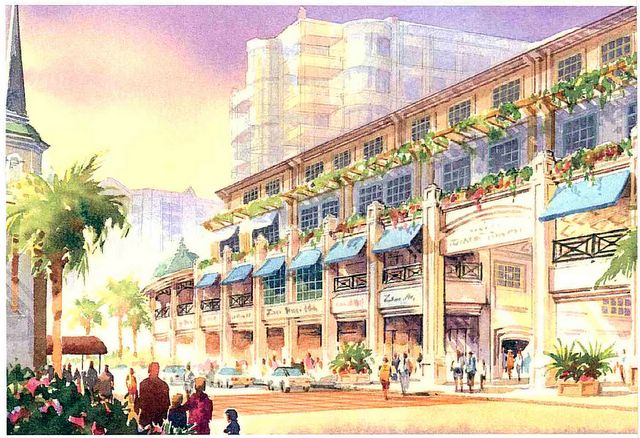

Monday, May 16, 2005
A Vibrant Downtown
In an article published in the Washington Post, architect Roger K Lewis comments about things that make downtowns vibrant. He says "downtowns, traditional or otherwise, do not succeed simply by virtue of higher density or improved street networks. Higher densities, rational street-block patterns and enhanced mobility are necessary but not sufficient."
Diversity is a critical element. Diversity of people, places, options.
"Vibrant downtowns also promote and sustain diverse tenants and uses. They are places where ... people can find jobs, housing choices, shopping, culture, entertainment and transportation. Even ample, pedestrian-friendly sidewalks don't make downtowns truly viable without a critical mass of attractive activities, amenities and infrastructure."
"Nevertheless, much of the charm of traditional downtowns is attributable to the aesthetic quality of the public realm: well-landscaped, properly proportioned plazas and urban parks; tree-lined, well-lighted streets and sidewalks; and pedestrian-level storefronts that enliven the streetscape. Make walking pleasant, and people will choose to walk instead of drive.
In making places desirably urban, the right mix of uses and good streetscape design can be more important than pumping up density. Look at Georgetown, Alexandria and the Bethesda Row area of Bethesda.".
We believe he is absolutely right. To make Sarasota’s downtown vibrant - which is everyone’s goal - we need diversity; diversity in the many elements that make up our downtown.
So far we have approved a number of mixed use developments, a grocery store and are in the process of adding parking. There's nothing wrong with this. The big problem is that the residential units are so pricey that few year-round residents live there. And most of those that do live downtown are retired (many moved over from Longboat). While these are great people it’s not a diverse mixture of young and old, workers and managers, thinkers and doers, etc. We have little room for entertainment, no affordable housing, no plan to attract business and to top it off we are making a canyon out of main Street.
How about some streetscape, plazas, urban park areas, shade tree lined streets (not mono-culture Hi-Rise Oaks to match the hi-rise condos)? Let’s make our downtown truly walkable. A place where people want to walk around. Let’s inject a strong dose of diversity into our downtown.
Density is not the only answer. It is a byproduct of creating a vibrant, interesting place. A unique spot with a strong sense of place. We have other great amenities: beaches, public waterfront, great cultural institutions. A vibrant downtown is also a great amenity. Our civic leaders need to take a look at what else needs to be in the mix so we achieve needed diversity and a strong, year round, vibrant downtown.
Diversity is a critical element. Diversity of people, places, options.
"Vibrant downtowns also promote and sustain diverse tenants and uses. They are places where ... people can find jobs, housing choices, shopping, culture, entertainment and transportation. Even ample, pedestrian-friendly sidewalks don't make downtowns truly viable without a critical mass of attractive activities, amenities and infrastructure."
"Nevertheless, much of the charm of traditional downtowns is attributable to the aesthetic quality of the public realm: well-landscaped, properly proportioned plazas and urban parks; tree-lined, well-lighted streets and sidewalks; and pedestrian-level storefronts that enliven the streetscape. Make walking pleasant, and people will choose to walk instead of drive.
In making places desirably urban, the right mix of uses and good streetscape design can be more important than pumping up density. Look at Georgetown, Alexandria and the Bethesda Row area of Bethesda.".
We believe he is absolutely right. To make Sarasota’s downtown vibrant - which is everyone’s goal - we need diversity; diversity in the many elements that make up our downtown.
So far we have approved a number of mixed use developments, a grocery store and are in the process of adding parking. There's nothing wrong with this. The big problem is that the residential units are so pricey that few year-round residents live there. And most of those that do live downtown are retired (many moved over from Longboat). While these are great people it’s not a diverse mixture of young and old, workers and managers, thinkers and doers, etc. We have little room for entertainment, no affordable housing, no plan to attract business and to top it off we are making a canyon out of main Street.
How about some streetscape, plazas, urban park areas, shade tree lined streets (not mono-culture Hi-Rise Oaks to match the hi-rise condos)? Let’s make our downtown truly walkable. A place where people want to walk around. Let’s inject a strong dose of diversity into our downtown.
Density is not the only answer. It is a byproduct of creating a vibrant, interesting place. A unique spot with a strong sense of place. We have other great amenities: beaches, public waterfront, great cultural institutions. A vibrant downtown is also a great amenity. Our civic leaders need to take a look at what else needs to be in the mix so we achieve needed diversity and a strong, year round, vibrant downtown.
Sunday, May 15, 2005
New Life for the Sarasota Waterworks
Last week Historic Preservation Week was celebrated in Sarasota at the Sarasota Waterworks building. A large group of preservationists toured the building, sipped some wine and heard about Sarasota’s latest efforts to preserve the best of our past.
This wonderful building has been purchased by Frank Howell (Frank Howell Construction). It has been transformed into a space that is ready to receive a new occupant yet retains its historical significance. The restoration of the building was accomplished according to the Secretary of Interior's Standards of rehabilitation. Howell’s other historic restoration projects include Don CeSar on St. Pete Beach, Key West's Casa Marina Hotel, and the old Train Depot in Venice. Obviously they know what they are doing and they do it well!
The Sarasota Waterworks was built in 1925 and is registered on the National Historic Registry. Back in 1909 Sarasota’s water needs were served by an artesian well with a set of water lines. A devastating fire in the late teens resulted in the community deciding that a "real" water system was required. A referendum was unanimously passed to fund a construct the Sarasota Waterworks. The Sarasota Waterworks thus came into being and it was here that the pumps and a distribution systems were installed to serve the growing needs of our community.
Today, the old pumps and water lines have long been replaced by modern systems at a new location. The building remains, and is an excellent, open spaced structure. Mr. Howell is looking for tenant. If you know someone interested in a great space that can be arranged to meet most any need, ask them to contact Howell Construction. They too will be delighted with this building and its future possibilities.
This wonderful building has been purchased by Frank Howell (Frank Howell Construction). It has been transformed into a space that is ready to receive a new occupant yet retains its historical significance. The restoration of the building was accomplished according to the Secretary of Interior's Standards of rehabilitation. Howell’s other historic restoration projects include Don CeSar on St. Pete Beach, Key West's Casa Marina Hotel, and the old Train Depot in Venice. Obviously they know what they are doing and they do it well!
The Sarasota Waterworks was built in 1925 and is registered on the National Historic Registry. Back in 1909 Sarasota’s water needs were served by an artesian well with a set of water lines. A devastating fire in the late teens resulted in the community deciding that a "real" water system was required. A referendum was unanimously passed to fund a construct the Sarasota Waterworks. The Sarasota Waterworks thus came into being and it was here that the pumps and a distribution systems were installed to serve the growing needs of our community.
Today, the old pumps and water lines have long been replaced by modern systems at a new location. The building remains, and is an excellent, open spaced structure. Mr. Howell is looking for tenant. If you know someone interested in a great space that can be arranged to meet most any need, ask them to contact Howell Construction. They too will be delighted with this building and its future possibilities.
Friday, May 13, 2005
Here We Go Again
Once again we are in the news, this time for being the second highest real estate market in the country when measured by how fast home prices are rising - can you believe Bradenton is first?
While speculators think this is wonderful news (and real estate agents might think likewise), the more you think about this, the more you wonder how good this trend is. A look at the CNN story about this shows that Sarasota is 17th in the country when measured by median home price. At $326K, Sarasota trails 6 CA cities, Honolulu and a handful of large metro areas.
Compare this to a study about the effect of second homes on the economy of a resort city (Vail in this case). Among other things it seems that rapidly rising home prices are changing the community and the economy. Vail is seeing the emergence of three communities:
While speculators think this is wonderful news (and real estate agents might think likewise), the more you think about this, the more you wonder how good this trend is. A look at the CNN story about this shows that Sarasota is 17th in the country when measured by median home price. At $326K, Sarasota trails 6 CA cities, Honolulu and a handful of large metro areas.
Compare this to a study about the effect of second homes on the economy of a resort city (Vail in this case). Among other things it seems that rapidly rising home prices are changing the community and the economy. Vail is seeing the emergence of three communities:
- Those that own homes
- Those that build the homes and provide service to the home owners
- Those workers that serve the tourists
The home owners are mostly part year residents, thus increasing the effect of the seasonal swing in the local economy; the resort workers are increasingly foreign workers that work only for the season; and the local people that build the homes and provide services to the home owners struggle to find places to live in the local area.
This appears to be a story similar to what is happening in Sarasota. Home prices are high and rapidly rising. Homes are only affordable to people looking for a second home. Year round residents struggle to find affordable housing (unless you were lucky enought to have bought a home years ago). We are trying to diversify our economy, but success is difficult to achieve - although hope springs eternal. The attractiveness of our resort and cultural amenities attracts people with money and a desire to live (part time?) in a great, small city. Meanwhile the speculators are happy to try their luck at profiting in a "hot" market.
Sarasota and Manatee home growth also is driven by demand from people working in the Tampa area but wanting a better place to live - smaller city, more livable. Classic bedroom community.
We need to be aware of the changes that are happening and the implications of these changes to our current lifestyle. In a period of great change, many unforeseen changes will occur. We hope our leaders and planners are up to the task of thinking about the long range implications of the decisions they make or do not make today.
Sunday, May 08, 2005
What is “Old Florida”?
Below is a vision for the new version of "old Florida", a least that is what this advertisement claims. We all know how the marketing people try to create a vision in the potential buyer’s mind, a vision of a perfect world, a perfect place and a perfect time. A vision they hope you will "buy" into, literally.
While this particular vision may suck in some northerners, after you live here a while, you get a little tense when you see these ads or the start of a new monstrous building that restricts the view for all but a few, that leaves little room for native shade, is hard and glitzy, and makes everything look Disney perfect.
Old Florida, a slower time, brings a vision of grand oaks covered with moss and lots of shade, lazy, meandering water ways, single story homes, maybe up on pillars, down towns that served residents - not three month visitors. Well, you get the picture.
Today, Florida - at least along the coast - has changed dramatically. We have seen high growth, dramatic building booms and changing requirements for homes and buildings. We have closed off the outdoors. People have an indoor lifestyle. The Sarasota School of Architecture fit modern style homes into the environment surrounding the home. Inside and outside were connected in a seamless fashion, the environment was celebrated. Old Florida had a similar kind of style - homes were in scale with the surroundings; while there was a need for cooling and shade, this was found through design elements including roof overhangs, clerestory windows and cupolas to give air circulation, as well as trees. While we cannot go back to the past, there are truths that we can hang onto, visions of what could be and of course many lessons that should be learned.
Looking at the ad that claims "Guided by a Duany Plater-Zyberk master plan, an exciting new version of "old Florida" is rising on the historic (Fort Myers) downtown waterfront", makes one wonder what will become of Florida. I doubt this vision is even distantly connected to Duany's vision, let alone "old Florida". Is this just marketing hyperbole, or is it someone’s real understanding of a brave new world?
If this is to be the new, "old Florida", it is a sad future that is in our vision.
While this particular vision may suck in some northerners, after you live here a while, you get a little tense when you see these ads or the start of a new monstrous building that restricts the view for all but a few, that leaves little room for native shade, is hard and glitzy, and makes everything look Disney perfect.
Old Florida, a slower time, brings a vision of grand oaks covered with moss and lots of shade, lazy, meandering water ways, single story homes, maybe up on pillars, down towns that served residents - not three month visitors. Well, you get the picture.
Today, Florida - at least along the coast - has changed dramatically. We have seen high growth, dramatic building booms and changing requirements for homes and buildings. We have closed off the outdoors. People have an indoor lifestyle. The Sarasota School of Architecture fit modern style homes into the environment surrounding the home. Inside and outside were connected in a seamless fashion, the environment was celebrated. Old Florida had a similar kind of style - homes were in scale with the surroundings; while there was a need for cooling and shade, this was found through design elements including roof overhangs, clerestory windows and cupolas to give air circulation, as well as trees. While we cannot go back to the past, there are truths that we can hang onto, visions of what could be and of course many lessons that should be learned.
Looking at the ad that claims "Guided by a Duany Plater-Zyberk master plan, an exciting new version of "old Florida" is rising on the historic (Fort Myers) downtown waterfront", makes one wonder what will become of Florida. I doubt this vision is even distantly connected to Duany's vision, let alone "old Florida". Is this just marketing hyperbole, or is it someone’s real understanding of a brave new world?
If this is to be the new, "old Florida", it is a sad future that is in our vision.
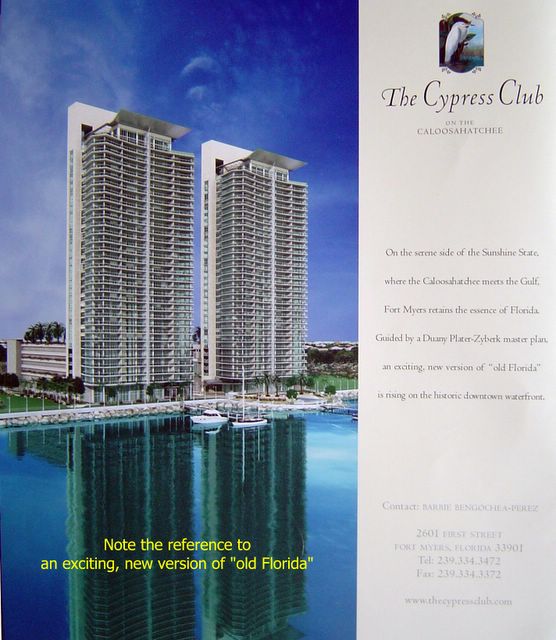
Thursday, May 05, 2005
Refloating the Conference Center?
The proposed bayfront location for the proposed conference center has re-surfaced.
Apparently Tim Clarke, from the Chamber of Commerce, spoke to the Sarasota Economic Development Corp. and asked their support for the downtown bayfront location. City Commissioner Mary Ann Servian and County Commissioner Nora Patterson sit on the board of the Economic Development Corp.
When it came time to vote on Mr. Clarke’s proposal, Commissioners Servian and Patterson abstained. The remaining members of the board voted for the proposal.
Save Our Sarasota is strongly opposed to the downtown bayfront location - it is a very poor use for one of our last remaining great public spaces. In our discussions and talks with a wide variety of residents of Sarasota, we receive overwhelming indications that these people agree that a convention/conference center should not be located on public bayfront property.
We think that the reason the Chamber is continuing down this rocky road is that they know that funding for a privately owned site will make the whole convention/conference center idea a very tough sell, likely tougher than grabbing the choicest piece of public property available in Sarasota. This latest effort to grab public property should again be quickly sunk.
We appreciate our elected commissioners stance on preserving this bayfront property for the benefit of all of Sarasota’s residents.
Apparently Tim Clarke, from the Chamber of Commerce, spoke to the Sarasota Economic Development Corp. and asked their support for the downtown bayfront location. City Commissioner Mary Ann Servian and County Commissioner Nora Patterson sit on the board of the Economic Development Corp.
When it came time to vote on Mr. Clarke’s proposal, Commissioners Servian and Patterson abstained. The remaining members of the board voted for the proposal.
Save Our Sarasota is strongly opposed to the downtown bayfront location - it is a very poor use for one of our last remaining great public spaces. In our discussions and talks with a wide variety of residents of Sarasota, we receive overwhelming indications that these people agree that a convention/conference center should not be located on public bayfront property.
We think that the reason the Chamber is continuing down this rocky road is that they know that funding for a privately owned site will make the whole convention/conference center idea a very tough sell, likely tougher than grabbing the choicest piece of public property available in Sarasota. This latest effort to grab public property should again be quickly sunk.
We appreciate our elected commissioners stance on preserving this bayfront property for the benefit of all of Sarasota’s residents.
Tuesday, May 03, 2005
Bay Water
At the commission meeting Monday, new Commissioner Ken Shelin commented on discussions he has recently had with Dr. K. Mahadevan, President of Mote Marine. As Commissioner Shelin reported, Dr. Mahadevan shares a concern about the water quality of Sarasota Bay. While this interest may have recently surfaced because of the infrastructure failures at the Hudson Bayou pumping station, there was an offer from Mote to conduct periodic water quality sampling and testing in and near Hudson and Whitaker Bayous.
Both of these bayous receive storm water runoff from a wide drainage area and have been the focus of study by the Sarasota Bay National Estuary Program as well as Mote Marine. Both bayous also have toxic sediments that have been there for a long time and are related to lead in gasoline, pesticides, boat anti-fouling chemicals and other causes. Mote would conduct additional studies and compare current results with historical data they have conducted.
It didn’t take Commissioner Shelin long to start asking questions about the health of our "signature" resource - Sarasota Bay. A renewed focus on water quality improvement here would be welcomed.
Both of these bayous receive storm water runoff from a wide drainage area and have been the focus of study by the Sarasota Bay National Estuary Program as well as Mote Marine. Both bayous also have toxic sediments that have been there for a long time and are related to lead in gasoline, pesticides, boat anti-fouling chemicals and other causes. Mote would conduct additional studies and compare current results with historical data they have conducted.
It didn’t take Commissioner Shelin long to start asking questions about the health of our "signature" resource - Sarasota Bay. A renewed focus on water quality improvement here would be welcomed.
Monday, May 02, 2005
Laurel Park's Future
Save Our Sarasota supports the Laurel Park Neighborhood Association Board’s position that the recently completed zoning designation RSM-9 is more appropriate for Laurel Park then the DTN zoning being proposed for consideration in the E.A.R. process.
We believe Downtown Neighborhood zoning would increase density and building heights, diminish the neighborhood’s vital tree canopy, increase traffic on narrow streets, hasten the destruction of historic homes, and compromise the quality of life in this residential neighborhood.
A city treasure has been preserved and enhanced by an exemplary neighborhood rehabilitation. We believe rezoning to DTN will jeopardize the great accomplishments that have been achieved in Laurel Park and urge you to retain the RSM-9 zoning.
As an important aside, we note when Andres Duany was last here (meeting with the architects), he made the comment that every ten years you go to the neighborhoods surrounding the urban center and ask if they are ready for more density. [not impose, just ask]. Per Duany's advice, Laurel Park has been asked and they have replied "No!"
We believe Downtown Neighborhood zoning would increase density and building heights, diminish the neighborhood’s vital tree canopy, increase traffic on narrow streets, hasten the destruction of historic homes, and compromise the quality of life in this residential neighborhood.
A city treasure has been preserved and enhanced by an exemplary neighborhood rehabilitation. We believe rezoning to DTN will jeopardize the great accomplishments that have been achieved in Laurel Park and urge you to retain the RSM-9 zoning.
As an important aside, we note when Andres Duany was last here (meeting with the architects), he made the comment that every ten years you go to the neighborhoods surrounding the urban center and ask if they are ready for more density. [not impose, just ask]. Per Duany's advice, Laurel Park has been asked and they have replied "No!"
Sunday, May 01, 2005
Laurel Park Speaks Out
The following was sent by the President of the Laurel Park Neighborhood Association. It clearly indicates the desire of the Laurel Park residents and owners.
Recent postings have discussed the future of Laurel Park. Now that the results of the city's Land Use Survey have been published, we know what residents and owners themselves want for the neighborhood. Survey participants, by a large margin, want to keep the existing RSM-9 zoning, according to results from the city administered Land Use Survey held at Payne Park on April 16.
The city is currently considering the issue of the most appropriate land use classification for Laurel Park as part of its review of the city’s comprehensive plan. Extending the downtown’s "new urban" land use classification to Laurel Park would allow increases in height and density, and possibly more commercial uses.
The survey, which consisted of 18 photos and statements, was designed to measure respondents’ desires for future development in Laurel Park. For example, in addition to one and two story houses, participants were asked to rate the desirability of three story rowhouses, two story live-work arrangements, and so on. Some 85 people took the survey, including resident homeowners, investors, and renters.
According to city figures, 71% of respondents voted to retain RSM-9, Laurel Park’s existing zoning. In addition, participants favored a maximum two stories rather than three, no increase in density, and no new commercial development. The exact questions and percentage figures are as follows:
Land Use Survey Questions
The city’s results do not break out the views of resident homeowners as a separate category, but the survey did ask participants whether they had a homestead exemption. As a group, homeowner residents voted even more strongly in favor of retaining the existing RSM-9 zoning, along with its lower height, lower density, and residential nature.
The city will continue its comprehensive plan review process--of which Laurel Park is just one element--through the summer. Public hearings will be held on June 22 (the Planning Board) and July 25 (the City Commission.)
Kate Lowman, President, Laurel Park Neighborhood Association
Recent postings have discussed the future of Laurel Park. Now that the results of the city's Land Use Survey have been published, we know what residents and owners themselves want for the neighborhood. Survey participants, by a large margin, want to keep the existing RSM-9 zoning, according to results from the city administered Land Use Survey held at Payne Park on April 16.
The city is currently considering the issue of the most appropriate land use classification for Laurel Park as part of its review of the city’s comprehensive plan. Extending the downtown’s "new urban" land use classification to Laurel Park would allow increases in height and density, and possibly more commercial uses.
The survey, which consisted of 18 photos and statements, was designed to measure respondents’ desires for future development in Laurel Park. For example, in addition to one and two story houses, participants were asked to rate the desirability of three story rowhouses, two story live-work arrangements, and so on. Some 85 people took the survey, including resident homeowners, investors, and renters.
According to city figures, 71% of respondents voted to retain RSM-9, Laurel Park’s existing zoning. In addition, participants favored a maximum two stories rather than three, no increase in density, and no new commercial development. The exact questions and percentage figures are as follows:
Land Use Survey Questions
- I want the City to retain the current RSM-9 zoning that is in place today. 71% YES
- The number of residential units on individual lots should be increased in Laurel Park. 80% NO
- I would like to see a limited amount of commercial retail and office development in Laurel Park (i.e. corner stores and offices located in housing structures. 69% NO
- Non-residential land uses (i.e. offices or stores) should be allowed in historic structures in Laurel Park. 65% NO
- New buildings in Laurel Park should not exceed two stories in height. 75% YES
- New apartment buildings should be allowed to be built in Laurel Park. 67% NO
The city’s results do not break out the views of resident homeowners as a separate category, but the survey did ask participants whether they had a homestead exemption. As a group, homeowner residents voted even more strongly in favor of retaining the existing RSM-9 zoning, along with its lower height, lower density, and residential nature.
The city will continue its comprehensive plan review process--of which Laurel Park is just one element--through the summer. Public hearings will be held on June 22 (the Planning Board) and July 25 (the City Commission.)
Kate Lowman, President, Laurel Park Neighborhood Association
Subscribe to:
Comments (Atom)

