Apparently the condo market is struggling even more these days. An article in the Palm Beach Post: Major commercial lenders are withdrawing from financing South Florida condo construction and conversion deals, another sign the overheated market may be too hot to handle.
"We are seeing lenders overall pulling the plug," said Dan Kodsi, president of Royal Palm Communities, a developer in Boca Raton.
It's not only lenders on the construction end who are newly nervous about risk. The federal government hopes to damp the sale of exotic home mortgages which enable even credit-poor prospective homeowners to buy. So, even if condo developers get financing, condo buyers may not.
Meanwhile, here in Sarasota another 144 luxury units have been announced.
Commercial real estate loans for such ventures as malls and office buildings are receiving more scrutiny .
Collier County commissioners recently turned down a proposed development even though 3 of 5 commissioners voted for the project. Collier requires a super-majority (4 votes) for a re-zoning to pass. The article in the Naples News indicates that the threat of slowing down development has been achieved.
Tuesday, February 28, 2006


Monday, February 27, 2006
Rigorous Objectivity?
The SHT editorial today comments on the recent Pineapple Square decision and what is ahead. The editorial asks some very critical questions. We hope these questions are not swept aside as were Commissioner Palmer's questions during the evaluation of the term sheet.
After the big Pineapple Square proposal got another vote of confidence last week from Sarasota city commissioners, some of them essentially told their staff to make the project happen. Whatever that might mean, the phrase has a troubling ring -- for two reasons:
After the big Pineapple Square proposal got another vote of confidence last week from Sarasota city commissioners, some of them essentially told their staff to make the project happen. Whatever that might mean, the phrase has a troubling ring -- for two reasons:
- While a couple of individual commissioners may want staff to make it happen, that is not the commission's official policy directive. The 4-1 vote Tuesday was not to finalize Pineapple Square, but rather to incrementally approve term-sheet revisions and start deeper contract negotiations.
- No matter how much conceptual support Pineapple Square enjoys, it cannot be built until and unless the developer wins approval of several key components -- a still-to-come process that should be handled with rigorous objectivity by city staff and, of course, commissioners.
We also were troubled by the comments directed toward the City Manager and his staff at the close of this portion of the meeting.
Since the city commissioners have chosen to invest upwards of $18M in city property and funds, it would seem prudent, at the least, to make sure all the facts concerning this proposal are laid out for public scrutiny. The city staff needs to be able to do this without "veiled directives". This needs to be done openly, fully and with attention to detail. We need to get beyond outright dismissal of the parking and appraisal consultants' expertise. Their input needs to be reviewed and honestly discussed.
A proposal of this magnitude must not be swept out of public view by telling the staff to "make it happen, now."
Sunday, February 26, 2006
.jpg)
Saturday, February 25, 2006
Signs of Spring
 Reds Rally Day was held in Sarasota today. Baseball fans turned out - at least a couple hundred - to get a spring fever fix.
Major League spring training has been a part of Sarasota for about 70 years. Jeff LaHurd's article about the NY Giants in this weeks SHT was a reminder of how long this community has been connected to baseball.
Jeff has a new book about Spring Training in Sarasota. It is available at Sarasota News and Books.
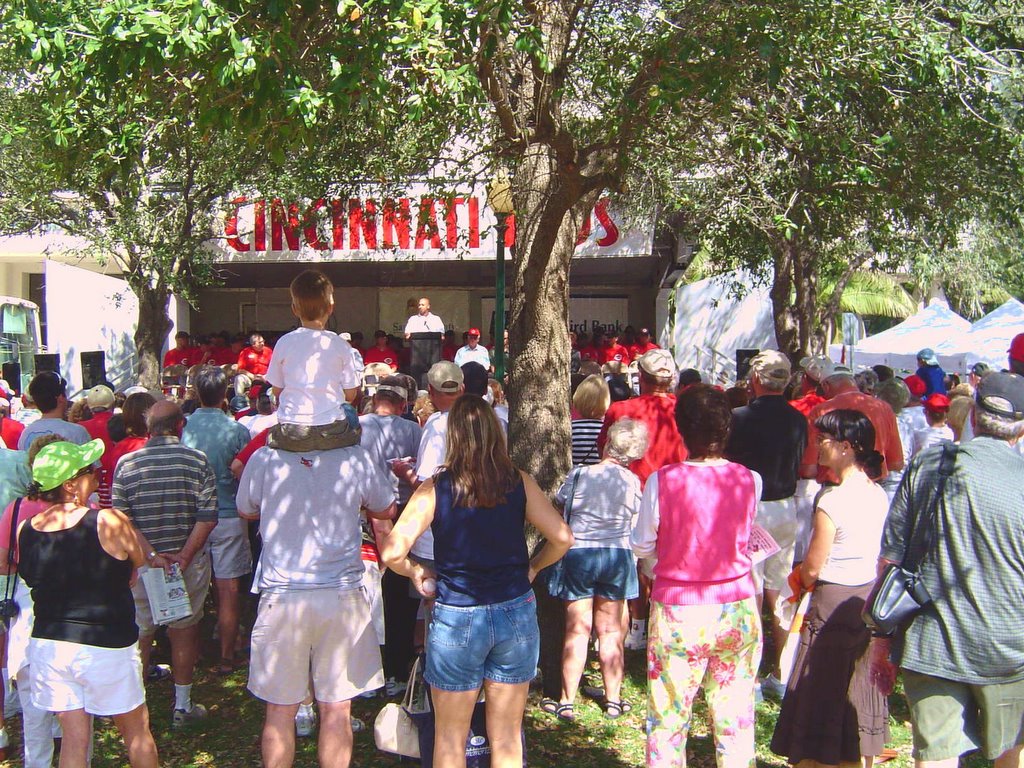 These days the Cincinnati Reds are the center piece of Sarasota's baseball fans. Over the years the Giants, Red Sox and White Sox have also spent spring time in Sarasota.
Politicians, team managers and players, a jazzy band and a color guard were part of the festivities.
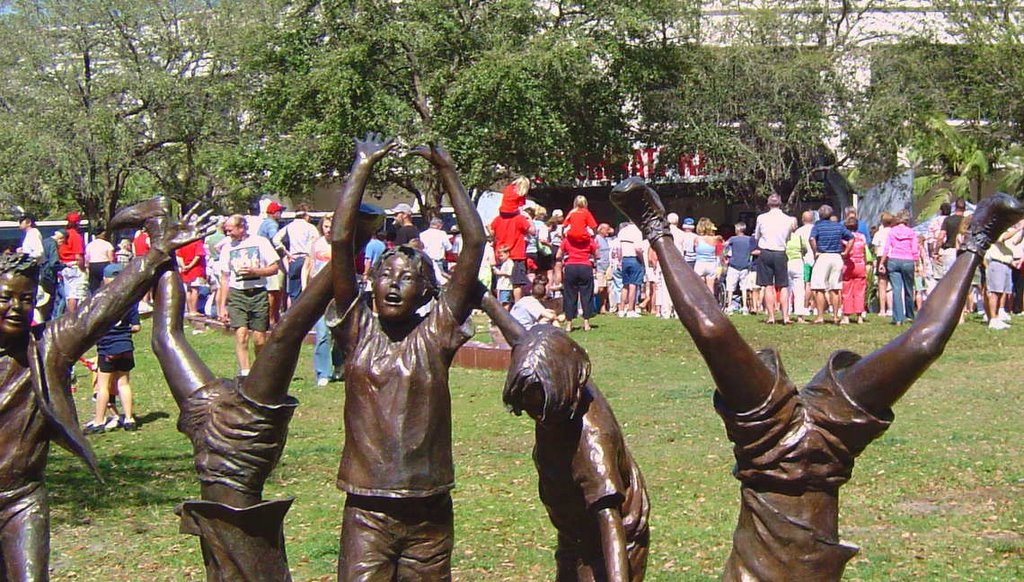 Young and old, baseball fans can't seem to get enough of this national pastime.
Friday, February 24, 2006
Attacking Prostitution on the North Trail
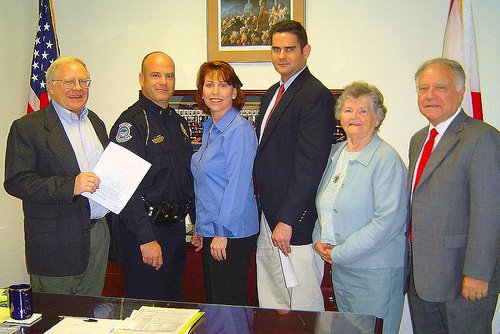 Left to right in the picture:Dick Clapp (President, IBSSA and Vice Chair, Scenic Highway), Lt Steve Breakstone (SPD), Rep. Donna Clarke, Det Jeff Steiner (SPD), Millie Small (Court Watch and Scenic Highway), Hugo Mazzoli (Chair, Scenic Highway Committee).
For years drug trafficking and prostitution have been problems associated with blighted areas (including some of the old motels) along Sarasota's North Trail. Neighborhoods and police have had limited success in addressing these problems.
Recently the Tamiami Trail Scenic Highway Committee, along with the North Trail Neighborhoods looked for new solutions. While the SPD has done everything they could, the current classification of prostitution as a misdemeanor means that almost all the time, the prostitutes are freed after paying a relatively small fine and they are back on the streets.
The Scenic Highway Committee met with the States Attorney General (Earl Moreland and Earl Varn) and the Chief Judge (Robert Bennett) for Sarasota to let them know that the problem was increasing and that the penalties were not deterring the criminal activity. The PEZ (Prostitute Exclusion Zone) program was reviewed and the judges and prosecutors were asked to use this tool when possible as it calls for upgrading the charge to a felony for repeat offenders.
Another tool was discussed that was not yet in place in Florida: making prostitution a felony when an arrest is made within 1000 ft of public buildings, parks or churches - the same as drug trafficking.
Rep Donna Clarke was asked to introduce a bill to help in this area. She introduced HR 1087 in the State Legislature this month that would allow this tool to be used. If it stays on track, in could become Florida law in October of this year.
The text of this bill is given below:
A bill to be entitled
An act relating to prostitution; amending s. 796.07, F.S. providing for reclassification of penalties for certain violations committed within a specified distance of certain locations; providing an effective date.
Be It Enacted by the Legislature of the State of Florida:
Section 1. Subsection (4) of section 796.07, Florida Statutes, is amended to read:
796.07 Prohibiting prostitution, etc.; evidence; penalties; definitions.--(4)(a) A person who violates any provision of this section commits:
1.(a) A misdemeanor of the second degree for a first violation, punishable as provided in s. 775.082 or s. 775.083.
2.(b) A misdemeanor of the first degree for a second violation, punishable as provided in s. 775.082 or s. 775.083.
3.(c) A felony of the third degree for a third or subsequent violation, punishable as provided in s. 775.082, s.775.083, or s. 775.084.
(b) If a felony or first degree misdemeanor violation of this section was committed within 1,000 feet of the real property comprising a child care facility as defined in s. 402.302 that is in compliance with the signage requirements for child care facilities in s. 893.13(1)(c); a public or private elementary, middle, or secondary school; or a physical place for worship where a church or religious organization regularly conducts religious services; or in, on, or within 1,000 feet of real property comprising a state, county, or municipal park, a community center, or a publicly owned recreational facility, the penalty shall be reclassified as follows:
1. A misdemeanor of the first degree is reclassified to a felony of the third degree.
2. A felony of the third degree is reclassified to a felony of the second degree.
Section 2. This act shall take effect October 1, 2006.
Sensible Growth Film to be Shown
A follow up to the last post:
Citizens for Sensible Growth has a meeting scheduled for February 28, 7 PM at the Jacaranda Library, 4143 Woodmere Park Blvd, Venice. Come and learn about Sensible Growth and how to stop sprawl. The award winning film--Tale of Two Counties--will be shown.
Members will be available to answer questions about the county proposals they are trying to put on a referendum ballot. If you can help with their petition drive or wish to sign the petitions go to their web site for information.
Everyone is welcome!
Citizens for Sensible Growth has a meeting scheduled for February 28, 7 PM at the Jacaranda Library, 4143 Woodmere Park Blvd, Venice. Come and learn about Sensible Growth and how to stop sprawl. The award winning film--Tale of Two Counties--will be shown.
Members will be available to answer questions about the county proposals they are trying to put on a referendum ballot. If you can help with their petition drive or wish to sign the petitions go to their web site for information.
Everyone is welcome!
Thursday, February 23, 2006
Say Yes to Sensible Growth
This article was originally printed in the Venice Gondolier.
BY BILL EARL GUEST COLUMNIST
Do you think Sarasota County is growing too fast? Do you think there is too much traffic congestion?
Do you think our environment is at risk? Do you think the cost of growth, including the pollution of Roberts Bay and Lemon Bay, is too high?
Most of your neighbors think so too. It is painfully obvious that growth problems are getting worse, not better, in Sarasota County.
The problem is that the playing field is not level for citizen input into county growth management decisions. Special interests, with their platoons of highly paid, full-time lobbyists, lawyers and consultants, drown out and wear down even those citizens who try to express their concerns at public meetings and hearings. The result is rapid and costly growth.
A grassroots group of your neighbors called Citizens for Sensible Growth is sponsoring two amendments to county law that will help county government hear and act on the growth concerns of its citizens.
The first amendment requires county government to seek voter approval before committing your tax dollars to subsidize growth and sprawl.
The second amendment requires a super-majority vote (four out of five votes instead of the current three out of five) by the county commission to approve major decisions increasing land density or intensity.
These amendments require greater oversight of major land-use decisions by county commissioners and by voters.
Sarasota County voters have the power to add these amendments to county law if they sign 12,030 petitions asking that they be placed on the ballot. If voters then approve them in the November 2006 election, they become county law.
Our sensible-growth amendments have been endorsed by the Sarasota County Council of Neighborhood Associations, Sarasota County Audubon, Manatee-Sarasota Sierra Club and other public interest groups.
The special-interest opposition is well heeled, and they and their advocates are trying every trick in the book to defeat the sensible-growth amendments.
They will tell you that sensible growth hurts affordable housing; that jobs will be lost; that our economy will suffer; and that growth management is too complicated for average citizens to understand.
None of it is true.
So, how do we reduce traffic congestion, relieve our tax burdens, protect the environment and still grow? It is actually not all that difficult.
We do it by encouraging growth in walkable neighborhoods near existing roads, parks and schools.
We do it by encouraging infill development and the redevelopment of half-empty shopping centers and rundown neighborhoods near existing water, sewer and public transportation facilities.
We do it by discouraging development on rural lands.
We do it by making developers provide the public facilities required to service their private development projects.
If the answer is so obvious, so simple and so sensible, why aren’t we already doing it? Because infill development and redevelopment are just not as easy or as profitable as bulldozing rural lands.
So, special interests and those supporting them may say they are concerned about affordable housing, jobs, the economy and the environment; or that if citizens are unhappy, they should vote county commissioners out of office.
Don’t believe them. Our amendments aren’t about current county commissioners or how they vote. They may even say our amendments are undemocratic. Don’t believe that either. Our amendments will increase representation by our citizens and lessen the influence of special interests. Nothing could be more democratic.
Our sensible-growth amendments are about fixing a system in which special interests drown out citizen input on growth issues. We must level the playing field by adopting the sensible-growth amendments.
The time to act is now. We need your help in signing and collecting petitions.
To learn more about Citizens for Sensible Growth, our political committee, and our proposed amendments, go to: www.sarasotacitizens.org. You can read and download the petitions for signing.
For those interested in helping, there will be a briefing and presentation of a short, award-winning film on sensible growth at the Jacaranda Library on Feb. 28 at 7 p.m.
Bill Earl is a retired environmental and land-use lawyer, Marine Corps veteran, father of five and past president of the Sarasota County Council of Neighborhood Associations.
BY BILL EARL GUEST COLUMNIST
Do you think Sarasota County is growing too fast? Do you think there is too much traffic congestion?
Do you think our environment is at risk? Do you think the cost of growth, including the pollution of Roberts Bay and Lemon Bay, is too high?
Most of your neighbors think so too. It is painfully obvious that growth problems are getting worse, not better, in Sarasota County.
The problem is that the playing field is not level for citizen input into county growth management decisions. Special interests, with their platoons of highly paid, full-time lobbyists, lawyers and consultants, drown out and wear down even those citizens who try to express their concerns at public meetings and hearings. The result is rapid and costly growth.
A grassroots group of your neighbors called Citizens for Sensible Growth is sponsoring two amendments to county law that will help county government hear and act on the growth concerns of its citizens.
The first amendment requires county government to seek voter approval before committing your tax dollars to subsidize growth and sprawl.
The second amendment requires a super-majority vote (four out of five votes instead of the current three out of five) by the county commission to approve major decisions increasing land density or intensity.
These amendments require greater oversight of major land-use decisions by county commissioners and by voters.
Sarasota County voters have the power to add these amendments to county law if they sign 12,030 petitions asking that they be placed on the ballot. If voters then approve them in the November 2006 election, they become county law.
Our sensible-growth amendments have been endorsed by the Sarasota County Council of Neighborhood Associations, Sarasota County Audubon, Manatee-Sarasota Sierra Club and other public interest groups.
The special-interest opposition is well heeled, and they and their advocates are trying every trick in the book to defeat the sensible-growth amendments.
They will tell you that sensible growth hurts affordable housing; that jobs will be lost; that our economy will suffer; and that growth management is too complicated for average citizens to understand.
None of it is true.
So, how do we reduce traffic congestion, relieve our tax burdens, protect the environment and still grow? It is actually not all that difficult.
We do it by encouraging growth in walkable neighborhoods near existing roads, parks and schools.
We do it by encouraging infill development and the redevelopment of half-empty shopping centers and rundown neighborhoods near existing water, sewer and public transportation facilities.
We do it by discouraging development on rural lands.
We do it by making developers provide the public facilities required to service their private development projects.
If the answer is so obvious, so simple and so sensible, why aren’t we already doing it? Because infill development and redevelopment are just not as easy or as profitable as bulldozing rural lands.
So, special interests and those supporting them may say they are concerned about affordable housing, jobs, the economy and the environment; or that if citizens are unhappy, they should vote county commissioners out of office.
Don’t believe them. Our amendments aren’t about current county commissioners or how they vote. They may even say our amendments are undemocratic. Don’t believe that either. Our amendments will increase representation by our citizens and lessen the influence of special interests. Nothing could be more democratic.
Our sensible-growth amendments are about fixing a system in which special interests drown out citizen input on growth issues. We must level the playing field by adopting the sensible-growth amendments.
The time to act is now. We need your help in signing and collecting petitions.
To learn more about Citizens for Sensible Growth, our political committee, and our proposed amendments, go to: www.sarasotacitizens.org. You can read and download the petitions for signing.
For those interested in helping, there will be a briefing and presentation of a short, award-winning film on sensible growth at the Jacaranda Library on Feb. 28 at 7 p.m.
Bill Earl is a retired environmental and land-use lawyer, Marine Corps veteran, father of five and past president of the Sarasota County Council of Neighborhood Associations.
Wednesday, February 22, 2006
Density Discussion
Over the next few weeks and months Sarasota will be discussing density. This will happen as the proposed "density bonus" comprehensive plan change winds its way through the public process.
An instructive essay on density and pedestrian friendly cities is given below. It is from a book City Comforts by David Sucher.
Density is a by-product of creating interesting places.
There is almost universal fear of the deleterious impacts of urban sprawl, and much hope for what is perceived as its opposite: urban villages. The urban village implies "densification", more people in a given area. But the word "densification" lacks poetic, much less political appeal. Certainly zoning changes to allow higher residential density are a necessary component of any central city or urban village strategy.
But allowing higher densities is only a precursor and it can put the cart before the horse. Discussions of density often implicitly assume that people must be cajoled into higher-density housing. Though there is an element of truth to that, the cajoling must take place in the form of creating great neighborhoods.
People are more than willing to live in high density if the amenity value of the surrounding environment is also great. Condos and apartments on the waterfront attract people. So do views. People will clamor to live in an interesting, walkable, human-scaled neighborhood.
One of the tradeoffs (and benefits) of purchasing in a multifamily structure in a dense neighborhood should be that one can walk safely and in comfort to stores, restaurants, theaters, and so forth along pleasant public sidewalks. Such pedestrian friendly environments are called for by the public policy of many jurisdictions, but are lagging in actually creating them. Moreover, and even troubling, we seem to be incapable of managing the public spaces of the pedestrian-friendly neighborhoods that already exist.
A decline in the quality of life in higher-density neighborhoods exacerbates the preference for the single-family home. The detached dwelling offers the home buyer the opportunity to create a private zone of comfort. Even if the public space of the immediate block or neighborhood declines, the home owner has his lot on which to buffer the world.
The buyer in a multifamily environment must deal with high "transaction costs" of condo association decision-making: many committees and rules. There is limited opportunity to enrich the environment because the open space of most multi-family structures is limited and held in common.
Multifamily dwellers are thus forced to take on the task of improving their neighborhood environment in the public space of the sidewalks and streets. They are ill equipped for this task and face enormous institutional resistance from municipal bureaucracies, most of which are still rooted in the task of moving automobiles. It is not uncommon for 50% of an American city's land area to be in the public right-of-way, but most of that is devoted to cars. But in that public space is the greatest possibility of small (and relatively inexpensive) improvements that can increase neighborhood comfort. These small city comforts have potential to benefit a neighborhood well beyond their cost. But they are difficult for home owners to carry out.
Over the past 20 years, and in general the rate of increase in value of multifamily condos has lagged the behind the single-family houses. It seems that people are aware that they will have less control over their neighborhood. Since the basic lesson of home buying is to "buy the neighborhood," this is a bad portent for the future of sustainable cities in which multifamily housing is to play a large part.
The way to densification is indirect. It is to propel local government (or allow private property owners the ability) to create public environments that can compete in quality of life with what one finds in single-family neighborhoods.
There are some interesting thoughts here. Things we should remember as we go down the road to possible density increases in downtown and the surrounding edges. We need to be particularly careful of increasing the density on the east side of Payne Park. This is not within walking distance to the heart of downtown (Five Points area) and there are few amenities and no pedestrian friendly walkable urban areas anywhere close.
There is also the issue of infrastructure. Where are all the cars going to go? If we increase density, people will still want their cars (we have no effective public transportation) and our sewer system is failing. High density and high car usage in urban centers makes no sense. It is a recipe for disaster.
Think about the quality of life along the first block of Fruitville. Cars zooming by within 4-5 feet of the front stoop. Is this walkable or pedestrian friendly? There are no amenities. Added density did not make it pedestrian friendly.
We have put the cart before the horse in some instances. We need to be careful not to repeat these errors.
An instructive essay on density and pedestrian friendly cities is given below. It is from a book City Comforts by David Sucher.
Density is a by-product of creating interesting places.
There is almost universal fear of the deleterious impacts of urban sprawl, and much hope for what is perceived as its opposite: urban villages. The urban village implies "densification", more people in a given area. But the word "densification" lacks poetic, much less political appeal. Certainly zoning changes to allow higher residential density are a necessary component of any central city or urban village strategy.
But allowing higher densities is only a precursor and it can put the cart before the horse. Discussions of density often implicitly assume that people must be cajoled into higher-density housing. Though there is an element of truth to that, the cajoling must take place in the form of creating great neighborhoods.
People are more than willing to live in high density if the amenity value of the surrounding environment is also great. Condos and apartments on the waterfront attract people. So do views. People will clamor to live in an interesting, walkable, human-scaled neighborhood.
One of the tradeoffs (and benefits) of purchasing in a multifamily structure in a dense neighborhood should be that one can walk safely and in comfort to stores, restaurants, theaters, and so forth along pleasant public sidewalks. Such pedestrian friendly environments are called for by the public policy of many jurisdictions, but are lagging in actually creating them. Moreover, and even troubling, we seem to be incapable of managing the public spaces of the pedestrian-friendly neighborhoods that already exist.
A decline in the quality of life in higher-density neighborhoods exacerbates the preference for the single-family home. The detached dwelling offers the home buyer the opportunity to create a private zone of comfort. Even if the public space of the immediate block or neighborhood declines, the home owner has his lot on which to buffer the world.
The buyer in a multifamily environment must deal with high "transaction costs" of condo association decision-making: many committees and rules. There is limited opportunity to enrich the environment because the open space of most multi-family structures is limited and held in common.
Multifamily dwellers are thus forced to take on the task of improving their neighborhood environment in the public space of the sidewalks and streets. They are ill equipped for this task and face enormous institutional resistance from municipal bureaucracies, most of which are still rooted in the task of moving automobiles. It is not uncommon for 50% of an American city's land area to be in the public right-of-way, but most of that is devoted to cars. But in that public space is the greatest possibility of small (and relatively inexpensive) improvements that can increase neighborhood comfort. These small city comforts have potential to benefit a neighborhood well beyond their cost. But they are difficult for home owners to carry out.
Over the past 20 years, and in general the rate of increase in value of multifamily condos has lagged the behind the single-family houses. It seems that people are aware that they will have less control over their neighborhood. Since the basic lesson of home buying is to "buy the neighborhood," this is a bad portent for the future of sustainable cities in which multifamily housing is to play a large part.
The way to densification is indirect. It is to propel local government (or allow private property owners the ability) to create public environments that can compete in quality of life with what one finds in single-family neighborhoods.
There are some interesting thoughts here. Things we should remember as we go down the road to possible density increases in downtown and the surrounding edges. We need to be particularly careful of increasing the density on the east side of Payne Park. This is not within walking distance to the heart of downtown (Five Points area) and there are few amenities and no pedestrian friendly walkable urban areas anywhere close.
There is also the issue of infrastructure. Where are all the cars going to go? If we increase density, people will still want their cars (we have no effective public transportation) and our sewer system is failing. High density and high car usage in urban centers makes no sense. It is a recipe for disaster.
Think about the quality of life along the first block of Fruitville. Cars zooming by within 4-5 feet of the front stoop. Is this walkable or pedestrian friendly? There are no amenities. Added density did not make it pedestrian friendly.
We have put the cart before the horse in some instances. We need to be careful not to repeat these errors.
Tuesday, February 21, 2006
Compatibility and Common Sense
It was almost like David and Goliath, the small Library Mews met up with the overwhelming Hembree building.
During the City Commission meeting to decide whether this proposal would move forward, the issue was clearly defined. The proposal met the code test for the DROD (Downtown Residential Overlay District) as well as the downtown zone code criteria, but the question was whether it was compatible with the surrounding neighborhood.
The City Comprehensive Plan requires that new projects be compatible with the neighborhood. The Comp Plan describes compatibility in terms of height, scale, size bulk and being sensitive to surrounding neighborhood. The Hembree proposal was for a 10 story building with a footprint basically lot line to lot line. This building would be nestled in between 2 and 3 story building on all sides. This is where the compatibility question came into play.
The result was that the commission voted 3-2 to turn the proposal down. The basis for those voting against the proposal was that it was not compatible, that there were ways that the proposal could be designed to take into consideration its effect on the surrounding building intensity.
 This was a victory for common sense. While the proposal met the DROD criteria and the downtown zone code criteria, it was simply not compatible with the surrounding area. Common sense over ruled the technical criteria.
During the City Commission meeting to decide whether this proposal would move forward, the issue was clearly defined. The proposal met the code test for the DROD (Downtown Residential Overlay District) as well as the downtown zone code criteria, but the question was whether it was compatible with the surrounding neighborhood.
The City Comprehensive Plan requires that new projects be compatible with the neighborhood. The Comp Plan describes compatibility in terms of height, scale, size bulk and being sensitive to surrounding neighborhood. The Hembree proposal was for a 10 story building with a footprint basically lot line to lot line. This building would be nestled in between 2 and 3 story building on all sides. This is where the compatibility question came into play.
The result was that the commission voted 3-2 to turn the proposal down. The basis for those voting against the proposal was that it was not compatible, that there were ways that the proposal could be designed to take into consideration its effect on the surrounding building intensity.
 This was a victory for common sense. While the proposal met the DROD criteria and the downtown zone code criteria, it was simply not compatible with the surrounding area. Common sense over ruled the technical criteria.
Coming to Terms with Pineapple Square
The City Commission accepted the revised term sheet for the Pineapple Square proposal by a 4-1 vote. Only Lou Ann Palmer voted against the proposal saying that even though she thought the proposal would be good for Sarasota there were still too many unanswered questions.
Commissioner Palmer asked many of the questions we have been asking: questions about the appraisal, the value of air rights, and the "accounting" of the parking spaces. Nothing was really settled with these questions as acceptable answers were not forthcoming.
Commissioner Palmer also pressed the issue of obtaining public parking spaces (in the proposed building on the State St parking lot) in trade for the current parking spaces on State St and in the First St parking lot (that the Isaacs want) as opposed to a cash payment. Given the price of parking spaces that developers want, as well as the difficulty we seem to have in negotiating an equitable deal, this seems to be a very good concept. The city would get more parking spaces without paying cash.
The city staff was charged with working out the details and putting together a contract based on the term sheet.
Commissioner Palmer asked many of the questions we have been asking: questions about the appraisal, the value of air rights, and the "accounting" of the parking spaces. Nothing was really settled with these questions as acceptable answers were not forthcoming.
Commissioner Palmer also pressed the issue of obtaining public parking spaces (in the proposed building on the State St parking lot) in trade for the current parking spaces on State St and in the First St parking lot (that the Isaacs want) as opposed to a cash payment. Given the price of parking spaces that developers want, as well as the difficulty we seem to have in negotiating an equitable deal, this seems to be a very good concept. The city would get more parking spaces without paying cash.
The city staff was charged with working out the details and putting together a contract based on the term sheet.
Monday, February 20, 2006
Historic Homes Tour
The Sarasota Alliance for Historic Preservation will have its 16th annual Historic Homes Tour on Sunday, March 5. This year the tour will be a walking tour in Laurel Park.
The homes that are featured are:

Two apartments in Spanish Oaks Apartments at 1637 Oak street. This building is a 1920's Mediterranean Revival and has been historically designated.

The Jerome K. Martin House is at 1675 Oak Street. It is a circa 1931 bungalow that has been historically designated.

The Ella Dulla Westermann Tenant House is located at 1716 Oak Street. It is a 1920's bungalow that has been historically designated.

At 1841 Oak Street is a two-story Dutch Colonial. This home once owned by Judge Early.

At 642 Ohio Place is this 1920's bungalow.
The neighborhood invites you to bring a picnic to enjoy in the park on Laurel Street. Tables and chairs will be set up, and water will be available for purchase.
The Laurel Park Neighborhood Association is in the process of designating a portion of their neighborhood as a National Historic District.
Additional photos of these homes can be found here.
The homes that are featured are:
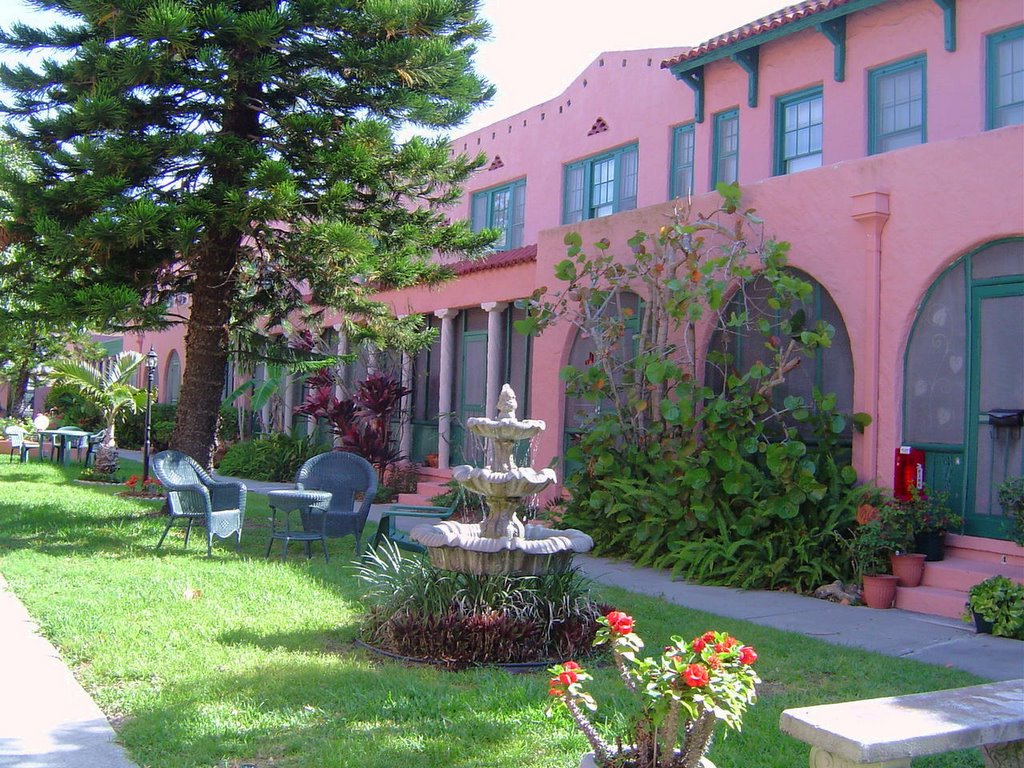
Two apartments in Spanish Oaks Apartments at 1637 Oak street. This building is a 1920's Mediterranean Revival and has been historically designated.
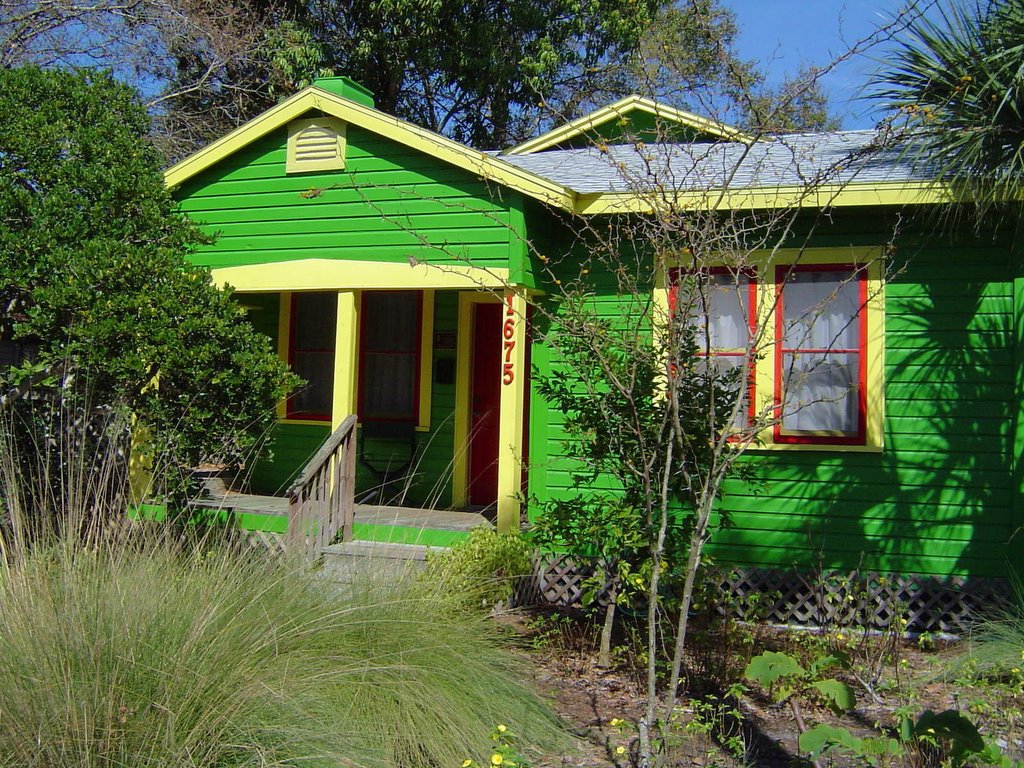
The Jerome K. Martin House is at 1675 Oak Street. It is a circa 1931 bungalow that has been historically designated.

The Ella Dulla Westermann Tenant House is located at 1716 Oak Street. It is a 1920's bungalow that has been historically designated.
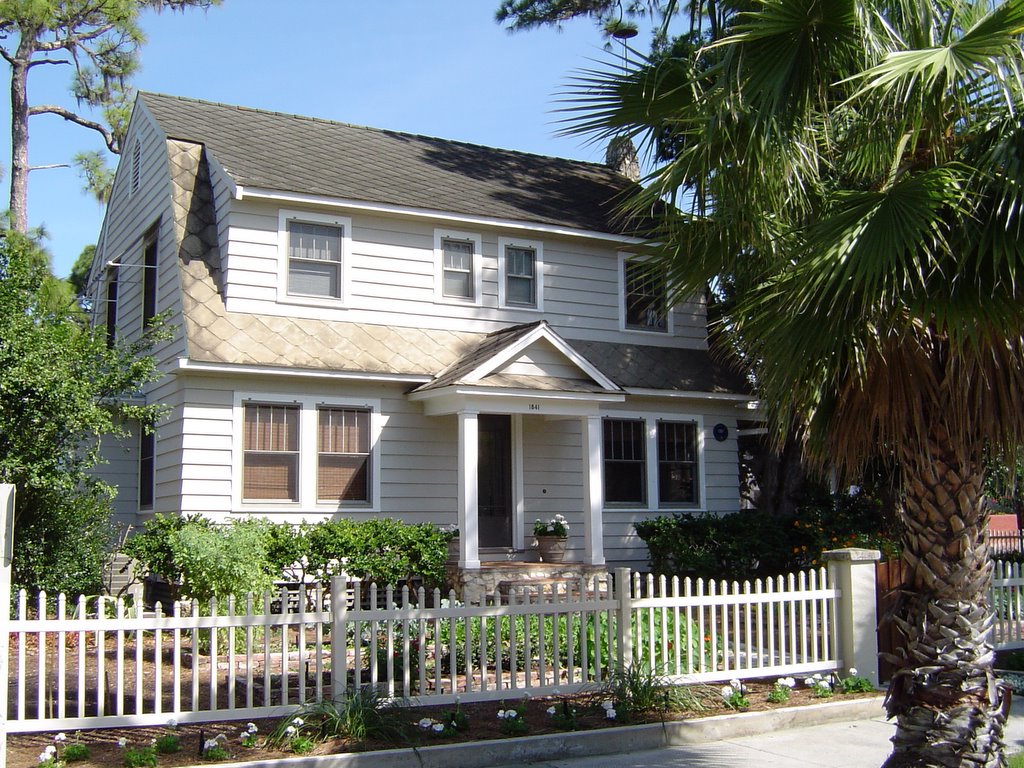
At 1841 Oak Street is a two-story Dutch Colonial. This home once owned by Judge Early.

At 642 Ohio Place is this 1920's bungalow.
The neighborhood invites you to bring a picnic to enjoy in the park on Laurel Street. Tables and chairs will be set up, and water will be available for purchase.
The Laurel Park Neighborhood Association is in the process of designating a portion of their neighborhood as a National Historic District.
Additional photos of these homes can be found here.
Sunday, February 19, 2006
Pineapple Square - What's the Deal?
As pointed out, once again, in Sundays paper, no one understands the deal that the Pineapple Square developers are getting. Why are the city commissioners so eager to give these developers a prime piece of downtown real estate, with an $11M appraised value along with $7.6M in TIF funds for 200 net new parking spaces?
Sure there is a $1M payment back to the city, but we are also giving up a good portion of State St right of way to this project.
As city residents we really want the commissioners to explain why this is such a good deal for us. The deal should be easily explainable in dollars and cents. Just a simple accounting would work fine. As far as we can figure out this deal, the net 200 new parking spaces will cost the city $17,600,000. This works out to $88,000 for each parking space! It also means that each resident of Sarasota is paying over $300 for this project - a family of four would contribute a total of $1200. Why is this a good deal for me and other residents?
No one begrudges the Isaacs developing their property as they see fit (within city code requirements). But why will it cost the residents so much? As the paper says, many like the vision; however no one understands the deal and why it costs so much.
Sarasota has many pressing issues that have a higher priority than fashion retail and upscale chain restaurants that need our dollars and attention. Infrastructure (particularly sewer failures), affordable housing, Newtown revitalization and traffic all need funding. These are problems that all residents continue to deal with. Don't our commissioners listen to the residents any more?
We would ask Commissioner Palmer to get answers to her three pages of questions. If there are no answers - answers that stand up to common sense - why are we rushing this proposal to approval so fast?
We have very competent citizens on the CRA Advisory Board, yet this board was not even asked about the TIF dollars that will be used on this project. These advisory boards are in place so the community gets the best advice possible. Why was this board not given the opportunity to review the proposal and the TIF funds required? Why do we have these boards if the commissioners are not going to give them the opportunity to review critical issues and offer insight?
This project is being rushed through without opportunity for scrutiny. Commissioners want us to trust them, trust that they are making the best decision for the long term. Trust comes when commissioners listen to citizens and communicate why their decisions are in the best public interest. Trust does not come when commissioners will not listen to citizens. Unless they are able to communicate why this decision is best for all citizens of Sarasota they will lose whatever trust they have been able to generate.
Commissioner Shelin made a significant campaign issue of accountability, he followed up with citizen workshops that discussed accountability of public servants. Many people contributed their time and effort in this process. The citizens did this because there is a growing feeling that the character of Sarasota is being lost and that the commissioners are not listening to the citizens. Was this discussion of accountability only a passing fancy or is their some substance behind this principle?
Will our commissioners be accountable when they make a decision on the Pineapple Square term sheet on Monday? Will they make an effort to explain to the citizens the dollars and cents of this deal. Will they explain why they refuse to listen to independent experts; experts that have been chosen to determine the value of our city's valuable downtown land, experts that have indicated that this project will increase the need for downtown parking spaces, experts chosen by the commissioners to give advice on investing TIF dollars? Or do they view themselves as politicians not subject to accountability, not accountable to the citizens that chose them to make decisions in the best interest of all the citizens and to communicate their reasoning?
We will find out on Tuesday.
Sure there is a $1M payment back to the city, but we are also giving up a good portion of State St right of way to this project.
As city residents we really want the commissioners to explain why this is such a good deal for us. The deal should be easily explainable in dollars and cents. Just a simple accounting would work fine. As far as we can figure out this deal, the net 200 new parking spaces will cost the city $17,600,000. This works out to $88,000 for each parking space! It also means that each resident of Sarasota is paying over $300 for this project - a family of four would contribute a total of $1200. Why is this a good deal for me and other residents?
No one begrudges the Isaacs developing their property as they see fit (within city code requirements). But why will it cost the residents so much? As the paper says, many like the vision; however no one understands the deal and why it costs so much.
Sarasota has many pressing issues that have a higher priority than fashion retail and upscale chain restaurants that need our dollars and attention. Infrastructure (particularly sewer failures), affordable housing, Newtown revitalization and traffic all need funding. These are problems that all residents continue to deal with. Don't our commissioners listen to the residents any more?
We would ask Commissioner Palmer to get answers to her three pages of questions. If there are no answers - answers that stand up to common sense - why are we rushing this proposal to approval so fast?
We have very competent citizens on the CRA Advisory Board, yet this board was not even asked about the TIF dollars that will be used on this project. These advisory boards are in place so the community gets the best advice possible. Why was this board not given the opportunity to review the proposal and the TIF funds required? Why do we have these boards if the commissioners are not going to give them the opportunity to review critical issues and offer insight?
This project is being rushed through without opportunity for scrutiny. Commissioners want us to trust them, trust that they are making the best decision for the long term. Trust comes when commissioners listen to citizens and communicate why their decisions are in the best public interest. Trust does not come when commissioners will not listen to citizens. Unless they are able to communicate why this decision is best for all citizens of Sarasota they will lose whatever trust they have been able to generate.
Commissioner Shelin made a significant campaign issue of accountability, he followed up with citizen workshops that discussed accountability of public servants. Many people contributed their time and effort in this process. The citizens did this because there is a growing feeling that the character of Sarasota is being lost and that the commissioners are not listening to the citizens. Was this discussion of accountability only a passing fancy or is their some substance behind this principle?
Will our commissioners be accountable when they make a decision on the Pineapple Square term sheet on Monday? Will they make an effort to explain to the citizens the dollars and cents of this deal. Will they explain why they refuse to listen to independent experts; experts that have been chosen to determine the value of our city's valuable downtown land, experts that have indicated that this project will increase the need for downtown parking spaces, experts chosen by the commissioners to give advice on investing TIF dollars? Or do they view themselves as politicians not subject to accountability, not accountable to the citizens that chose them to make decisions in the best interest of all the citizens and to communicate their reasoning?
We will find out on Tuesday.
Thursday, February 16, 2006
Green Space or Liner Building?
During the Pineapple Square discussion, the Burns Square group indicated they disliked the idea of a liner building along the bank parking lot west wall (on Lemon). They indicated that a visual sight line to Burns Square would be good for them and good for downtown. 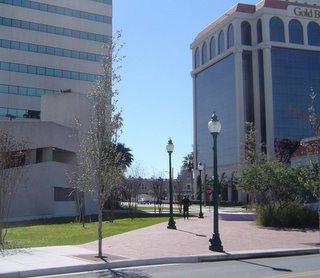
We agree.
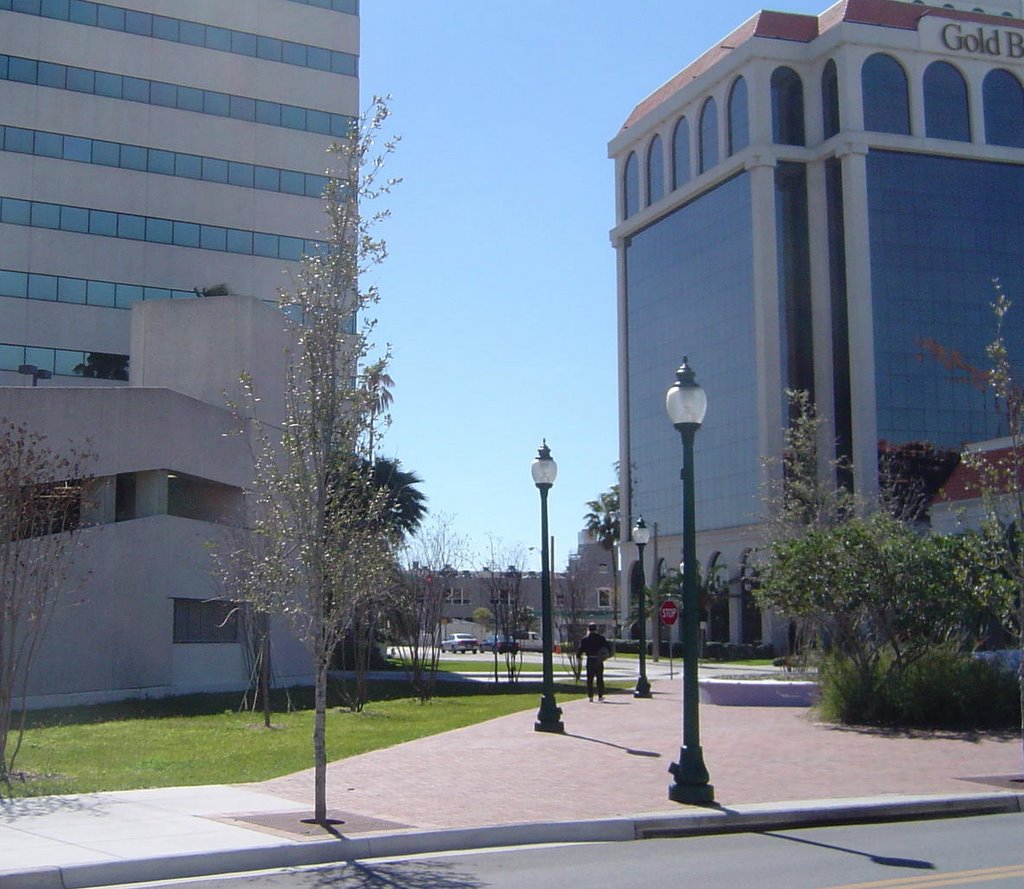
Here is a picture of the view across this area toward Burns Square (click on the picture to see a larger version).
The next picture is an attempt to show the impact of the required (new code) liner building.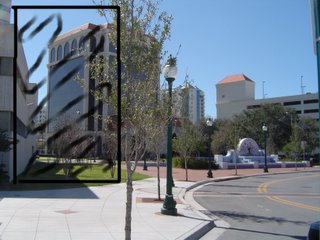
The impact of the liner building would be great. While the code attempts to liven the street activity through creation of more retail frontage at the ground level, giving up green space at this particular location does not seem to be a good trade off. The retail space would be separated from the street and valuable green space would be lost.
Save Our Sarasota would much rather have the existing green space preserved. This space could be connected with the fountain area to make a larger green space here. Live oaks with a canopy potential would make a wonderful space for a bench or two and could compliment Five Points Park a couple blocks away.
Whether the State St lot is developed or not, we prefer keeping this particular space green. We have very few places for green space and trees downtown.
We agree.
Here is a picture of the view across this area toward Burns Square (click on the picture to see a larger version).
The next picture is an attempt to show the impact of the required (new code) liner building.
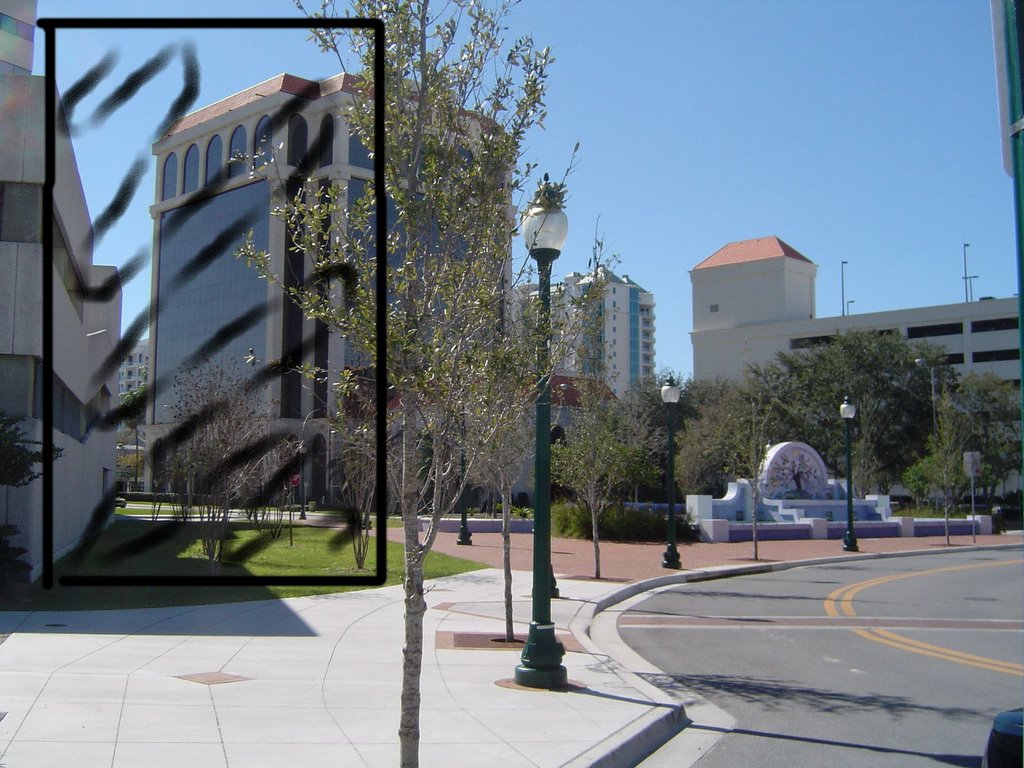
The impact of the liner building would be great. While the code attempts to liven the street activity through creation of more retail frontage at the ground level, giving up green space at this particular location does not seem to be a good trade off. The retail space would be separated from the street and valuable green space would be lost.
Save Our Sarasota would much rather have the existing green space preserved. This space could be connected with the fountain area to make a larger green space here. Live oaks with a canopy potential would make a wonderful space for a bench or two and could compliment Five Points Park a couple blocks away.
Whether the State St lot is developed or not, we prefer keeping this particular space green. We have very few places for green space and trees downtown.
Wednesday, February 15, 2006
Good Golly, Miss Mollie
Today we read that Mollie Cardamone also is/was/will be on the Pineapple Square payroll. The newspaper article says:
Cardamone, who served on the City Commission from 1993 to 2001, now runs a consulting business. She said this week that she simply gave Simon political advice as he embarked on what some have called an unprecedented neighborhood lobby.
"Am I working for him? No," she said. "Am I going to charge him for a couple of hours? Yeah."
Cardamone is one of several prominent people who spoke in favor of the project but didn't reveal their connections to Simon -- including Drayton Saunders, whose real estate firm plans to sell units in Pineapple Square, and Ernie Ritz, a contractor also working on the project.
Mayor Mary Anne Servian doesn't think public disclosure was necessary for Cardamone or the others. Servian already knew about their affiliations to the project.
A previous article had indicated that Ernie Ritz and Drayton Saunders had not revealed that they too had a financial interest in connection to Pineapple Square.
The issue here is one of accountability. While one or more commissioners may have known that these people had a financial connection to the project, the general public did not know, nor, it turned out, did all the commissioners. Instead, these persons represented themselves as interested citizens (which they are), but failed to also indicate their financial interests.
Mayor Servian is quoted in the article as saying: "I wouldn't call Mollie a lobbyist by any stretch of the imagination."
According to the dictionary, a lobbyist is one who "tries to influence the thinking of legislators or other public officials for or against a specific cause: lobbying for stronger environmental safeguards." A paid lobbyist is one who tries to influence legislators and gets paid by a third party.
Being accountable is "an obligation or willingness to accept responsibility or to account (a statement of reasons, causes, or motives) for one’s actions."
Commissioner Shelin hosted several public workshops last year focusing on the topic of accountability of public officials. Many citizens participated and gave their views on improving accountability.
Mollie Cardamone did, after the fact, acknowledge her financial relationship with Pineapple Square and apologized for not disclosing her "prior involvement" after the fact.
It is our understanding she is also consultant for another major area project, the proposed Wal-Mart on 301. We have no quarrel with this relationship, but would urge that when testifying on behalf of that company, she will clarify she is doing so as a consultant, not only as a former mayor and commissioner.
Citizens and commissioners deserve to know when persons testifying before the commission have financial interests in a project. No matter how upright or honest the lobbyist or consultant, or the commissioners, when this is not done, it casts doubt upon the testimony and the process.
Our government processes depend upon openness and honesty.
When questions about accountability are brushed aside, the citizens become cynical. It is time for some very serious discussion of a variety of accountability issues. Let that discussion begin.
Cardamone, who served on the City Commission from 1993 to 2001, now runs a consulting business. She said this week that she simply gave Simon political advice as he embarked on what some have called an unprecedented neighborhood lobby.
"Am I working for him? No," she said. "Am I going to charge him for a couple of hours? Yeah."
Cardamone is one of several prominent people who spoke in favor of the project but didn't reveal their connections to Simon -- including Drayton Saunders, whose real estate firm plans to sell units in Pineapple Square, and Ernie Ritz, a contractor also working on the project.
Mayor Mary Anne Servian doesn't think public disclosure was necessary for Cardamone or the others. Servian already knew about their affiliations to the project.
A previous article had indicated that Ernie Ritz and Drayton Saunders had not revealed that they too had a financial interest in connection to Pineapple Square.
The issue here is one of accountability. While one or more commissioners may have known that these people had a financial connection to the project, the general public did not know, nor, it turned out, did all the commissioners. Instead, these persons represented themselves as interested citizens (which they are), but failed to also indicate their financial interests.
Mayor Servian is quoted in the article as saying: "I wouldn't call Mollie a lobbyist by any stretch of the imagination."
According to the dictionary, a lobbyist is one who "tries to influence the thinking of legislators or other public officials for or against a specific cause: lobbying for stronger environmental safeguards." A paid lobbyist is one who tries to influence legislators and gets paid by a third party.
Being accountable is "an obligation or willingness to accept responsibility or to account (a statement of reasons, causes, or motives) for one’s actions."
Commissioner Shelin hosted several public workshops last year focusing on the topic of accountability of public officials. Many citizens participated and gave their views on improving accountability.
Mollie Cardamone did, after the fact, acknowledge her financial relationship with Pineapple Square and apologized for not disclosing her "prior involvement" after the fact.
It is our understanding she is also consultant for another major area project, the proposed Wal-Mart on 301. We have no quarrel with this relationship, but would urge that when testifying on behalf of that company, she will clarify she is doing so as a consultant, not only as a former mayor and commissioner.
Citizens and commissioners deserve to know when persons testifying before the commission have financial interests in a project. No matter how upright or honest the lobbyist or consultant, or the commissioners, when this is not done, it casts doubt upon the testimony and the process.
Our government processes depend upon openness and honesty.
When questions about accountability are brushed aside, the citizens become cynical. It is time for some very serious discussion of a variety of accountability issues. Let that discussion begin.
Tuesday, February 14, 2006
Rudolph on Riverview
Harold Bubil has noted this:
Martie Lieberman, secretary of the Sarasota Architectural Foundation, is sending out an e-mail with a link to a Web site called Blue Mountain.com. It features a photo of architect Paul Rudolph (who died in 1997).
Click on the "Play" link and a computerized voice intones:"Excuse me, Paul Rudolph here. Did I just hear that Sarasota plans to demolish Riverview High School? Have you not maintained this important building properly? Is Sarasota High School next?"
Martie Lieberman, secretary of the Sarasota Architectural Foundation, is sending out an e-mail with a link to a Web site called Blue Mountain.com. It features a photo of architect Paul Rudolph (who died in 1997).
Click on the "Play" link and a computerized voice intones:"Excuse me, Paul Rudolph here. Did I just hear that Sarasota plans to demolish Riverview High School? Have you not maintained this important building properly? Is Sarasota High School next?"
Monday, February 13, 2006
Sarasota Condo Market
An article published in the Wall Street Journal has been talked about extensively here in Sarasota. The article surveys the condo market in 5 US cities, one being Sarasota. The Sarasota excerpt is:
Sarasota, Fla.
IN A SNAPSHOT: An overbuilt downtown condo market is leading to incentives such as deals on beach-club memberships.
The downtown market has been on a tear since the Ritz-Carlton, which included 50 residences atop the hotel, was completed in 2001. More than a dozen condo projects have been built since then in this city of 55,000, and there are as many units under construction now as have been completed over the past six years. Plus, about 273 condos are on the market.
That's almost triple the amount of condos on the market here a year ago, according to real-estate firm Michael Saunders & Co. And more continue to be announced, including Marquee on the Bay, a 16-story tower with 12 units starting at 4,750 square feet for $3 million, and the Grande Sarasotan, with 144 condominium units priced from $1 million to $3 million.
"Where are the people going to come from?" says broker Barbara Ackerman, who predicts the median condo price in downtown will drop a "minimum of 10%" this year.
January is typically a slow month here, but this year there were six condos that resold, down from 14 in January 2005, according to Michael Saunders & Co. It's no longer uncommon for sellers to offer hard-to-get golf and beach-club memberships, which can cost as much as $75,000 apiece. Bert and Jane Kummel, retirees who put their three-bedroom condo on the market for $2.4 million at Thanksgiving, have thrown in $1,000 worth of opera tickets as a lure. But to no avail, says Mrs. Kummel: "It's a great marketing idea, but people just aren't buying like they were."
The other city "snapshots" are:
Atlanta
IN A SNAPSHOT: To drive up sales and per-square-foot prices, developers have shrunk condo units 12%.
Boston
IN A SNAPSHOT: Median condo price per square foot rose 11% last year to $617; existing condo sales fell 30% from a year earlier.
Minneapolis
IN A SNAPSHOT: While a major correction is unlikely, local analysts say they expect a lull in the market.
San Diego
IN A SNAPSHOT: Prices dropped from the end of 2004 to the end of 2005 -- the first such drop since 2001.
The article indicates that 759 condos have been built in downtown Sarasota since 2000, and that 1263 more units are either under construction or have been approved. The article also says that one year rise in condo resales is about 200%.
Sarasota, Fla.
IN A SNAPSHOT: An overbuilt downtown condo market is leading to incentives such as deals on beach-club memberships.
The downtown market has been on a tear since the Ritz-Carlton, which included 50 residences atop the hotel, was completed in 2001. More than a dozen condo projects have been built since then in this city of 55,000, and there are as many units under construction now as have been completed over the past six years. Plus, about 273 condos are on the market.
That's almost triple the amount of condos on the market here a year ago, according to real-estate firm Michael Saunders & Co. And more continue to be announced, including Marquee on the Bay, a 16-story tower with 12 units starting at 4,750 square feet for $3 million, and the Grande Sarasotan, with 144 condominium units priced from $1 million to $3 million.
"Where are the people going to come from?" says broker Barbara Ackerman, who predicts the median condo price in downtown will drop a "minimum of 10%" this year.
January is typically a slow month here, but this year there were six condos that resold, down from 14 in January 2005, according to Michael Saunders & Co. It's no longer uncommon for sellers to offer hard-to-get golf and beach-club memberships, which can cost as much as $75,000 apiece. Bert and Jane Kummel, retirees who put their three-bedroom condo on the market for $2.4 million at Thanksgiving, have thrown in $1,000 worth of opera tickets as a lure. But to no avail, says Mrs. Kummel: "It's a great marketing idea, but people just aren't buying like they were."
The other city "snapshots" are:
Atlanta
IN A SNAPSHOT: To drive up sales and per-square-foot prices, developers have shrunk condo units 12%.
Boston
IN A SNAPSHOT: Median condo price per square foot rose 11% last year to $617; existing condo sales fell 30% from a year earlier.
Minneapolis
IN A SNAPSHOT: While a major correction is unlikely, local analysts say they expect a lull in the market.
San Diego
IN A SNAPSHOT: Prices dropped from the end of 2004 to the end of 2005 -- the first such drop since 2001.
The article indicates that 759 condos have been built in downtown Sarasota since 2000, and that 1263 more units are either under construction or have been approved. The article also says that one year rise in condo resales is about 200%.
Latest Technology?
Everyone interested in real estate should take a look at Zillo.
According to the Wall Street Journal:
[It is] a new, well-designed, free online service for finding the value of a home that doesn't require you to identify yourself or to communicate with an agent or broker, and provides heaps of information directly to consumers.
Zillow uses data such as tax records, sales history and the actual prices of "comparables" -- homes in your area that are similar to yours -- to come up with an estimate, which it calls a "Zestimate." It backs up the estimate with lavish data -- aerial photos and maps showing prices in a neighborhood; loads of charts and graphs displaying historical data and price movements, as well as details on the size and room totals of a home. It even allows you to enter information, like the types and prices of recent renovations, that might change an estimate.
According to the Wall Street Journal:
[It is] a new, well-designed, free online service for finding the value of a home that doesn't require you to identify yourself or to communicate with an agent or broker, and provides heaps of information directly to consumers.
Zillow uses data such as tax records, sales history and the actual prices of "comparables" -- homes in your area that are similar to yours -- to come up with an estimate, which it calls a "Zestimate." It backs up the estimate with lavish data -- aerial photos and maps showing prices in a neighborhood; loads of charts and graphs displaying historical data and price movements, as well as details on the size and room totals of a home. It even allows you to enter information, like the types and prices of recent renovations, that might change an estimate.
Sunday, February 12, 2006
Urban Canyon Effects - Wind
A story from "Capital Weather" gives a good explanation of the wind effects caused by urban canyons:
Urban Windtunnel: Squeezing Air Between Densely Packed Edifices
Tall buildings can significantly disturb airflows over urban areas, and even a building 10 yards high can deflect winds. Denser collections of buildings in downtown districts of larger metropolitan areas can be windier than surrounding rural areas, with quite marked gusts. This is the result of the increased surface roughness that the urban skyline creates, leading to strong vortices and eddies. In some cases, these faster, turbulent winds are funneled in between buildings while barely perceptible pocket-vacuums are formed.
Bernoulli's principle enters this urban situation wherein, he found, ANY velocity of a gas or liquid will increase as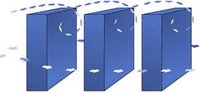 pressure drops (near these short-lived "vacuums" of lower air pressure) around leeward sides of buildings.
When the wind hits a high building, the air stream divides. A part of it moves upwards and the rest goes around the building. These swirling eddies--products of Bernoulli's principle--demonstrate the Venturi Effect.
Streets with high buildings on each side of the road create wind tunnels with these small portions of spinning air. It is the main roads leading into a city that act as the main corridors by which the wind enters. These wide thoroughfares for the wind initially allow the wind to follow the direction of the street. But in the more narrow street "canyons," the wind speed is significantly increased at street corners and local eddies are additionally generated at these junctions where different air currents meet.
When the wind blows perpendicular to a row of buildings, the windward side is exposed to strong gusts of wind, while leeward side is in a so-called aerodynamic shadow (theoretical "pocket-vacuum" mentioned above). Local eddies develop on these leeward side of tall buildings and the size of the eddy increases with the height of the building. Lower buildings in proximity to skyscrapers often still suffer as a result of this wind re-directioning. Air streams generated by the nearby high buildings may, for example, cause the low buildings to vibrate.
All metropolitan buildings act as flow interrupters. With the Venturi Effect, average wind speeds are about 30% higher on turbulent days than in the suburbs.
An article about NY skyscrapers describes canyon effect wind as follows:
At first, the solitary new skyscrapers were warmly welcomed especially by the gladdened male voyeurs who gathered at the 23rd Street apex of the Flatiron Building to wait that the strong wind hitting the walls of the building would turn upward -- at the same time lifting women's skirts high...
As the number of skycrapers increased, the laughter was over. Wind passing through the street "canyons" between skyscrapers tends to bounce off the ground and the sides of the building, creating columns of rising air. This canyon effect lifts litter from the ground and makes the holding of an umbrella a test of strength.
Seems like we may be introduced to some new weather effects on breezy days.
[Nice article in today's SHT about the canyon effect on First St between Central and Lemon (Starbucks to Whole Foods) . The pictures that I took, referenced in this article, are in the Jan 29 post].
Urban Windtunnel: Squeezing Air Between Densely Packed Edifices
Tall buildings can significantly disturb airflows over urban areas, and even a building 10 yards high can deflect winds. Denser collections of buildings in downtown districts of larger metropolitan areas can be windier than surrounding rural areas, with quite marked gusts. This is the result of the increased surface roughness that the urban skyline creates, leading to strong vortices and eddies. In some cases, these faster, turbulent winds are funneled in between buildings while barely perceptible pocket-vacuums are formed.
Bernoulli's principle enters this urban situation wherein, he found, ANY velocity of a gas or liquid will increase as
 pressure drops (near these short-lived "vacuums" of lower air pressure) around leeward sides of buildings.
 When the wind hits a high building, the air stream divides. A part of it moves upwards and the rest goes around the building. These swirling eddies--products of Bernoulli's principle--demonstrate the Venturi Effect.
Streets with high buildings on each side of the road create wind tunnels with these small portions of spinning air. It is the main roads leading into a city that act as the main corridors by which the wind enters. These wide thoroughfares for the wind initially allow the wind to follow the direction of the street. But in the more narrow street "canyons," the wind speed is significantly increased at street corners and local eddies are additionally generated at these junctions where different air currents meet.
When the wind blows perpendicular to a row of buildings, the windward side is exposed to strong gusts of wind, while leeward side is in a so-called aerodynamic shadow (theoretical "pocket-vacuum" mentioned above). Local eddies develop on these leeward side of tall buildings and the size of the eddy increases with the height of the building. Lower buildings in proximity to skyscrapers often still suffer as a result of this wind re-directioning. Air streams generated by the nearby high buildings may, for example, cause the low buildings to vibrate.
All metropolitan buildings act as flow interrupters. With the Venturi Effect, average wind speeds are about 30% higher on turbulent days than in the suburbs.
An article about NY skyscrapers describes canyon effect wind as follows:
At first, the solitary new skyscrapers were warmly welcomed especially by the gladdened male voyeurs who gathered at the 23rd Street apex of the Flatiron Building to wait that the strong wind hitting the walls of the building would turn upward -- at the same time lifting women's skirts high...
As the number of skycrapers increased, the laughter was over. Wind passing through the street "canyons" between skyscrapers tends to bounce off the ground and the sides of the building, creating columns of rising air. This canyon effect lifts litter from the ground and makes the holding of an umbrella a test of strength.
Seems like we may be introduced to some new weather effects on breezy days.
[Nice article in today's SHT about the canyon effect on First St between Central and Lemon (Starbucks to Whole Foods) . The pictures that I took, referenced in this article, are in the Jan 29 post].
Friday, February 10, 2006
What's the Value of Sarasota?
According to John Simon of Pineapple Square a prime lot in downtown Sarasota is worthless. He reluctantly gave the city $1,000,000 for the lot appraised at $10,900,000 by a highly respected appraisal firm. But Simon continues to insist it has no value.
He also was able to convince four commissioners that it was worthless as they agreed with his assessment and brushed off the appraiser's valuation.
Mike Saewitz reports that "Simon originally didn’t want to pay $1 million for the lot — he wanted to pay nothing."
"Mayor Mary Anne Servian thinks Simon may be right about the lot’s value.
But Commissioner Lou Ann Palmer doesn’t understand how the State Street lot could be worth so little. It’s just a block from Main Street. “I just don’t agree that it’s valueless,” Palmer said."
What's he real answer? Commissioner Shelin says "The truth is always somewhere in the middle." Simon says: "[he] acknowledged the two vastly different opinions about the value of the State Street the lot — “the right one, and another one.”
Only the professional appraiser has the credentials, expertise and lack of financial interest in the project. No one has shown his methodology (the commonly used comparable sales method) to be inaccurate. So why do commissioners and Simon insist they know better?
Your guess is a good as mine. It would seem that a heavy dose of politics mixed with a slick sales pitch and topped with a bit of wanting something so badly that common sense was over ruled, resulted in tossing out the facts in favor of make believe.
Too bad the citizens of Sarasota are being forced to fork over $18,000,000+ of our property and cash with no explaination needed (or allowed). A little math shows this means every resident of Sarasota (all 55,000+ of us) will be donating over $300 each for this project. No explaination other than the business owners and most commissioners are enthralled by the project and were unwilling to negotiate a fair price.
He also was able to convince four commissioners that it was worthless as they agreed with his assessment and brushed off the appraiser's valuation.
Mike Saewitz reports that "Simon originally didn’t want to pay $1 million for the lot — he wanted to pay nothing."
"Mayor Mary Anne Servian thinks Simon may be right about the lot’s value.
But Commissioner Lou Ann Palmer doesn’t understand how the State Street lot could be worth so little. It’s just a block from Main Street. “I just don’t agree that it’s valueless,” Palmer said."
What's he real answer? Commissioner Shelin says "The truth is always somewhere in the middle." Simon says: "[he] acknowledged the two vastly different opinions about the value of the State Street the lot — “the right one, and another one.”
Only the professional appraiser has the credentials, expertise and lack of financial interest in the project. No one has shown his methodology (the commonly used comparable sales method) to be inaccurate. So why do commissioners and Simon insist they know better?
Your guess is a good as mine. It would seem that a heavy dose of politics mixed with a slick sales pitch and topped with a bit of wanting something so badly that common sense was over ruled, resulted in tossing out the facts in favor of make believe.
Too bad the citizens of Sarasota are being forced to fork over $18,000,000+ of our property and cash with no explaination needed (or allowed). A little math shows this means every resident of Sarasota (all 55,000+ of us) will be donating over $300 each for this project. No explaination other than the business owners and most commissioners are enthralled by the project and were unwilling to negotiate a fair price.
Thursday, February 09, 2006
Snagged
In the rush to judgment on Pineapple Square, apparently a few minor details were overlooked.
Today's SHT reports on the problem of the State St lot being acquired through bonding sources and it may prove difficult to remove this "encumbrance".
The mayor seems to have shot the messenger when she indicated:
"Pineapple Square has been an ongoing discussion for almost a year," she said. "Why weren't these issues researched sooner? They shouldn't wait till the 11th hour of the 11th day to bring these issues before us."
Many issues were researched thoroughly, including the parking issues (this development will create more parking demand than it provides), the staff position that the deal was tipped in favor of the developer (at the expense of the city's residents) and the appraised value of the State St lot. Of course the research done here was disregarded.
Seems like if you want the information you should use it to make a judgment.
Over on the City Managers Blog we find this comment:
Ms. Servian: You were quoted in the October 2004 issue of SRQ magazine when asked actions you would like to revisit:
"I would have wanted better economic analysis of the TIF dollars given to developers, particularly regarding Whole Foods. If I'm truly honest with myself, I was probably more concerned about fulfilling the goal of the master plan in getting a grocery downtown and securing a quality project from Casto. In retrospect, I would have demanded more information. We probably still would have given Whole Foods TIF dollars, but maybe not as much.
Since then, we have hired a financial consultant to help us analyze the TIF dollar requests."
Well let's see what we have here. In retrospect it would have been better to have more information. However when expert information is given it is ignored. When unexpected information comes up the response is to chastise "them", with no recognition that it is us, it is our staff, it is people trying to do their best.
And then there is the question about using the CRA Advisory Board and analysis of TIF funding. Here the commissioners have incredulously bought the developer's pitch that no city funds are being used and no TIF dollars are being asked for.
One nagging question though, where is the $7,600,000 going to come from? Why did the commissioners strongly wish to avoid the CRAAB review? Is it because they didn't want the scrutiny and advice? Why has the TIF financial expertise not weighed in on this? Apparently the answer is "don't confuse us with the facts. We already made up our minds".
Today's SHT reports on the problem of the State St lot being acquired through bonding sources and it may prove difficult to remove this "encumbrance".
The mayor seems to have shot the messenger when she indicated:
"Pineapple Square has been an ongoing discussion for almost a year," she said. "Why weren't these issues researched sooner? They shouldn't wait till the 11th hour of the 11th day to bring these issues before us."
Many issues were researched thoroughly, including the parking issues (this development will create more parking demand than it provides), the staff position that the deal was tipped in favor of the developer (at the expense of the city's residents) and the appraised value of the State St lot. Of course the research done here was disregarded.
Seems like if you want the information you should use it to make a judgment.
Over on the City Managers Blog we find this comment:
Ms. Servian: You were quoted in the October 2004 issue of SRQ magazine when asked actions you would like to revisit:
"I would have wanted better economic analysis of the TIF dollars given to developers, particularly regarding Whole Foods. If I'm truly honest with myself, I was probably more concerned about fulfilling the goal of the master plan in getting a grocery downtown and securing a quality project from Casto. In retrospect, I would have demanded more information. We probably still would have given Whole Foods TIF dollars, but maybe not as much.
Since then, we have hired a financial consultant to help us analyze the TIF dollar requests."
Well let's see what we have here. In retrospect it would have been better to have more information. However when expert information is given it is ignored. When unexpected information comes up the response is to chastise "them", with no recognition that it is us, it is our staff, it is people trying to do their best.
And then there is the question about using the CRA Advisory Board and analysis of TIF funding. Here the commissioners have incredulously bought the developer's pitch that no city funds are being used and no TIF dollars are being asked for.
One nagging question though, where is the $7,600,000 going to come from? Why did the commissioners strongly wish to avoid the CRAAB review? Is it because they didn't want the scrutiny and advice? Why has the TIF financial expertise not weighed in on this? Apparently the answer is "don't confuse us with the facts. We already made up our minds".
Subscribe to:
Posts (Atom)