Sunday, November 13, 2005

What Makes a Charrette?

"Charrette" is a word we hear more and more.

But what is a charrette and why would we be concerned about them? The National Charrette Institute is a non-profit institute that gives insight into how the charrette can be used to make community change. It involves the community in the transformation process.

The National Charrette Institute describes charrettes as follows:

The French word, "Charrette" means "cart" and is often used to describe the final, intense work effort expended by art and architecture students to meet a project deadline. This use of the term is said to originate from the École des Beaux Arts in Paris during the 19th century, where proctors circulated a cart, or “charrette”, to collect final drawings while students frantically put finishing touches on their work.

What is an "NCI Charrette"?

The NCI Charrette combines this creative, intense work session with public workshops and open houses. The NCI Charrette is a collaborative planning process that harnesses the talents and energies of all interested parties to create and support a feasible plan that represents transformative community change.
  • At least four consecutive days
  • An open process that includes all interested parties
  • A collaborative process involving all disciplines in a series of short feedback loops
  • A process that produces a feasible plan
  • A generalist, holistic approach

An "NCI Charrette" is not:
  • A one-day workshop
  • A multi-day marathon meeting involving everyone all the time
  • A plan authored by a select few that will affect many
  • A “visioning session” that stops short of implementation
The NCI web site gives much more information about charrettes and is an excellent source of information. (Also note that New College professor Dr. David Brain is a member of the board of directors of NCI)

Sarasota has seen the charrette process several times: the Sarasota County 2050 Plan and the City Downtown Master Plan. The process used for input into the Cultural District Master Plan was not a charrette. Here, public input was taken and the designers came back a few months later with a plan.

Recently the Burn's Square Property Owners have conducted a process they have called a charrette. Based on the criteria and descriptions given by the National Charrette Institute, it appears that this process would not properly be called a charrette.

The City Downtown Master Plan process concluded with a vision for the downtown. As noted in the NCI commentary about change, the third phase is a critical phase - implementation. When Andres Duany was involved here he indicated that the zoning code needed to be put in place quickly or the result would be something quite different than envisioned. The NCI says:

After the Charrette, it is important to quickly review the work, make any necessary adjustments and get back to the public for a last look. The longer this period lasts, the greater the risk of failure. To the greatest extent possible, critical stakeholders should be kept in the loop by being involved in the testing for market, financial, physical, and political feasibility. Within no more than 45 days following the Charrette, a final public review is held, sometimes on two consecutive evenings with a design teamwork session in between. This can help to catch those who missed the Charrette. The two meetings also allow people who felt left out of the Charrette the opportunity to see their concerns addressed before the final plan is adopted.

As we all know Sarasota did not follow this advice and the result was many changes and delay before implementing the downtown code. Special interest groups won at the expense of the community good.

In a couple weeks, New College will be conducting a charrette for their campus master plan. This had been scheduled to start the weekend that Wilma visited our state and was postponed. New College has already gathered input from both the New College community and the public. During the next phase (starting the last week in November) the design team will spend 4-5 days at the New College campus and will work on a draft of the master plan. These sessions will be interactive with the college community and the public. The end product will be a plan that everyone has had a hand in developing. This “collaboration” with many stakeholders produces a high level of support and ultimately an excellent chance of putting the design in place.

So far all indications are positive that the New College charrette will develop an excellent plan for the future of their campus. We may even get to see a charrette that works as envisioned.

Sense of Place

We hear the phrase "Sense of Place" more and more these days. Lately it seems like the developers have co-opted the the phrase to add just another layer of promotion to their marketing arsenal.

Here is a description of "Sense of Place" that was printed in the Spring 2005 issue of FORUM - Magazine of the Florida Humanities Council, in an article by Janine Finver:

A “sense of place” is difficult to define, but you know it when you have it. It’s a term many of us first came upon while studying the works of William Faulkner or Thomas Hardy. But today the term is used by city planners, environmentalists, and civic and cultural leaders to describe the intimate connection that people can have with the place in which they live. It is an attachment to place that emerges through knowledge of its history and heritage, literature and lore, flora and fauna, geography and geology.

Along with that connection comes a sense of ownership and stewardship that will help us preserve and protect our cultural history, our historic places, and our natural environment.


This describes very well our feelings about "Sense of Place".

Saturday, November 12, 2005

Quay Vision Becomes Clearer

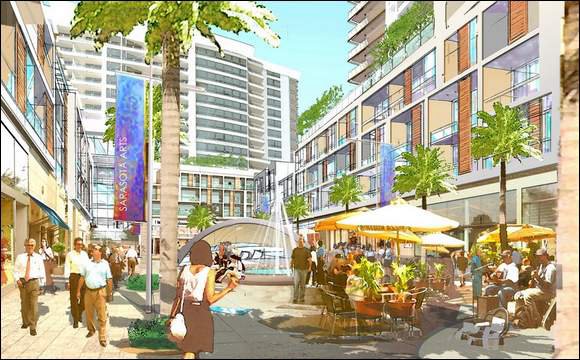
Today's SHT has an article about the plan for the Quay that has been filed with the city. At the left is the marketing rendition of the proposed development.

Previously Patrick Kelly, the developer, had indicated that a model he had in mind was the Grafton Street shopping area in South Dublin.

The latest plan for Sarasota apparently has changed from the original concepts floated more than a year ago.

According to the article the plan now indicates:

  • four 18 story condo buildings
  • 702 condos
  • a 136 room hotel
  • 2000 parking spots
  • 140,000 square feet of upscale shopping

The Multi Use Recreation Trail would ring the 15 acre site and be along the waterfront. The historic Belle Haven could become a restaurant.

Kevin McQuaid's article indicates that Kelly may be interested in tying together the Metropolitan property, the Ritz and his own project.

We hope the visionaries have put to rest any idea of resurrecting the idea of a convention center on the public Cultural District site. Earlier this year the concept of using the Cultural District land for a convention center was soundly rejected.

It will also be critical to understand the traffic implications of this massive redevelopment in the context of the Ritz development, the planned Metropolitan and the planned Cultural District. The traffic concurrency exception area will have to be re-examined in light of these plans, the current development boom in downtown Sarasota and the planned Pineapple Square development. Traffic implications must be addressed now.

Friday, November 11, 2005

Whither the Quay?

The sea horse does not look particularly happy and the faded sign says: "Warning and We Care". This image greets visitors to the Quay building. But the Sarasota Quay is on its last legs.

Soon the wrecking ball will start the transformation of the current, sad looking collection of buildings into a world-class, open air "Main Street" project featuring top-tier retailers, restaurants and cultural establishments, office and high-rise, luxury condominiums..... scheduled to open in 2008 , according to the advertisements.

Apparently there is still one holdout at the El Verona Condo site. Some delay may face the Irish American Partners that is redeveloping this central Sarasota property.

But some of Sarasota's history still resides here. The major player is the Belle Haven. Recent announcements have indicated it will remain on the site but will be moved 150 feet.

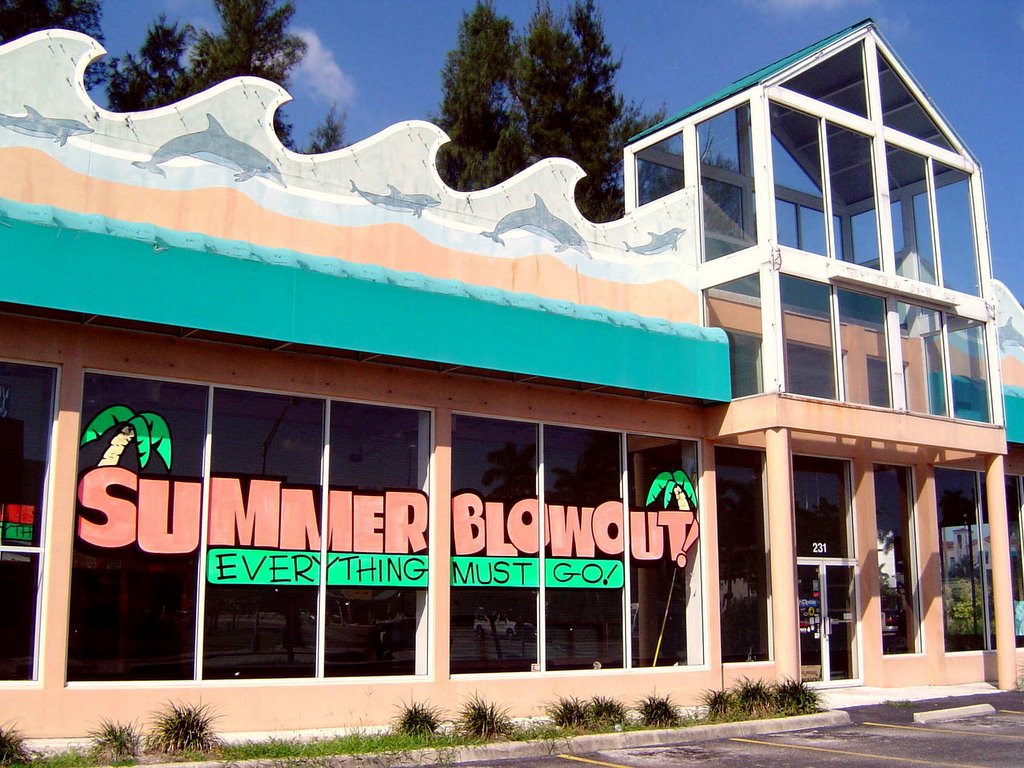
Everyone recognizes the "Splash" building, residents and visitors alike. The current sign saying "Summer Blowout, Everything must go" couldn't be more appropriate. Change happens.


The major Quay building has had a variety of occupants but is almost vacant as it awaits its demise.

The sea horses that decorate parts of the quay originally resided at the Lido Casino, itself a victom of the wrecking ball in the early 60's.


We hope someone cares about these sea horses and a prominent place can be found for them to spend the next few decades.

Wednesday, November 09, 2005

A View of the Metropolitan

On September 19, the City Commission reviewed a revised plan for the Metropolitan condo project (corner of US 41 and Gulfstream), currently a vacant lot. This agenda item indicated:

Public Hearing Re: Proposed Ordinance No. 05-4635, amending rezoning Ordinance No. 03-4489 and 04-4580 to reflect the approval and substitution of Site Plan 05-SP-18 for previously approved Site Plan 04-SP-31 pertaining to a residential condominium project known as The Metropolitan; increasing the enclosed parking for 65 additional vehicles and providing a larger pedestal to accommodate same and increased width through the latitudinal section of the building tower thus increasing the gross building area on property zoned Commercial Central Business District (CCBD) and located at one North Tamiami Trail...

Upon checking, it was learned that the "pedestal" surrounding the building consists of a 12 foot wall. When we asked planning why would a 12 foot wall be allowed when city code only allows a 6 1/2 foot wall or fence, the response was that this was just a revision to a previously accepted plan, it was a "pedestal" not a wall, and the developer had made some changes in the design of the facade so there would be inset places for plants.

This 12 foot wall, along US 41 and Gulfstream, will completely block any view at this significant intersection. We believe this is highly detrimental for this corner and it will completely destroy any sense of pedestrian friendliness or visual interest. This will be another design disaster in a string of problems downtown.

Driving or walking, the view will be a wall twice the height of the current chain link fence. Not a pretty view at all.

Tuesday, November 08, 2005

Referendum Approved by Voters

The voters have spoken.

We want to preserve more of Sarasota County for future generations.

Many people worked very hard to help pass these referendum questions.


The result was overwhelming approval.

Save Our Sarasota wishes to thank those members of our community that invested many long hours in this project.

Future generations will truly appreciate your efforts.

Thank you!

Pedestrian Friendly?

Bob Ardren has this comment in last week's Main Street Beat:

New lights to save you at Main/Lemon

New traffic lights are going in at Lemon and Main and their purpose, I’m told, is to make sure that we make the right decisions. Honestly, that’s what I was told.

You see, some of us rather liked the four-way stop signs at the intersection. After all, when all the traffic actually stops, it really slows down traffic on Main and, overall, I happen to think that’s a good idea with all the pedestrians around. And we are supposed to be a pedestrian-friendly city, right?

Well, apparently we are pedestrian friendly, but not thought to be very bright. When I asked for an official explanation of why lights, which would allow steady streams of traffic, were better than a four-way stop, the answer from the city’s engineering department was that pedestrians don’t always make the right decisions (in other words they walk in front of cars) and so these lights will make it easier – and safer – for them.

That, my friends, is a perfect example why it’s important to always keep an eagle eye on your government.

Here's another solution. Madison, WI (always on the lists for the best place to live, despite the winters) gives absolute right of way to pedestrians at every intersection. That is pedestrian friendly!

Post script: the light is up now.

Monday, November 07, 2005

100 Central - Response From Mike McNees

We asked city officials to respond to the comments made on the recent 100 Central Ave posting. Specifically the questions posed were:

Would you take a look at today's [Nov 2] posting on the Save Our Sarasota Blogsite, and particularly the comments that were also posted.

Does this section of Central meet EDCM requirements? Is there a solution to the Whole Foods truck unloading issue?

City Manager Mike McNees promptly responded:

Mr. Clapp - I read what's on the blog, and the accompanying comments. I would offer the following, feel free to reprint anything you want to on the blog.

The Engineering Design Criteria Manual (EDCM) provides for a process whereby exceptions to its requirements, called technical deviations, can be granted. There are criteria established for such, and when exceptions are granted through that formal process the resulting improvements are legal. I am most familiar with the exceptions granted in this case for the Whole Foods loading dock, because I sat in on what turned into many hours of discussion as that particular engineering problem was addressed.

To say that locating something like the Whole Foods Market on a site like our Lemon Ave. site, or any other downtown site for that matter, is problematic is an understatement of the highest order. The standards of companies like Whole Foods or Publics for store orientation, configuration of back-of-the-house space, loading facilities, and any number of other items are extremely exacting. The same can be said for our EDCM standards; in a way it's a classic case of the irresistible force meeting the immovable object, and is way of the major reasons other cities have struggled to achieve the same goal. In this case it was clearly in the public interest, as defined in the Downtown Master Plan 2020, to make the market happen, and it is precisely for this type of issue that the exception process exists within the EDCM.

As for the loading dock, clearly compromises were made as reflected in the technical deviations that were granted . Everyone at the table understood that the solutions to which all parties eventually agreed were not perfect, and reality has proven that to be true. Everyone also understood that we would have to watch closely and make further adjustments as necessary -something one of your posters has pointed out has happened with redesignation of some parking spaces on Second Street, for example. Rather than an admission of failure of some sort, I see that as appropriate follow-up and adjustment based on everyone's observation of real-life conditions, which can only be estimated by even the most brilliant engineers. I am certain that all parties will continue to work to improve the situation, which again we all know is not optimal from an engineering stand point. The City could have, of course, demanded an optimally correct engineering solution that me all EDCM requirements. The downside to that course of action would have been no market, so clearly there were trade-offs, which are simply the name of the game with urban redevelopment. I would argue that the Whole Foods Market makes its own arguments for whether or not the compromise was justified.

As for Central Ave., deviations were also granted there I believe. In that case, certain right-of-way agreements were also required, all of which demanded approval of the full CRA, and which also were compromises agreed upon to make the project, in which the City is a partner, work. In their defense, I must say that the City Engineering Department fought very hard to preserve adequate function of the facilities that would eventually be built. Of course whether or not we accomplished that is a subjective question, which we will all have to judge for ourselves.

Regards, Mike McNees

Sunday, November 06, 2005

Sarasota Again Ranks No. 1

Boy, we just keep raking in the accolades. What a great place to live.

Finally we rank higher than Miami! We hold the title for the most number of new or planned condos per resident, anywhere in this condo crazy market. We have a condo for every 19 people. Miami trails with a measly one condo for every 24 people. It makes me feel claustrophobic just thinking about having 23 other people in a condo with me. I need a little more breathing room.

In the good old days we were satisfied with a car for every garage and a chicken in every pot. But the here the bar has been raised! Is this a great place to live or what? We need to keep pushing for a condo for every resident! And let's make it a million $ one while we're at it!

The story says:

Condos priced from $400,000 to $800,000 have been flying off the shelf, but real estate agents warn that sector might cool next year when construction is completed on nearly 1,000 new units.

This is a much better vision than a mere chicken flying off the shelf. Our marketing profession has truly worked wonders o'er these last few years. Nothing is resistible anymore.

I mean, just look at this related story. Here we find that the former owner of the Dallas Mavericks - he's a regular guy, unlike his former team - came to visit our storyland city one day a couple years ago. He stayed at the newly built Ritz and loved it so much he immediately bought a condo for himself and his wife, right in the Ritz Towers, next to the hotel. And then, because he really, really liked it, he bought 16 more! That's right, 16 more. What a guy!

Talk about condo's flying off the shelf. No squawks from the chickens this time.

Now this is a vision we should all aspire to. Not a mere one condo for yourself and 18 close friends, but 17 condos all for your self. This should give the maids plenty of time to spiff things up between stopovers.

So hey y'all, come on down to Florida. The land of dreams. Have we got a vision? You bet. You want a condo, or 17? We got 'em. Come on down and we'll put a smile on your face. Don't forget, Sarasota's No 1.

Disclaimer: no chickens allowed.

The Role of the Planner

Here's a portion of a commentary from Sept 11 posting at "An Affair With Urban Policy". The same questions apply in Sarasota.

The other night I posted a photo - showing some small graffiti on a storefront window that said "Do We Really Need More Condos?" It's a provoking question - condo development seems to be a strong part of residential markets in a number of urban areas.

...The more I thought about the issue, the more I began wondering what exactly the role of the planner is in the current condo-crazed market?

From what I've come to understand (fully admitting that I'm not a planner), the role of Planning is to determine the most ideal/needed land uses within specified areas. I also believe that Planning is most effective when it can be applied to specific sites (that is applying the theoretical to the specific).

Unfortunately, I'm far too removed from the institution of Planning to fully understand whether the field is still actively involved in actually planning areas (that is, considering all the range of potential - and needed - land uses for specifice sites) that are undergoing rapid condo redevelopment, or, if it is merely letting market pressures (whether actual, or perceived) drive all new land uses.

That is:

  • Are planners really planning areas, or are they simply letting areas develop themselves?
  • Are the usual social amenities (e.g. parks, commericial services, other social institutions such as schools and community spaces) still being integrated into developing areas, or is the market completely leading the way and the role of the planner simply to make sure the sufficient parking is attached to a site?
  • Would a planning staff still say "no" to a new condo development proposal, based on an area need for other uses on a site?

My guess is that it's a bit of both - although in Minneapolis the market clearly drives site use. Two of the fastest growing areas in the city (the "North Loop" and "Downtown East") are being built up (nearly) completely with developments, and plenty of ramped and underground parking, irrespective of the need for public spaces and parks.

There is mixed use development, but much of it consists of smaller bays (e.g. galleries and restaurants) that don't necessarily serve all the needs of residents - but more are indications of "cool areas".

So I don't know. Are more condos needed? The market says so... and you can't really defend saving a record store at the expense constructing a new high-rise luxury building. But does the profession still say "no" when "no" is really the right answer?

Interesting comments here. If you view the posting, be sure to check the comments on the posting.

Saturday, November 05, 2005

Letter to the Mayor

We receive comments and notes from time to time. Here is a recent e-mail; the author indicated we could post it on our blog.

Wednesday, November 2nd, 2005

To: Ms. Mary Anne Servian - Mayor
City of Sarasota

RE: Proposed Arcades on Main Street

Dear Mayor Servian;

My reason for writing you is because this is an issue I hold very truly to heart, and by this I mean the proposal of placing arcades over the storefronts and uprooting our trees.

Mayor, I used to be employed at the Main Street Bistro as a host. You would not believe how many people I sat that requested to sit on the patio not only because of the beautiful weather we were having at the time, but because they told me they loved the sound of the birds as they flew from one tree to the other. I have sat guests from every corner of the world and all I heard was how beautiful this city is, especially Main Street. They said they loved to walk under the beautiful trees as they ventured from one boutique to another. Mayor, I could not even fathom the idea of replacing the beautiful "small town feel" with cold feeling arcades. Mayor, it was downtown Main Street that attracted me to this area and is why I chose to make Sarasota my home. Also Mayor, I strongly feel I am not alone on this important issue.

Mayor, I also had to laugh when I read in the Monday edition of the Sarasota Herald - Tribune, Mike Saewitz's column when he quoted a statement by Bruce Franklin, the president of the ADP Group;

" If you say arcades are bad, that's like saying the sky is falling, Don't show up and tell us what you don't like. It's incredulous to me. I hope our elected officials could discern between rabblerousing and legitimate input".

Mayor, this is so far from the truth. I bet if you put it to a vote right this minute and ask the citizens of this great city on whether they would prefer the natural beauty of the trees or the coldness, big city feel of the arcades, that over 95% would vote in favor of keeping the trees. Mayor, all I ask is to vote on what you feel that is in the best interest of the people who placed each city elected official in office in the first place. Please do not listen on what the developers feel is best for us.

Mayor, I think you for your time and just wanted to voice my opinion.

Respectfully,

Daniel Zumbro

Thursday, November 03, 2005

Is City Living Healthier Than in the Suburbs?

Yes, according to a report on public health as it relates to development patterns by the Ontario College of Family Physicians.

A graph in their report indicates the greater the density (sprawl index), the fewer the fatalities per 1000 people (as calculated over 83 U.S. regions that covered two-thirds of the total population).

Why are people dying? The reports showed lower densities have higher incidence of cardiovascular and lung diseases including asthma in children, cancer, diabetes, obesity, traffic injuries and deaths. They feel these are exacerbated by an increase in air pollution, gridlock, traffic accidents and lack of physical activity.

What to do? They suggest the following:

  • Move to a town or city that has a reliable public transportation system;
  • Choose a place to live that has bicycle lanes and pedestrian paths;
  • Choose a town with parks and wildlife areas to clean and cool the air;
  • If possible, choose a community where you can walk to work, stores and schools;
  • Get to know your neighbors and volunteer in the community.

Since we don't want to move, maybe we should place a high value on achieving these qualities right here in Sarasota:

  1. Instead of parking lots, put the money into a really good transit system;
  2. don't remove bicycle lanes (as suggested for Fruitville), put more in place;
  3. keep the trees we have and find ways to increase green space downtown, along 41 and 301, and in the neighborhoods;
  4. put affordable housing on the State Street parking lot and the lot behind the opera (create walk to work, affordable housing instead of more parking structures);
  5. and of course walk around, meet your fellow citizens and talk about how to make Sarasota even better!

Natural Disasters and Top Places to Live

From the October issue of AAII Magazine:

Idyllic coastal locations, especially those blessed by wide, sandy beaches, warm coastal waters, and sunny subtropical weather, have long been prized as retirement havens. Unfortunately, as Hurricanes Katrina and Rita have demonstrated recently, the good life along some of America’s most popular coasts is not without serious risks to life and property.

What should careful retirees consider when relocating?

Warren Bland, a geographer and professor at California State University, Northridge, and author of “Retire in Style: 60 Outstanding Places Across the USA and Canada,” has these suggestions:
  • Don’t overreact to perceived dangers. Understand that you are in greater danger during routine car trips and from air pollution than from catastrophic but rare hazards like hurricanes, tsunamis, earthquakes and tornadoes.
  • If you decide to live along the Gulf or Atlantic coasts despite the hurricane threat, be sure to minimize your risk from storm surges by choosing a home site at least a mile inland and 20 feet above sea level.
  • If your choice is California, avoid low-lying, tsunami-threatened areas along the coast, proximity to active earthquake faults, smoggy areas, and places having a history of landslides.
  • In the American Heartland, avoid floodplain sites and have a storm cellar where you can seek shelter from tornadoes.

Dr. Bland’s top picks include: Victoria, British Columbia; Boulder, Colorado; Portland, Oregon; San Antonio, Texas; Asheville, North Carolina; Sarasota, Florida; Tucson, Arizona; and Ithaca, New York.

If you retire to Sarasota, consider his advice: live at least a mile inland and find a spot at least 20' above sea level! In Sarasota this generally means east of 301.

Wednesday, November 02, 2005

Concrete Again Trumps Trees

Here's the view of 100 Central, looking south. Note the porte-cochere jutting out into the street on the left. Now the city has also brought the sidewalk out to the edge of the porte-cochere apparently to give the impression that it belongs there. Also note the black olive trees on the right that shade the street and the R-O-W between the curb and the library walkway. Evidently now that the street has been narrowed, these tree branches will have to be trimmed - likely to be sheared parallel to the curb line.

In the other photograph you can see how the porte-cochere juts out into the street. The curb line north of 2nd St (shown in this photo) used to align with the curb south of 2nd St. The city has extended the sidewalk out to the line of the porte-cochere for the enitire block of Central between 1st St. and 2nd St., apparently to line up with the new porte-cochere. This "concrete chunk" results in the narrowing of the street.

This extended sidewalk area also removes a number of on street parking spots in a area that needs parking. Concrete also trumps parking.

When we asked the City Traffic Engineer what effect this would have on the trees along Central he responded as follows.

Ms. Reynolds:

The traffic will continue to be two-ways on Central Avenue between 1st and 2nd Streets and one-way as it has always been between Main and 1st Streets.

The trees on the west side (Library side) will need to be trimmed for trucks to be able to pass side by side. The width of the street is about 24 feet from back of curb to back of curb and that is a sufficient width for two-way traffic in the urban core.

If you have any questions or need further clarification, please feel free to call our office at (941) 954-4180.

Sam Freija Manager of Traffic Engineering


The only question we have is:

Why? Why did we allow this "concrete chunk"?

Tuesday, November 01, 2005

Speculating in Sarasota

Recent commentary on Sarasota's real estate market:

From Harold Bubil's Blog (SHT):
They call them flippers, flippers ...
... And faster than lightning, they are dumping their condo units into the market. That's how longtime Sarasota Realtor Ron Moxom explains the huge increase of condominiums listed for sale in the Sarasota MLS:

"A large factor in the increase of condo listings is the substantial number of apartment conversions that were heavily purchased by 'flippers.' Apartment conversions, in my opinion, have created a new breed of investor -- one not nearly as financially stable as our more stable, 'higher end' investor," he writes in response to my [Bubil's]blog item "How long to sell?"

As apartments, the units never showed up in the MLS stats before," he continues. "Now, I would suspect that there are hundreds of them listed for sale in MLS."

From Michael Braga's Blog (SHT):
Speculating on condos risky, Realtor says...
Chad Roffers, president of Sky Sotheby’s Realty, says he’d rather deal with end-users than speculators when it comes to high-end condominium. “It’s risky to be buying and selling condos as investments,” he said.

Roffers pointed out that most of the buyers of the Ritz-Carlton and Tower Residences condo units were speculators. “Those investments didn’t perform that well,” Roffers said. “Many investors still own them.”

Entreprenurial Climate

Where are entrepreneurs migrating lately?

According to Entrepreneur Magazine they're moving where housing prices are low and the quality of life is high. At least the successful ones are.

"Entrepreneurial Hot Cities" are ranked on the number of companies that started 4 to 14 years ago and have at least five employees today and that company's job growth.

Naples and Ft Myers are ranked, but Sarasota is not to be found on this list.

According to the article, "... some Hot Cities feature low costs and rapid population growth. Others offer stable populations with excellent quality of life. Some Hot City economies rely on government and tourism, while others are supported by financial services and manufacturing. Communities that fared best tend to have pleasant climates, good universities and capacious airports."

There is some food for thought here as we try to diversify our local and regional economy. While our weather climate may be excellent, we may need to see if we can improve our "entrepreneurial climate."

Monday, October 31, 2005

Portraying the Future

Today’s SHT has a great article about arcades and downtown Sarasota.

Although the reporter (Mike Saewitz) portrays the issue as a community conflict with a cast of opposing characters, Save Our Sarasota is a grass roots organization interested in making Sarasota a really great small city. We realize that there are those in the development community that share the same objective. Maybe what makes us different is that Save Our Sarasota tries to be community inclusive, looking at the common good. Others may lean more toward the "special interest" end of the spectrum. (We know that there are those that would portray us a just another "special interest", none the less, we keep trying).

Developers always show pretty pictures of what their project will look like when it is finished. They always use the "dreamscape" approach. They like to show nice looking people having a wonderful time in a dream like place. Reality however is always quite different.

Consider the Pineapple Square proposal Sarasota is currently considering. Notice how the 10 or 11 story hi-rise portion of the proposal fades into the background, whereas the much lower portion next to the sidewalk is prominently shown with happy people.

Or consider the Plaza at Five Points. The building height is minimized by the chosen view. This is nothing like the looming building that is about to open its doors.


Reality is different than dreamscapes.

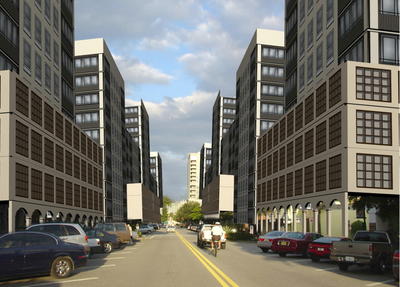
While we cannot exactly picture the future buildout of downtown Sarasota, the reality is likely to be much closer to the rendition we have pictured below, than the dreamscapes that developers portray.

Apparently the developers do not like others using the same tools they use when showing a vision for the future. Bruce Franklin is quoted in the article:

[This] "lacks absolute credibility," especially with tricks such as the doctored photo.


Franklin and other developers commonly use fanciful dreamscapes to hide the cold reality of their project. We have shown the cold reality of the potential of allowing arcades over public sidewalks and giving the space above the arcades to developers as an incentive.

We fully understand it is not a pretty picture.

Sunday, October 30, 2005

"Only if portions of Sarasota County are kept natural will future generations get to know and love a place of great character and beauty."

This endorsement comes from today's SHT editorial.

A related editorial makes a good case for arguing that land for affordable housing and saving environmentally sensitive land or urban park land are not mutually exclusive.

The Pelican Press also concurs, saying:

"Just as that beachfront bungalow is no longer within financial reach of the average resident, these sensitive lands are now threatened by increasing encroachment of development and rising land prices. The county needs to act swiftly to purchase and protect as much desirable property as possible before it disappears into new developments."

Save Our Sarasota also urges all county voters to go to the polls on Nov 8 (early voting is currently underway), and vote YES, YES. One Yes vote extends the current tax referendum for 10 years; the second YES vote allows some of the funds to be used for urban park land purchase.

For more information visit the Sarasota County Forever website.

[Picture is from the Sarasota County Forever website]

Thursday, October 27, 2005

Conversations With Ken

Commissioner Ken Shelin hosted a couple forums today - "What are the possibilities for assuring accountability in the City of Sarasota government?"

About 20 people attended the morning session and about 35 in the afternoon.

Keith Fitzgerald, New College Political Professor facilitated the afternoon session - the one I attended.

Attendees were primarily active members of the community that have a high level of commitment to our city.

The starting premise was that there is much discontent within Sarasota about how our city works. The attendees were asked to think about the questions:
  • What is the next step for making things better?
  • What are the problems?
  • What kind of solutions are possible?

A variety of issues and possible solutions were discussed. A common theme was the lack of discussion forums, "Town Hall" type gatherings to discuss vision, issues and solutions in an informal way (less "threatening" than a public hearing on TV).

I posted a more complete summary on Suncoast Blog.

Another session will be held on Sunday, Oct 30 at Sudakoff from 2-4 PM. If you are interested let Ken know.

Wednesday, October 26, 2005

Notes From Tiger Bay Meeting: Affordable Housing

The Sarasota Tiger Bay Club Topic: "We are being priced out of home ownership and rental housing!"

Moderator: Marge Baldwin

Panel: Jody Hudgins, Banker and County Planning Commissioner
Dr. John McGruder, Jr., S.U.R.E. (Sarasota United for Responsibility and Equity)
Jud Boedecker, Builder/Attorney-Southwest Florida Homes
Mike Jacobson, Executive Director, Habitat for Humanity.

Jud wished there would be a twelve mo. moratorium on new land use regulations. He thinks the reason for not building affordable housing is lack of land. He's seen the imbalance in pricing happen over the last four years. This should be our number one community priority. Tough decisions will have to be made. Compromises on the environment will have to be made.

Mike asked "what does affordable mean?" Without a definition all agree on nothing will get done. With more density, builders could build smaller, lower priced units.

Jody said the City has done a great job. Compare it to downtown Bradenton or downtown Ft. Myers. To get density into the county you have to make sure infrastructure is there, and that growth is compatible with the neighborhood. The cost of land is being driven up.

Jud said density is a bad word in this community but it can prevent sprawl and provide workforce housing.

Jody suggested that density by itself is not the panacea for affordable housing.

Jud thinks the county has the tool box to solve this problem. He is proudly a for-profit builder of single homes. Developers need to be offered mild incentives like rezoning for higher density, give overlay districts for workforce housing and affordable housing. We (the developer) would make sure infrastructure is in place.

John put on the table that there's another important issue besides land (and density) and that's providing living wages to workers.

Questioner reminded all that this community depends on service people. They can't be put out east. Some don't have transportation. Where are the plans for service people?

Jud noted that in Jacksonville, land is given to builders like Habitat for Humanity. The city gives land for $1 (a year?)

Mike is aware of Jacksonville's policies and thinks that there is the political will, the problem is clear to them (unlike here, I presume). We are talking about folks who live in the city making less than $24,000. Workforce housing isn't sexy. The sucking noise you are hearing are the people leaving. Why don't you put together a panel of Habitat owners. Meet the working poor, single moms.

John says that Habitat is no longer the model to follow. Habitat homes can be flipped. We want perpetual affordability. Even in the Housing Trust fund which is great, only 30% of it goes to those making 60% of the median income or less. Most of the money goes to the high end. Keep in mind that Sarasota is way below average for acceptance of diversity. The poor need to live in town.

Marge read from a 2003 City resolution which requested more affordability. It was a plea then. Even more urgent now.

Jody said in 1999, he, Joe Barbetta and another sat on a blue ribbon panel re: affordable housing. The County has dedicated staff and will. The Community Housing Trust of Sarasota County is considering workforce overlay district. It's been in existence for two months and is already a model. Pappas is the chair. Money for the project coming from selling lots in North Port. There's a plan to build 3,000 homes in 10 years.

Marge replied, but, we need them now. That isn't nearly enough. Jody responded that new land requirements require affordable housing must be included.

Marge wanted to know where City TIF money will go. Jud replied that City has been asked to participate.

Mike acknowledged (to John) that Habitat has to make changes. They've built 250,000 homes across the country. Now they are looking for a blending of paradigms. Just building a house for a family and handing them the keys isn't enough.

Marge wanted to know when someone applies, do you screen that person?

Mike said families have to show the ability to pay for their home. We don't see this as a handout but rather a hand up. Habitat has built 150 houses in Sarasota in the past 20 yrs and only a few have changed hands.

John is glad that the city and county are aware finally that affordable housing is missing and that that's a problem. TIF is a real possibility for providing funds. CRAAB is made up of developers. Look where TIF money has gone downtown - to high end projects like Whole Foods and the Herald Tribune. $20 million already spent on development downtown. If Newtown becomes a TIF CRA, please don't spend it in Newtown as it has been spent downtown.

Jody noted that 90% of Sarasota households make less than $80,0000.

Jud challenged - let's create it rather than preserve it. Home ownership gets folks out of lower class with their ability to build equity. A housing trust will take that away from them. Questions: Let's hear from the no growth people. Sounds like affordable housing has to come from the government (not his preference).

Mike jumped in - give 2 to 4 acres, we'd bring in volunteers and show you what's possible. Homes would be put up you'd be proud of to dispel the nimby reaction. Jody says that the county owns most of the land in Sarasota County. Sensitive lands are out - not developable anyway. It's a goal in the comp plan to preserve these lands.

Jud suggested the room is filled with well intentioned people who want to keep the well being of the community intact.

John asked "what can we do?" I'm looking for a few heroes. Let's get a fund together of $1 million dollars for affordable housing to seed the endeavor.

Questioner responded that service people can't live here and businesses needing service people cannot stay. She knows of several businesses that have closed and moved north. People who make $7 to $10 an hr can't afford to live here and Habitat can't cover the thousands in need.

John reminded everyone that we need more rental units and that the landlords need help. (Always we are discussing single home ownership when that doesn't fit for a lot of people, singles, retired, single mothers, etc.

Mike offered that Habitat is branching out into building duplexes, triplexes and rental apartment buildings. This is the next generation. Next questioner urged everyone to contact the legislature and tell them to keep the fund created ten years ago - the Housing Trust Fund which gets money from doc stamp tax. Money is given for rental and mortgage assistance. Help keep the Sadowski Trust Fund.

Another questioner likes the free market. He pays his maid $20 an hour. He says she bought a home in Sarasota County for $200,000. (You do the math.)

Marge used the old saw but if wages go up, then the price of products and services go up. Hasn't killed off popular places, someone quipped.

Jud wanted to know what John considered a living wage. Would it be $15 to $20.

John countered that yes, that would be a start. He also noted that greed is alive and well. Economics will not solve this problem. We have no controls on flipping. Speculators are driving up prices.

Jud acknowledged that a living wage won't buy a person a home here.

Another questioner wanted to know where will Sarasota be in ten years? Still discussing this problem? Everything he has heard so far are only band aid solutions.

Someone mentioned that those of us who have been here a while and own homes have seen our values goes three fold, all fine and good, but what about everyone else!

John thinks funding must come from many sources. It's a moral issue above all else to his mind. It will take the whole community to do something. Action is absolutely missing.

Jody thinks inclusionary funding is the key. He thinks the community housing trust can include rentals.

Jud sees this as a community-wide responsibility.

Mike wants a long term solution, getting all the stakeholders together.

Let's put a stake in the ground and start the momentum urged Mike.

Marge summed up: I think everyone is concerned. Let's start now. There has to be money out there. The City makes millions and contributes not a nickel to affordable housing.

John as a postscript recommended the city and county work with Manatee and Charlotte in a broad way to deal with affordable housing.

Submitted by Jude Levy.